




An ideal gas enclosed in a vertical cylindrical container supports a freely moving piston of mass M. The piston and cylinder have equal cross sectional area A. When the piston is in equilibrium, the volume of the gas is ${V_0}$ and its pressure is ${P_0}$. The piston is slightly displaced from the equilibrium position and released. Assuming that the system is completely isolated from its surrounding, the piston executes a simple harmonic motion with frequency.
A. $\dfrac{1}{{2\pi }}\dfrac{{{V_0}M\left( {{P_0} + \dfrac{{Mg}}{A}} \right)}}{{{A^2}\gamma }}$
B. $\dfrac{1}{{2\pi }}\sqrt {\dfrac{{{A^2}\gamma \left( {{P_0} + \dfrac{{Mg}}{A}} \right)}}{{M{V_0}}}} $
C. $\dfrac{1}{{2\pi }}\sqrt {\dfrac{{M{V_0}}}{{A\gamma \left( {{P_0} + \dfrac{{Mg}}{A}} \right)}}} $
D. $\dfrac{1}{{2\pi }}\dfrac{{A\gamma \left( {{P_0} + \dfrac{{Mg}}{A}} \right)}}{{{V_0}M}}$
Answer
 Verified
598.5k+ views
Hint: In case of finding frequency or time period for SHM the first thing we should do is balance the forces as initially the system will be in equilibrium. Later provide very small displacement and then restoring force will act due to imbalance in forces and it tries to bring the system back to equilibrium condition. From this equation we can find out the time period and frequency and angular velocity.
Formula used:
${F_r} = - m{\omega ^2}x$
$\omega = 2\pi f$
$P{V^\gamma } = K$
Complete answer:
Initially the piston is in equilibrium condition. That means forces are balanced. Let P be the pressure acting of the gas. Same pressure will be acting on the piston and due to this gas pressure force will act upwards on the piston and will be balanced by weight. The diagram below represents the equilibrium situation.
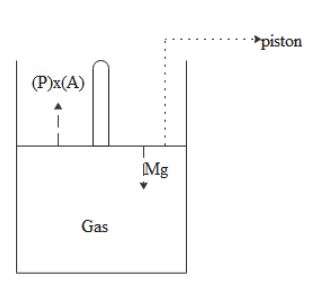
By balancing we get
$PA = Mg$
Where A is the area of the cross section of the piston and ‘g’ is the acceleration due to gravity and M is the mass of the piston.
Let us assume we move the piston by ‘x’ displacement. Then pressure will be increased by $dP$. Restoring force will be ${F_r} = - m{\omega ^2}x$
Then the force equation will be
$\eqalign{
& (P + dP)A - Mg = - M{\omega ^2}x \cr
& \Rightarrow (dP)A = - M{\omega ^2}x \cr} $
It is given that the system is isolated which means the processes will be adiabatic as there will be no heat transfer with surroundings. Adiabatic equation will be
$P{V^\gamma } = K$
By differentiating this we will get
$dP = \dfrac{{ - \gamma P}}{V}dV$ … eq 1
Where $\gamma $ is the ratio of specific heats.
As ‘x’ amount of small displacement Is given the change in volume will be negative as volume decreases and volume change will be
$dV = - Ax$
By substituting above result in equation 1 we get
$dP = \dfrac{{ - \gamma P}}{V}dV$
$ \Rightarrow dP = \dfrac{{\gamma P}}{V}Ax$
By substituting dP value in $(dP)A = - M{\omega ^2}x$ we get
$(dP)A = - M{\omega ^2}x$
$\eqalign{
& \Rightarrow \dfrac{{\gamma P}}{V}{A^2}x = - M{\omega ^2}x \cr
& \Rightarrow \omega = \sqrt {\dfrac{{\gamma P{A^2}}}{{{V_0}M}}} \cr} $
We know pressure acting on gas = pressure acting on piston = P
$P = {P_0} + \dfrac{{Mg}}{A}$
$ \Rightarrow \omega = 2\pi f$
By substituting the above results in $\omega = \sqrt {\dfrac{{\gamma P{A^2}}}{{{V_0}M}}} $ we get
$ \Rightarrow f = \dfrac{1}{{2\pi }}\sqrt {\dfrac{{{A^2}\gamma \left( {{P_0} + \dfrac{{Mg}}{A}} \right)}}{{M{V_0}}}} $
Hence option B will be correct.
Note:
These all equations are valid only for the small displacements given. Even though the pressure of the gas given is some value, we should add the pressure created due to piston weight on the gas also to get the gas pressure and substitute it as pressure applied by gas on the piston in all the equations. That’s how we got $P = {P_0} + \dfrac{{Mg}}{A}$ rather than ${P_0}$.
Formula used:
${F_r} = - m{\omega ^2}x$
$\omega = 2\pi f$
$P{V^\gamma } = K$
Complete answer:
Initially the piston is in equilibrium condition. That means forces are balanced. Let P be the pressure acting of the gas. Same pressure will be acting on the piston and due to this gas pressure force will act upwards on the piston and will be balanced by weight. The diagram below represents the equilibrium situation.
By balancing we get
$PA = Mg$
Where A is the area of the cross section of the piston and ‘g’ is the acceleration due to gravity and M is the mass of the piston.
Let us assume we move the piston by ‘x’ displacement. Then pressure will be increased by $dP$. Restoring force will be ${F_r} = - m{\omega ^2}x$
Then the force equation will be
$\eqalign{
& (P + dP)A - Mg = - M{\omega ^2}x \cr
& \Rightarrow (dP)A = - M{\omega ^2}x \cr} $
It is given that the system is isolated which means the processes will be adiabatic as there will be no heat transfer with surroundings. Adiabatic equation will be
$P{V^\gamma } = K$
By differentiating this we will get
$dP = \dfrac{{ - \gamma P}}{V}dV$ … eq 1
Where $\gamma $ is the ratio of specific heats.
As ‘x’ amount of small displacement Is given the change in volume will be negative as volume decreases and volume change will be
$dV = - Ax$
By substituting above result in equation 1 we get
$dP = \dfrac{{ - \gamma P}}{V}dV$
$ \Rightarrow dP = \dfrac{{\gamma P}}{V}Ax$
By substituting dP value in $(dP)A = - M{\omega ^2}x$ we get
$(dP)A = - M{\omega ^2}x$
$\eqalign{
& \Rightarrow \dfrac{{\gamma P}}{V}{A^2}x = - M{\omega ^2}x \cr
& \Rightarrow \omega = \sqrt {\dfrac{{\gamma P{A^2}}}{{{V_0}M}}} \cr} $
We know pressure acting on gas = pressure acting on piston = P
$P = {P_0} + \dfrac{{Mg}}{A}$
$ \Rightarrow \omega = 2\pi f$
By substituting the above results in $\omega = \sqrt {\dfrac{{\gamma P{A^2}}}{{{V_0}M}}} $ we get
$ \Rightarrow f = \dfrac{1}{{2\pi }}\sqrt {\dfrac{{{A^2}\gamma \left( {{P_0} + \dfrac{{Mg}}{A}} \right)}}{{M{V_0}}}} $
Hence option B will be correct.
Note:
These all equations are valid only for the small displacements given. Even though the pressure of the gas given is some value, we should add the pressure created due to piston weight on the gas also to get the gas pressure and substitute it as pressure applied by gas on the piston in all the equations. That’s how we got $P = {P_0} + \dfrac{{Mg}}{A}$ rather than ${P_0}$.
Recently Updated Pages
Three beakers labelled as A B and C each containing 25 mL of water were taken A small amount of NaOH anhydrous CuSO4 and NaCl were added to the beakers A B and C respectively It was observed that there was an increase in the temperature of the solutions contained in beakers A and B whereas in case of beaker C the temperature of the solution falls Which one of the following statements isarecorrect i In beakers A and B exothermic process has occurred ii In beakers A and B endothermic process has occurred iii In beaker C exothermic process has occurred iv In beaker C endothermic process has occurred

Master Class 12 Social Science: Engaging Questions & Answers for Success
Master Class 12 Physics: Engaging Questions & Answers for Success
Master Class 12 Maths: Engaging Questions & Answers for Success
Master Class 12 Economics: Engaging Questions & Answers for Success
Master Class 12 Chemistry: Engaging Questions & Answers for Success
Three beakers labelled as A B and C each containing 25 mL of water were taken A small amount of NaOH anhydrous CuSO4 and NaCl were added to the beakers A B and C respectively It was observed that there was an increase in the temperature of the solutions contained in beakers A and B whereas in case of beaker C the temperature of the solution falls Which one of the following statements isarecorrect i In beakers A and B exothermic process has occurred ii In beakers A and B endothermic process has occurred iii In beaker C exothermic process has occurred iv In beaker C endothermic process has occurred
Master Class 12 Social Science: Engaging Questions & Answers for Success
Master Class 12 Physics: Engaging Questions & Answers for Success
Trending doubts
Which are the Top 10 Largest Countries of the World?
Draw a labelled sketch of the human eye class 12 physics CBSE
Explain the structure of megasporangium class 12 biology CBSE
What are the major means of transport Explain each class 12 social science CBSE
Differentiate between homogeneous and heterogeneous class 12 chemistry CBSE
Sulphuric acid is known as the king of acids State class 12 chemistry CBSE