



An equilateral triangle, a square and a circle have equal parameters. If T denotes the area of the triangle, S is the area of the square and C is the area of the circle, then:
A. $S< T< C$
B. $T< C< S$
C. $T< S< C$
D. $C< S< T$
Answer
 Verified
597.9k+ views
Hint: For solving this question you should know about the areas of a triangle, square and a circle. IN this problem we will first find the areas of triangle, square and circle and then we will compare all the areas with each other.
Complete step-by-step solution:
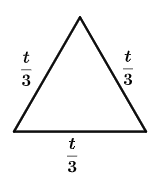
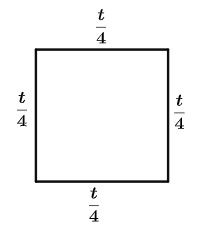
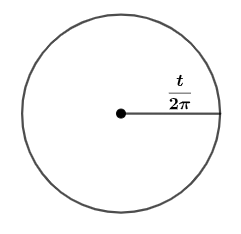
According to the question, it is asked that an equilateral triangle, a square and a circle have equal parameters. And if T denotes the area of the triangle, S is the area of the square and C is the area of the circle. If we consider that the perimeters of each figure to be $tcm$, then,
The sides of the equilateral triangle will be $=\dfrac{t}{3}$
And the sides of the square will be $=\dfrac{t}{4}$
And the radius of the circle will be $=\dfrac{t}{2\pi }$
Since we know that the area of an equilateral triangle is equal to $\dfrac{\sqrt{3}}{4}{{a}^{2}}$, where $a$ is the side of that triangle. So, the area of equilateral triangle for side $\dfrac{t}{3}$ will be:
$T=\dfrac{\sqrt{3}}{4}\times {{\left( \dfrac{t}{3} \right)}^{2}}=\dfrac{\sqrt{3}{{t}^{2}}}{36}$
As we know that the area of a square is ${{a}^{2}}$, so the area of a square with side $\dfrac{t}{4}$ will be:
$S={{\left( \dfrac{t}{4} \right)}^{2}}=\dfrac{{{t}^{2}}}{16}$
And we know that the area of the circle is $\pi {{r}^{2}}$. So, the area of the circle whose radius is $\dfrac{t}{2\pi }$ is:
$C=\pi \times \left( \dfrac{t}{2\pi } \right)=\dfrac{{{t}^{2}}}{4\pi }=\dfrac{7{{t}^{2}}}{88}=0.0795{{t}^{2}}$
So, all the areas are:
$\begin{align}
& T=\dfrac{\sqrt{3}{{t}^{2}}}{36}=\dfrac{1.732}{36}{{t}^{2}}=0.0481{{t}^{2}} \\
& S=0.0625{{t}^{2}} \\
& C=0.0795{{t}^{2}} \\
& \therefore C>S>T \\
\end{align}$
So, the correct option is C.
Note: While solving this question you should know about the areas of the given shapes. And if in any question the parameters are given then we have to calculate the areas according to the measurements. And by using these we can also calculate the parameters of each other if any one is common from their area or peripherance.
Complete step-by-step solution:
According to the question, it is asked that an equilateral triangle, a square and a circle have equal parameters. And if T denotes the area of the triangle, S is the area of the square and C is the area of the circle. If we consider that the perimeters of each figure to be $tcm$, then,
The sides of the equilateral triangle will be $=\dfrac{t}{3}$
And the sides of the square will be $=\dfrac{t}{4}$
And the radius of the circle will be $=\dfrac{t}{2\pi }$
Since we know that the area of an equilateral triangle is equal to $\dfrac{\sqrt{3}}{4}{{a}^{2}}$, where $a$ is the side of that triangle. So, the area of equilateral triangle for side $\dfrac{t}{3}$ will be:
$T=\dfrac{\sqrt{3}}{4}\times {{\left( \dfrac{t}{3} \right)}^{2}}=\dfrac{\sqrt{3}{{t}^{2}}}{36}$
As we know that the area of a square is ${{a}^{2}}$, so the area of a square with side $\dfrac{t}{4}$ will be:
$S={{\left( \dfrac{t}{4} \right)}^{2}}=\dfrac{{{t}^{2}}}{16}$
And we know that the area of the circle is $\pi {{r}^{2}}$. So, the area of the circle whose radius is $\dfrac{t}{2\pi }$ is:
$C=\pi \times \left( \dfrac{t}{2\pi } \right)=\dfrac{{{t}^{2}}}{4\pi }=\dfrac{7{{t}^{2}}}{88}=0.0795{{t}^{2}}$
So, all the areas are:
$\begin{align}
& T=\dfrac{\sqrt{3}{{t}^{2}}}{36}=\dfrac{1.732}{36}{{t}^{2}}=0.0481{{t}^{2}} \\
& S=0.0625{{t}^{2}} \\
& C=0.0795{{t}^{2}} \\
& \therefore C>S>T \\
\end{align}$
So, the correct option is C.
Note: While solving this question you should know about the areas of the given shapes. And if in any question the parameters are given then we have to calculate the areas according to the measurements. And by using these we can also calculate the parameters of each other if any one is common from their area or peripherance.
Recently Updated Pages
What are the two major island groups in India class 9 social science CBSE

What is Jhum cultivation class 9 biology CBSE
Write an Article on Save Earth Save Life
Silk is obtained from of the silk moth APupa BLarva class 9 chemistry CBSE
Write chemical formulas of the following compounds class 9 chemistry CBSE
The Indo Gangetic Plains of India are fertile due to class 9 social science CBSE
Trending doubts
Fill the blanks with the suitable prepositions 1 The class 9 english CBSE
Difference Between Plant Cell and Animal Cell
What is the full form of pH?
What is pollution? How many types of pollution? Define it
On an outline map of India show its neighbouring c class 9 social science CBSE
What is momentum with examples class 9 physics CBSE