




An equiconvex lens of glass of focal length 0.1 m is cut along a plane perpendicular to the principal axis into two equal parts. The ratio of focal length of new lenses formed is
$
{\text{A}}{\text{. 1:1}} \\
{\text{B}}{\text{. 1:2}} \\
{\text{C}}{\text{. 2:1}} \\
{\text{D}}{\text{. 2:}}\dfrac{1}{2} \\
$
Answer
 Verified
662.1k+ views
Hint: Using the lens maker formula, we can study the lenses of any shape and refracting surface. By comparing the lens maker formula for initial biconvex lens and final cut lens, we can find the ratio of their focal lengths.
Formula used: The lens maker formula is given as
$\dfrac{1}{f} = \left( {\mu - 1} \right)\left( {\dfrac{1}{{{R_1}}} - \dfrac{1}{{{R_2}}}} \right)$
where f is the focal length of the lens, $\mu $ signifies the refractive index of the material of the lens, ${R_1}$ and ${R_2}$ are the radius of curvatures of the two refracting surfaces of the lens.
Complete step by step answer:
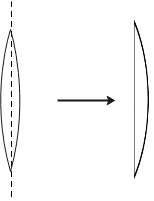
The lens maker formula can be used to study the given lenses. The first lens is biconvex and the two refracting surfaces have the same radii of curvature which is equal to 0.1 m. Therefore we can write the lens maker formula for first lens as follows:
$
\dfrac{1}{{{f_{initial}}}} = \left( {\mu - 1} \right)\left( {\dfrac{1}{{ + R}} - \dfrac{1}{{ - R}}} \right) \\
= \left( {\mu - 1} \right)\left( {\dfrac{1}{R} + \dfrac{1}{R}} \right) \\
= \left( {\mu - 1} \right)\left( {\dfrac{2}{R}} \right){\text{ }}...{\text{(i)}} \\
$
Now this lens is cut into half from the middle along the plane perpendicular to the principal axis of the lens. Therefore one refracting surface is convex while the other refracting surface is plane. The radius of curvature of the convex side is the same as before but the radius of curvature of the plane side is at infinity. Therefore, we can write the lens maker formula for the new lens as follows:
$
\dfrac{1}{{{f_{final}}}} = \left( {\mu - 1} \right)\left( {\dfrac{1}{{ + R}} - \dfrac{1}{\infty }} \right) \\
= \left( {\mu - 1} \right)\left( {\dfrac{1}{R}} \right){\text{ }}...{\text{(ii)}} \\
$
Now, by dividing the equation (i) with equation (ii), we get
$
\dfrac{{{f_{final}}}}{{{f_{initial}}}} = \dfrac{{\left( {\mu - 1} \right)\left( {\dfrac{2}{R}} \right){\text{ }}}}{{\left( {\mu - 1} \right)\left( {\dfrac{1}{R}} \right)}} \\
\Rightarrow \dfrac{{{f_{final}}}}{{{f_{initial}}}} = \dfrac{2}{1} = 2:1 \\
$
Hence, the correct answer is option C.
Note:
1. All distances to the left of the lens are taken to be negative while all distances to the right of the lens are taken to be negative.
2. The focus is defined on the basis of curvature of the front circle of the lens. A concave lens has negative focus because it lies on the left side of the lens while a convex lens has positive focus because it lies on the right side of the lens.
Formula used: The lens maker formula is given as
$\dfrac{1}{f} = \left( {\mu - 1} \right)\left( {\dfrac{1}{{{R_1}}} - \dfrac{1}{{{R_2}}}} \right)$
where f is the focal length of the lens, $\mu $ signifies the refractive index of the material of the lens, ${R_1}$ and ${R_2}$ are the radius of curvatures of the two refracting surfaces of the lens.
Complete step by step answer:
The lens maker formula can be used to study the given lenses. The first lens is biconvex and the two refracting surfaces have the same radii of curvature which is equal to 0.1 m. Therefore we can write the lens maker formula for first lens as follows:
$
\dfrac{1}{{{f_{initial}}}} = \left( {\mu - 1} \right)\left( {\dfrac{1}{{ + R}} - \dfrac{1}{{ - R}}} \right) \\
= \left( {\mu - 1} \right)\left( {\dfrac{1}{R} + \dfrac{1}{R}} \right) \\
= \left( {\mu - 1} \right)\left( {\dfrac{2}{R}} \right){\text{ }}...{\text{(i)}} \\
$
Now this lens is cut into half from the middle along the plane perpendicular to the principal axis of the lens. Therefore one refracting surface is convex while the other refracting surface is plane. The radius of curvature of the convex side is the same as before but the radius of curvature of the plane side is at infinity. Therefore, we can write the lens maker formula for the new lens as follows:
$
\dfrac{1}{{{f_{final}}}} = \left( {\mu - 1} \right)\left( {\dfrac{1}{{ + R}} - \dfrac{1}{\infty }} \right) \\
= \left( {\mu - 1} \right)\left( {\dfrac{1}{R}} \right){\text{ }}...{\text{(ii)}} \\
$
Now, by dividing the equation (i) with equation (ii), we get
$
\dfrac{{{f_{final}}}}{{{f_{initial}}}} = \dfrac{{\left( {\mu - 1} \right)\left( {\dfrac{2}{R}} \right){\text{ }}}}{{\left( {\mu - 1} \right)\left( {\dfrac{1}{R}} \right)}} \\
\Rightarrow \dfrac{{{f_{final}}}}{{{f_{initial}}}} = \dfrac{2}{1} = 2:1 \\
$
Hence, the correct answer is option C.
Note:
1. All distances to the left of the lens are taken to be negative while all distances to the right of the lens are taken to be negative.
2. The focus is defined on the basis of curvature of the front circle of the lens. A concave lens has negative focus because it lies on the left side of the lens while a convex lens has positive focus because it lies on the right side of the lens.
Recently Updated Pages
Which of the following graphs shows the variation of class 12 physics CBSE

Draw a labelled diagram of the human male reproductive class 12 biology CBSE
Describe the experiment to compare the emf of two cells class 12 physics CBSE
What is standard hydrogen electrode
What is conventional current and electric current class 12 physics CBSE
2Bromopentane is treated with an alcoholic KOH solution class 12 chemistry CBSE
Trending doubts
Draw a labelled sketch of the human eye class 12 physics CBSE
Which are the Top 10 Largest Countries of the World?
Differentiate between homogeneous and heterogeneous class 12 chemistry CBSE
Draw ray diagrams each showing i myopic eye and ii class 12 physics CBSE
Which is the correct genotypic ratio of mendel dihybrid class 12 biology CBSE
What is the Full Form of PVC, PET, HDPE, LDPE, PP and PS ?