




An element A crystalizes in a Fcc structure. $200g$ of this element has $4.12 \times {10^{24}}$ atoms. The density of A is $7.2\,gc{m^{ - 3}}$ . Calculate the edge length of the unit cell.
A.\[26.97 \times {10^{ - 24}}cm\]
B.$299.9\,pm$
C.$5 \times {10^{ - 12}}\,cm$
D.$2.99\,cm$
Answer
 Verified
639.6k+ views
Hint: The formula for finding density is $\dfrac{{Z \times M}}{{{a^3} \times {N_0} \times {{10}^{ - 30}}}}$. On substituting the values, we will get the desired result.
Complete step by step answer:
We know that, Density = $\dfrac{{Z \times M}}{{{a^3} \times {N_0} \times {{10}^{ - 30}}}}$
For hcp and fcc structure, we will take Z=$4$
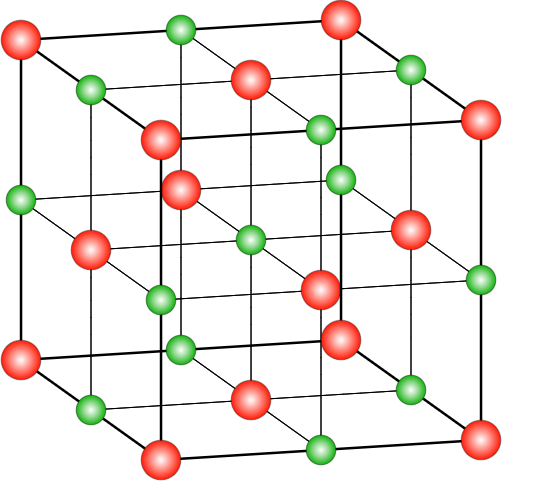
Diagram showing FCC structure
So, According to question,
Density is given as $7.2\,gc{m^{ - 3}}$
Mass given = $200g$
Atomic mass (M) of the element is calculated as:
In $200g$ , $4.12 \times {10^{24}}$ atoms of the element are present
$6.022 \times {10^{23}}$ atoms of the element are present in
$ = \,\dfrac{{200g}}{{4.12 \times {{10}^{24}}}}\, \times \,6.022 \times {10^{23}}\, = \,29.23g$
Atomic Mass (M) of the element = $29.23\,g\,mo{l^{ - 1}}$
Value of Avogadro’s Number (${N_0}$) = \[6.022 \times {10^{23\,}}mol{e^{ - 1}}\]
On substituting the values,
\[{a^3}\, = \,\dfrac{{4 \times 29.23}}{{7.2 \times 6.022 \times {{10}^{23}} \times {{10}^{ - 30}}}}\]
$ = \,26.97 \times {10^6}\,{(pm)^3}$
Edge Length (a) = \[{[26.97 \times {10^6}\,{(pm)^3}]^{\dfrac{1}{3}}}\, = \,2.999\, \times \,{10^2}\,pm{\kern 1pt} \, = \,299.9\,pm\]
Therefore, option A, C and D are incorrect.
Hence, the correct answer is $2.99\,cm$ which is option B.
Note:
For BCC, Z = $2$
For HCP, Z = $4$
In the Face Centered Cubic arrangement, there is one atom centered in each of the faces and eight atoms at corners of the unit cell. The atom in the face is shared with the adjacent cell. FCC unit cells consist of four atoms, eight eighths at the corners and six halves in the faces.
The body-centered cubic unit cell has atoms at each of the eight corners of a cube (like the cubic unit cell) plus one atom in the center of the cube. The corner atoms are shared among eight unit cells.
Complete step by step answer:
We know that, Density = $\dfrac{{Z \times M}}{{{a^3} \times {N_0} \times {{10}^{ - 30}}}}$
For hcp and fcc structure, we will take Z=$4$
Diagram showing FCC structure
So, According to question,
Density is given as $7.2\,gc{m^{ - 3}}$
Mass given = $200g$
Atomic mass (M) of the element is calculated as:
In $200g$ , $4.12 \times {10^{24}}$ atoms of the element are present
$6.022 \times {10^{23}}$ atoms of the element are present in
$ = \,\dfrac{{200g}}{{4.12 \times {{10}^{24}}}}\, \times \,6.022 \times {10^{23}}\, = \,29.23g$
Atomic Mass (M) of the element = $29.23\,g\,mo{l^{ - 1}}$
Value of Avogadro’s Number (${N_0}$) = \[6.022 \times {10^{23\,}}mol{e^{ - 1}}\]
On substituting the values,
\[{a^3}\, = \,\dfrac{{4 \times 29.23}}{{7.2 \times 6.022 \times {{10}^{23}} \times {{10}^{ - 30}}}}\]
$ = \,26.97 \times {10^6}\,{(pm)^3}$
Edge Length (a) = \[{[26.97 \times {10^6}\,{(pm)^3}]^{\dfrac{1}{3}}}\, = \,2.999\, \times \,{10^2}\,pm{\kern 1pt} \, = \,299.9\,pm\]
Therefore, option A, C and D are incorrect.
Hence, the correct answer is $2.99\,cm$ which is option B.
Note:
For BCC, Z = $2$
For HCP, Z = $4$
In the Face Centered Cubic arrangement, there is one atom centered in each of the faces and eight atoms at corners of the unit cell. The atom in the face is shared with the adjacent cell. FCC unit cells consist of four atoms, eight eighths at the corners and six halves in the faces.
The body-centered cubic unit cell has atoms at each of the eight corners of a cube (like the cubic unit cell) plus one atom in the center of the cube. The corner atoms are shared among eight unit cells.
Recently Updated Pages
Basicity of sulphurous acid and sulphuric acid are

Master Class 12 Economics: Engaging Questions & Answers for Success
Master Class 12 Biology: Engaging Questions & Answers for Success
Master Class 11 English: Engaging Questions & Answers for Success
Master Class 11 Physics: Engaging Questions & Answers for Success
Master Class 11 Computer Science: Engaging Questions & Answers for Success
Trending doubts
Draw a labelled sketch of the human eye class 12 physics CBSE
The chemical formula of tear gas is A CO Cl 2 B C 10 class 12 chemistry CBSE
Draw ray diagrams each showing i myopic eye and ii class 12 physics CBSE
Which are the Top 10 Largest Countries of the World?
Differentiate between homogeneous and heterogeneous class 12 chemistry CBSE
Which is the correct genotypic ratio of mendel dihybrid class 12 biology CBSE