




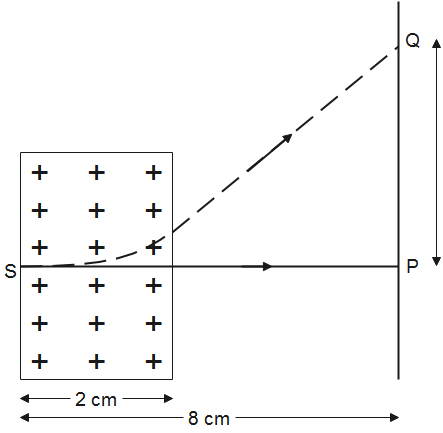
An electron, moving along the x-axis with an initial energy of $100eV$,enters a region of magnetic field $\vec{B}=\left( 1.5\times {{10}^{-3}}T \right)\hat{k}$ at S (See figure). The field extends between $x = 0$ and $x = 2cm$. The electron is detected at the point Q on screen placed $8cm$away from the point. What is the distance $d$ between P and Q (on the screen)?
(electron's charge =$1.6\times {{10}^{-19}}C$, mass of electron =$~9.1\times {{10}^{-3}}kg$)
A. 12.85 cm
B. 1.22 cm
C. 11.65 cm
D. 2.25 cm
Answer
 Verified
615.3k+ views
Hint: In magnetic field, a moving charge experiences force known as magnetic force. As charge moves perpendicular to the magnetic field, the path it follows in the magnetic field is circular. The centripetal force is provided by magnetic force. Find the radius of the circular path and then use geometry to obtain the separation between P and Q.
Complete step by step answer:
When a charge $q$ enters a magnetic field $B$ with velocity $v$, it experiences a force known as magnetic force given by
${{\mathbf{F}}_{m}}=q\left( \mathbf{v}\times \mathbf{B} \right)$
If charge is moving perpendicular to direction of magnetic field, force acts on it tangentially and the path of the charge in the magnetic field is circular. The centripetal force is provided by magnetic force and therefore,
$qvB=\dfrac{m{{v}^{2}}}{R}\Rightarrow R=\dfrac{\sqrt{2m({{E}_{k}})}}{qB}$
Where R is the radius of the circle and ${{E}_{k}}$ is its kinetic energy. In this problem, electron has kinetic energy ${{E}_{k}}=100eV$ enters a region of magnetic field $\vec{B}=\left( 1.5\times {{10}^{-3}}T \right)\hat{k}$. Therefore, radius of the circle
$R=\dfrac{\sqrt{2\times 9.1\times {{10}^{-31}}(100\times 1.6\times {{10}^{-19}})}}{1.6\times {{10}^{-19}}\times 1.5\times {{10}^{-3}}}$
On solving this, we get
$R=2.248cm$
Let us assume that the electron exits at an angle $\theta$ to the horizontal.
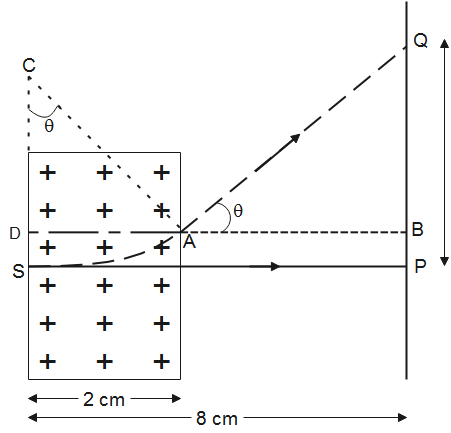
According to trigonometric ratios, in triangle ACD
$\sin \theta =\dfrac{BD}{CB}=\dfrac{2}{2.248}=0.89$
From identity ${{\sin }^{2}}\theta +co{{s}^{2}}\theta =1$, we have
$\cos \theta =\sqrt{1-{{\sin }^{2}}\theta }=\sqrt{1-0.79}=\sqrt{0.21}=0.46$
In triangle ABQ
$\tan \theta =\dfrac{QB}{BA}$
It can be observed that $BA=8cm-2cm=6cm$
Substituting this, we have
$\tan \theta =\dfrac{QB}{6}=\dfrac{\sin \theta }{\cos \theta }$
Substituting the values and rearranging,
$QB=6\times \dfrac{0.89}{0.46}=11.61cm$
Also, $BP=DS=R(1-\cos \theta )=2.248\times 0.54=1.21cm$
$PQ=BP+QB=11.61+1.21=12.82cm$
Therefore, $d=12.82cm$
Which is approximately equal to option A.
Therefore, option A is the correct answer.
Note:
A moving charge experiences a force in a magnetic field known as magnetic force. The direction of force is perpendicular to both the direction of motion and direction of magnetic field. If motion of charge is perpendicular to direction of magnetic field, charge moves in circular path.
Complete step by step answer:
When a charge $q$ enters a magnetic field $B$ with velocity $v$, it experiences a force known as magnetic force given by
${{\mathbf{F}}_{m}}=q\left( \mathbf{v}\times \mathbf{B} \right)$
If charge is moving perpendicular to direction of magnetic field, force acts on it tangentially and the path of the charge in the magnetic field is circular. The centripetal force is provided by magnetic force and therefore,
$qvB=\dfrac{m{{v}^{2}}}{R}\Rightarrow R=\dfrac{\sqrt{2m({{E}_{k}})}}{qB}$
Where R is the radius of the circle and ${{E}_{k}}$ is its kinetic energy. In this problem, electron has kinetic energy ${{E}_{k}}=100eV$ enters a region of magnetic field $\vec{B}=\left( 1.5\times {{10}^{-3}}T \right)\hat{k}$. Therefore, radius of the circle
$R=\dfrac{\sqrt{2\times 9.1\times {{10}^{-31}}(100\times 1.6\times {{10}^{-19}})}}{1.6\times {{10}^{-19}}\times 1.5\times {{10}^{-3}}}$
On solving this, we get
$R=2.248cm$
Let us assume that the electron exits at an angle $\theta$ to the horizontal.
According to trigonometric ratios, in triangle ACD
$\sin \theta =\dfrac{BD}{CB}=\dfrac{2}{2.248}=0.89$
From identity ${{\sin }^{2}}\theta +co{{s}^{2}}\theta =1$, we have
$\cos \theta =\sqrt{1-{{\sin }^{2}}\theta }=\sqrt{1-0.79}=\sqrt{0.21}=0.46$
In triangle ABQ
$\tan \theta =\dfrac{QB}{BA}$
It can be observed that $BA=8cm-2cm=6cm$
Substituting this, we have
$\tan \theta =\dfrac{QB}{6}=\dfrac{\sin \theta }{\cos \theta }$
Substituting the values and rearranging,
$QB=6\times \dfrac{0.89}{0.46}=11.61cm$
Also, $BP=DS=R(1-\cos \theta )=2.248\times 0.54=1.21cm$
$PQ=BP+QB=11.61+1.21=12.82cm$
Therefore, $d=12.82cm$
Which is approximately equal to option A.
Therefore, option A is the correct answer.
Note:
A moving charge experiences a force in a magnetic field known as magnetic force. The direction of force is perpendicular to both the direction of motion and direction of magnetic field. If motion of charge is perpendicular to direction of magnetic field, charge moves in circular path.
Recently Updated Pages
Master Class 12 Business Studies: Engaging Questions & Answers for Success

Master Class 12 Chemistry: Engaging Questions & Answers for Success
Master Class 12 Biology: Engaging Questions & Answers for Success
Class 12 Question and Answer - Your Ultimate Solutions Guide
Master Class 11 English: Engaging Questions & Answers for Success
Master Class 11 Social Science: Engaging Questions & Answers for Success
Trending doubts
Which are the Top 10 Largest Countries of the World?
Draw a labelled sketch of the human eye class 12 physics CBSE
The end of compass needle which points towards north class 12 physics CBSE
Differentiate between homogeneous and heterogeneous class 12 chemistry CBSE
In order to find out the different types of gametes class 12 biology NEET_UG
Why is the cell called the structural and functional class 12 biology CBSE