




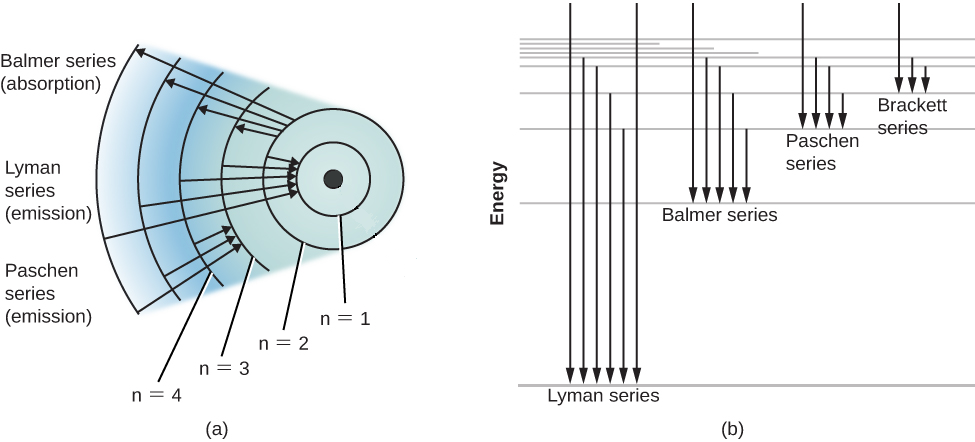
An electron in a hydrogen atom undergoes a transition from an orbit with quantum number ${n_i}$ to another with quantum number ${n_f}$ . ${V_i}$ and ${V_f}$ are respectively the initial and the final potential energies of the electron. If $\dfrac{{{V_i}}}{{{V_f}}} = 6.25$ , then the smallest possible ${n_f}$is
Answer
 Verified
602.7k+ views
Hint:Use the relation between the quantum number of the electron and its potential energy and substitute the given ratio of the potential energy in it. In order to find the smallest possible final quantum number, the largest possible initial quantum number is taken.
Useful formula:
The relation between the quantum number and the potential energy is given by
$\dfrac{{{V_i}}}{{{V_f}}} = \dfrac{{{n_f}^2}}{{{n_i}_{}^2}}$
Where ${V_i}$ is the initial potential energy of the electron, ${n_i}$ is the initial quantum number of the electron and ${n_f}$ is the final quantum number.
Complete step by step solution:
It is given that the
Ratio of the initial and the final potential energy is, $\dfrac{{{V_i}}}{{{V_f}}} = 6.25$
Using the relation given above,
$\dfrac{{{V_i}}}{{{V_f}}} = \dfrac{{{n_f}^2}}{{{n_i}_{}^2}}$
Substituting the values of the $\dfrac{{{V_i}}}{{{V_f}}}$ in the above relation,
$\dfrac{{{n_f}^2}}{{{n_i}_{}^2}} = 6.25$
Taking square root on both sides of the equation
$\sqrt {\dfrac{{{n_f}^2}}{{{n_i}_{}^2}}} = \sqrt {6.25} $
$\dfrac{{{n_f}^{}}}{{{n_i}_{}^{}}} = 2.5$
The initial quantum number cannot be $1$ , so it is taken as $2$ .
Substituting the values of the ${n_i}$ in the above equation.
${n_f}^{} = 2.5 \times {n_i}_{}^{}$
${n_f}^{} = 2.5 \times 2$
By performing the simple arithmetic operations,
${n_f}^{} = 5$
Thus, the value of the final quantum number is obtained as $5$.
Note:Note that when the electron of the hydrogen atoms migrates from the small quantum levels to the large quantum levels, it absorbs some energy. And this process is called ionizing. But when the electron moves to the lower from the higher quantum levels, it releases some energy.
Useful formula:
The relation between the quantum number and the potential energy is given by
$\dfrac{{{V_i}}}{{{V_f}}} = \dfrac{{{n_f}^2}}{{{n_i}_{}^2}}$
Where ${V_i}$ is the initial potential energy of the electron, ${n_i}$ is the initial quantum number of the electron and ${n_f}$ is the final quantum number.
Complete step by step solution:
It is given that the
Ratio of the initial and the final potential energy is, $\dfrac{{{V_i}}}{{{V_f}}} = 6.25$
Using the relation given above,
$\dfrac{{{V_i}}}{{{V_f}}} = \dfrac{{{n_f}^2}}{{{n_i}_{}^2}}$
Substituting the values of the $\dfrac{{{V_i}}}{{{V_f}}}$ in the above relation,
$\dfrac{{{n_f}^2}}{{{n_i}_{}^2}} = 6.25$
Taking square root on both sides of the equation
$\sqrt {\dfrac{{{n_f}^2}}{{{n_i}_{}^2}}} = \sqrt {6.25} $
$\dfrac{{{n_f}^{}}}{{{n_i}_{}^{}}} = 2.5$
The initial quantum number cannot be $1$ , so it is taken as $2$ .
Substituting the values of the ${n_i}$ in the above equation.
${n_f}^{} = 2.5 \times {n_i}_{}^{}$
${n_f}^{} = 2.5 \times 2$
By performing the simple arithmetic operations,
${n_f}^{} = 5$
Thus, the value of the final quantum number is obtained as $5$.
Note:Note that when the electron of the hydrogen atoms migrates from the small quantum levels to the large quantum levels, it absorbs some energy. And this process is called ionizing. But when the electron moves to the lower from the higher quantum levels, it releases some energy.
Recently Updated Pages
Master Class 12 Economics: Engaging Questions & Answers for Success

Master Class 12 English: Engaging Questions & Answers for Success
Master Class 12 Social Science: Engaging Questions & Answers for Success
Master Class 12 Maths: Engaging Questions & Answers for Success
Master Class 12 Physics: Engaging Questions & Answers for Success
Master Class 12 Business Studies: Engaging Questions & Answers for Success
Trending doubts
Which are the Top 10 Largest Countries of the World?
Draw a labelled sketch of the human eye class 12 physics CBSE
Differentiate between homogeneous and heterogeneous class 12 chemistry CBSE
Why is the cell called the structural and functional class 12 biology CBSE
Draw ray diagrams each showing i myopic eye and ii class 12 physics CBSE
Which is the correct genotypic ratio of mendel dihybrid class 12 biology CBSE