




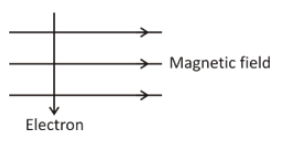
An electron enters a magnetic field at right angles to it as shown in figure. The direction of force acting on the electron will be:
A. To the right
B. To the left
C. Out of the page
D. Into the page
Answer
 Verified
568.8k+ views
Hint:Here we have to use Fleming’s left hand rule. The magnetic field acting on it is given by the left hand law of Flemings when a force conductor holding current is located perpendicular to the direction of the magnetic field. The direction of force acting on it as travelling perpendicular to the direction of the magnetic field is the same as that acting on a current-carrying conductor located perpendicular to the direction of the magnetic field, since the direction of current is the same as that of the motion of a positive charge
Complete answer:
The left-hand rule of Fleming explains that – the conductor feels a force perpendicular to both the field and the direction of current flow when a current-carrying conductor is put in an external magnetic field.
The conducting wire encounters a force perpendicular both to the field and to the direction of the current flow (i.e. they are mutually perpendicular) as current passes across a conducting wire and an additional magnetic field is exerted through the flow. It is possible to hold a left hand to represent three mutually orthogonal axes on the thumb, fore finger and middle finger. A quantity (mechanical power, magnetic field and electricity) is then allocated to each finger.
Fleming's left hand rule is used in electric motors. One magnetic field is induced around it as the current passes into a conductor. It is easy to visualize the magnetic field by considering the number of closed magnetic force lines along the conductor. Using the left hand law of Fleming here, we can see that the force direction is perpendicular to the direction of the magnetic field and current. The direction of force is also contrary to the acceleration of electrons on the paper at ${90^ \circ }$ .
Hence, option C is correct.
Note:Here we have to see whether an electron or any other component is given. Since, the electron is negatively charged, so the direction of current is opposite. Since, the current is in the upward direction, the electron moves downwards and goes out of the page.
Complete answer:
The left-hand rule of Fleming explains that – the conductor feels a force perpendicular to both the field and the direction of current flow when a current-carrying conductor is put in an external magnetic field.
The conducting wire encounters a force perpendicular both to the field and to the direction of the current flow (i.e. they are mutually perpendicular) as current passes across a conducting wire and an additional magnetic field is exerted through the flow. It is possible to hold a left hand to represent three mutually orthogonal axes on the thumb, fore finger and middle finger. A quantity (mechanical power, magnetic field and electricity) is then allocated to each finger.
Fleming's left hand rule is used in electric motors. One magnetic field is induced around it as the current passes into a conductor. It is easy to visualize the magnetic field by considering the number of closed magnetic force lines along the conductor. Using the left hand law of Fleming here, we can see that the force direction is perpendicular to the direction of the magnetic field and current. The direction of force is also contrary to the acceleration of electrons on the paper at ${90^ \circ }$ .
Hence, option C is correct.
Note:Here we have to see whether an electron or any other component is given. Since, the electron is negatively charged, so the direction of current is opposite. Since, the current is in the upward direction, the electron moves downwards and goes out of the page.
Recently Updated Pages
Master Class 12 Economics: Engaging Questions & Answers for Success

Master Class 12 Physics: Engaging Questions & Answers for Success
Master Class 12 English: Engaging Questions & Answers for Success
Master Class 12 Social Science: Engaging Questions & Answers for Success
Master Class 12 Maths: Engaging Questions & Answers for Success
Master Class 12 Business Studies: Engaging Questions & Answers for Success
Trending doubts
Which are the Top 10 Largest Countries of the World?
What are the major means of transport Explain each class 12 social science CBSE
Draw a labelled sketch of the human eye class 12 physics CBSE
Why cannot DNA pass through cell membranes class 12 biology CBSE
Differentiate between insitu conservation and exsitu class 12 biology CBSE
Draw a neat and well labeled diagram of TS of ovary class 12 biology CBSE