




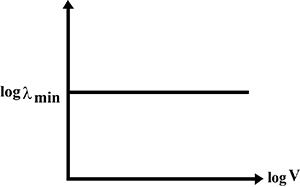
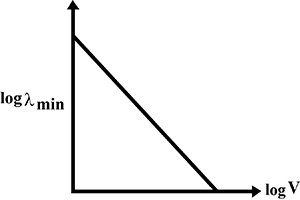
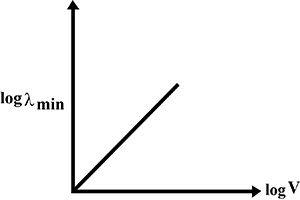
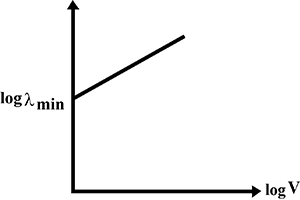
An electron beam is accelerated by a potential difference V to hit a metallic target to produce X-rays. It produces continuous as well as characteristic X-rays. If λ$_{\min }$ is the smallest possible wavelength of X-rays in the spectrum, the variation of log λ$_{\min }$ with log V is correctly represented in :
A.
B.
C.
D.
Answer
 Verified
671.4k+ views
Hint: When we accelerate an electron a potential difference is produced, which changes into kinetic energy inside the electron , when those highly charged electrons hit the metallic wall, then those it emits X-Rays which contains photons.
Complete step by step answer:
When we accelerate an electron, the potential difference that occurs do some work that is represented as,
W= Vq =eV, in which V is the potential difference,
Now the work done in accelerating the electron changes into K.E (kinetic energy of the electron)
Now these electrons with kinetic energy hits a metallic surface and changes into X-rays, and in X-rays we know that there are photons and those photons contains an energy, which is represented by,
E=hc/ λ
Now if we take λ$_{\min }$ which will help to produce protons,
Now we have E$_{\max }$ = hc/ λ$_{\min }$
So when λ is minimum energy produced by photons is maximum,
Now as the potential difference caused during acceleration of electrons , is the cause of this energy hence we can say that,
eV= E$_{\max }$ = hc/ λ$_{\min }$
Now we can say that ,
eV$=\dfrac{hc}{{{\lambda }_{\min }}}$,
Now taking log on both sides,
$\log (eV)=\log (\dfrac{hc}{{{\lambda }_{\min }}})$,
Now according to properties of logarithm ,
Log e + log V = log hc - log λ$_{\min }$
log λ$_{\min }$= log hc - Log e - log V,
log λ$_{\min }$= log (hc/e) – log V,
log λ$_{\min }$= – log V + log (hc/e) ……. Eq 1
Now the above equation matches with the equation of straight line which is (Y= mx +c)
Now, if we plot the graph by comparing the straight line equation with equation 1.
We get the graph as,
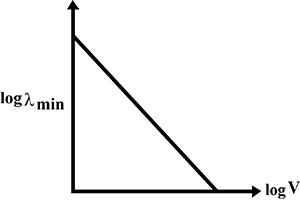
Hence option B is the correct option.
Note: Try to bring the equation for the graph as close as possible to the equation of the straight line then it will be easy for us to fix how the graph is plotted. The potential difference eV is equal to the energy given by the photons as the energy that the photons are giving is related to the potential difference eV as it is the cause of high kinetic energy in the electron resulting in X-rays when they hit a metal wall.
Complete step by step answer:
When we accelerate an electron, the potential difference that occurs do some work that is represented as,
W= Vq =eV, in which V is the potential difference,
Now the work done in accelerating the electron changes into K.E (kinetic energy of the electron)
Now these electrons with kinetic energy hits a metallic surface and changes into X-rays, and in X-rays we know that there are photons and those photons contains an energy, which is represented by,
E=hc/ λ
Now if we take λ$_{\min }$ which will help to produce protons,
Now we have E$_{\max }$ = hc/ λ$_{\min }$
So when λ is minimum energy produced by photons is maximum,
Now as the potential difference caused during acceleration of electrons , is the cause of this energy hence we can say that,
eV= E$_{\max }$ = hc/ λ$_{\min }$
Now we can say that ,
eV$=\dfrac{hc}{{{\lambda }_{\min }}}$,
Now taking log on both sides,
$\log (eV)=\log (\dfrac{hc}{{{\lambda }_{\min }}})$,
Now according to properties of logarithm ,
Log e + log V = log hc - log λ$_{\min }$
log λ$_{\min }$= log hc - Log e - log V,
log λ$_{\min }$= log (hc/e) – log V,
log λ$_{\min }$= – log V + log (hc/e) ……. Eq 1
Now the above equation matches with the equation of straight line which is (Y= mx +c)
Now, if we plot the graph by comparing the straight line equation with equation 1.
We get the graph as,
Hence option B is the correct option.
Note: Try to bring the equation for the graph as close as possible to the equation of the straight line then it will be easy for us to fix how the graph is plotted. The potential difference eV is equal to the energy given by the photons as the energy that the photons are giving is related to the potential difference eV as it is the cause of high kinetic energy in the electron resulting in X-rays when they hit a metal wall.
Recently Updated Pages
Master Class 12 Physics: Engaging Questions & Answers for Success

Master Class 12 Social Science: Engaging Questions & Answers for Success
Master Class 12 English: Engaging Questions & Answers for Success
Master Class 12 Maths: Engaging Questions & Answers for Success
Master Class 12 Business Studies: Engaging Questions & Answers for Success
Master Class 12 Chemistry: Engaging Questions & Answers for Success
Trending doubts
Draw a labelled sketch of the human eye class 12 physics CBSE
Which are the Top 10 Largest Countries of the World?
Draw ray diagrams each showing i myopic eye and ii class 12 physics CBSE
Which is the correct genotypic ratio of mendel dihybrid class 12 biology CBSE
Which is the strongest oxidising agent out of the following class 12 chemistry CBSE
Differentiate between homogeneous and heterogeneous class 12 chemistry CBSE