




An electromagnetic waves can be produced, when charge is
A. Moving with constant velocity.
B. Moving in circular orbit.
C. Falling in the electric field.
D. Both B and C.
Answer
 Verified
622.5k+ views
Hint: The basic concept which will be used in this question is when a charge is in the accelerated state it produces an electromagnetic field. An oscillating charge is accelerating continuously, it will radiate electromagnetic waves continuously.
Complete answer:
In option, B charge is moving in circular orbit which means that the charge is changing its direction during its motion which means the charge is in accelerated state.
Hence option B moving in circular orbit is correct further in option C. We can see that charge is falling in an electric field and we know that when charge falls in the electric field it experiences a force and hence motion can be defined as accelerated motion. So further we can say that option C is also held true.
So, the correct answer is “Option D”.
Additional Information:
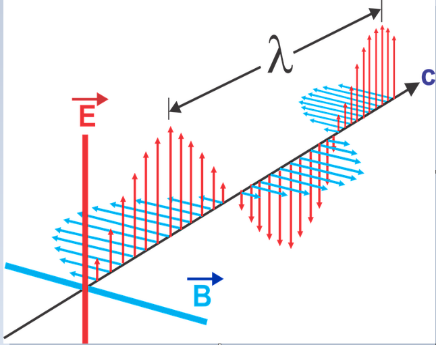
Vibrations between an electric field and magnetic field results in or production of electromagnetic waves. In other words, EM waves are made up of oscillating electric and magnetic fields.
Electromagnetic waves do not require any medium for their movement which means they can travel through solid liquid gas and also through the vacuum of space. Some examples of electromagnetic waves are radio waves, microwaves, infrared, (visible) light, ultraviolet, X-rays, and gamma rays. This also proved that radio waves are part of the light.
Note:
An electron circulates in an atom around the nucleus in a stable orbit, although we can say that only accelerating does not emit an electromagnetic wave. Waves are only emitted when an electron jumps from a higher energy orbit to a lower energy orbit. A simple LC oscillator is used to produce the waves of a different or desired frequency.
Complete answer:
In option, B charge is moving in circular orbit which means that the charge is changing its direction during its motion which means the charge is in accelerated state.
Hence option B moving in circular orbit is correct further in option C. We can see that charge is falling in an electric field and we know that when charge falls in the electric field it experiences a force and hence motion can be defined as accelerated motion. So further we can say that option C is also held true.
So, the correct answer is “Option D”.
Additional Information:
Vibrations between an electric field and magnetic field results in or production of electromagnetic waves. In other words, EM waves are made up of oscillating electric and magnetic fields.
Electromagnetic waves do not require any medium for their movement which means they can travel through solid liquid gas and also through the vacuum of space. Some examples of electromagnetic waves are radio waves, microwaves, infrared, (visible) light, ultraviolet, X-rays, and gamma rays. This also proved that radio waves are part of the light.
Note:
An electron circulates in an atom around the nucleus in a stable orbit, although we can say that only accelerating does not emit an electromagnetic wave. Waves are only emitted when an electron jumps from a higher energy orbit to a lower energy orbit. A simple LC oscillator is used to produce the waves of a different or desired frequency.
Recently Updated Pages
Master Class 12 Business Studies: Engaging Questions & Answers for Success

Master Class 12 Biology: Engaging Questions & Answers for Success
Master Class 12 Chemistry: Engaging Questions & Answers for Success
Class 12 Question and Answer - Your Ultimate Solutions Guide
Master Class 11 English: Engaging Questions & Answers for Success
Master Class 11 Social Science: Engaging Questions & Answers for Success
Trending doubts
Which are the Top 10 Largest Countries of the World?
Draw a labelled sketch of the human eye class 12 physics CBSE
Differentiate between homogeneous and heterogeneous class 12 chemistry CBSE
Why is the cell called the structural and functional class 12 biology CBSE
Draw ray diagrams each showing i myopic eye and ii class 12 physics CBSE
Which is the correct genotypic ratio of mendel dihybrid class 12 biology CBSE