




An electric line of force in the XY plane is given by the equation ${{x}^{2}}+{{y}^{2}}=1$. A particle with unit positive charge initially at rest at a point x=1, y=0 in the XY plane
a) not move at all
b) will move along the straight line
c) will move along the circular line of force
d) information is insufficient to draw any conclusion
Answer
 Verified
618.9k+ views
Hint: An electric line of force is basically the line of action of force that exists due do the electric field of a charge distribution or a unit charge. If we look at the equation of the line of force i.e. ${{x}^{2}}+{{y}^{2}}=1$ it depicts that the line of force originates at origin and exists within a circular region of radius equal to 1unit. Hence we can easily depict the effect on the unit positive charge from this information.
Complete step by step answer:
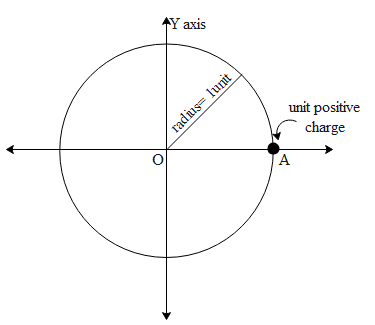
As shown in the fig a unit positive charge is kept at x= 1unit. If we consider the equation of the line of action of force the, for x = 1, and y = 0 the equation is satisfied. Hence the charge is in the influence of the electric field region. If we look at the above diagram, the lines of force exist in a circular region which is only possible if there is a charge at the origin. If there exists a charge Q at the origin by Coulomb's law the force on the charge at a distance r is given by $F=\dfrac{Qq}{4\pi {{\in }_{\circ }}{{r}^{2}}}\widehat{r}$ where q is the charge kept at a distance r from charge Q, $\widehat{r}$is a unit vector along the direction of force and $\dfrac{1}{4\pi {{\in }_{\circ }}}$is the permittivity of free space. According to Coulomb’s law the direction of force is always along the line of action connecting the two charges. Hence the charge will move in a straight line.
Hence, the correct answer is option B.
Note:
It is not specified in the question about the nature of the charge placed at origin nor the direction of the line of force. If the charge is positive then the unit positive charge will move away from the origin. If the charge placed at the origin is negative then the unit positive charge will move towards the origin. This is based on the fact that like charges repel each other and unlike charges attract each other.
Complete step by step answer:
As shown in the fig a unit positive charge is kept at x= 1unit. If we consider the equation of the line of action of force the, for x = 1, and y = 0 the equation is satisfied. Hence the charge is in the influence of the electric field region. If we look at the above diagram, the lines of force exist in a circular region which is only possible if there is a charge at the origin. If there exists a charge Q at the origin by Coulomb's law the force on the charge at a distance r is given by $F=\dfrac{Qq}{4\pi {{\in }_{\circ }}{{r}^{2}}}\widehat{r}$ where q is the charge kept at a distance r from charge Q, $\widehat{r}$is a unit vector along the direction of force and $\dfrac{1}{4\pi {{\in }_{\circ }}}$is the permittivity of free space. According to Coulomb’s law the direction of force is always along the line of action connecting the two charges. Hence the charge will move in a straight line.
Hence, the correct answer is option B.
Note:
It is not specified in the question about the nature of the charge placed at origin nor the direction of the line of force. If the charge is positive then the unit positive charge will move away from the origin. If the charge placed at the origin is negative then the unit positive charge will move towards the origin. This is based on the fact that like charges repel each other and unlike charges attract each other.
Recently Updated Pages
Master Class 12 Business Studies: Engaging Questions & Answers for Success

Master Class 12 Biology: Engaging Questions & Answers for Success
Master Class 12 Chemistry: Engaging Questions & Answers for Success
Class 12 Question and Answer - Your Ultimate Solutions Guide
Master Class 11 Social Science: Engaging Questions & Answers for Success
Master Class 11 English: Engaging Questions & Answers for Success
Trending doubts
Which is more stable and why class 12 chemistry CBSE
Which are the Top 10 Largest Countries of the World?
Draw a labelled sketch of the human eye class 12 physics CBSE
Differentiate between homogeneous and heterogeneous class 12 chemistry CBSE
What are the major means of transport Explain each class 12 social science CBSE
Sulphuric acid is known as the king of acids State class 12 chemistry CBSE