




An electric iron draws 10 amp, an electric toaster draws 5 amp and an electric refrigerator draws 3 amp from and 220 volts service line. The three appliances are connected in parallel. If all the three are operating at the same time, the fuse to be used should be
A. 10 amp
B. 5 amp
C. 15 amp
D. 20 amp
Answer
 Verified
648.6k+ views
Hint:Here, the resistances are connected in parallel. If the resistances are connected in parallel, the reciprocal of the net resistance is equal to the sum of reciprocals of the individual resistances in the circuit.
If ${R_1},{R_2},{R_3}...{R_n}$ are individual resistances connected in parallel in the circuit, the net resistance of the circuit,
$\dfrac{1}{R} = \dfrac{1}{{{R_1}}} + \dfrac{1}{{{R_2}}} + \dfrac{1}{{{R_3}}} + .. + \dfrac{1}{{{R_n}}}$
Complete step-by-step answer:
When the resistors are connected in parallel, the net resistance is –
$\dfrac{1}{R} = \dfrac{1}{{{R_1}}} + \dfrac{1}{{{R_2}}} + \dfrac{1}{{{R_3}}} + .. + \dfrac{1}{{{R_n}}}$
In a parallel circuit, the voltage across the parallel branch remains the same but the current divides into several branches depending on the individual values of resistances.
If $V$ is the voltage across the parallel branch and ${R_i}$ is an individual resistor in the parallel circuit, the current flowing through the branch will be:
${I_i} = \dfrac{V}{{{R_i}}}$
In this problem, there are three resistances namely, i) Electric iron, whose resistance is ${R_1}$ and current through it is, ${I_1} = 10A$ ii) Electric toaster, whose resistance is ${R_2}$ and current through it is, ${I_2} = 5A$ iii) Electric refrigerator, whose resistance is ${R_3}$ and current through it is, ${I_3} = 3A$
The circuit diagram looks like this:
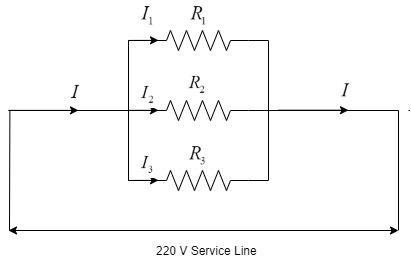
From the circuit diagram, it is clear that the main branch current $I$ branches into three smaller branch currents through the resistors namely, ${I_1},{I_2}\& {I_3}$. At the end of the branches, they recombine back to form the main branch current $I$.
Thus,
$I = {I_1} + {I_2} + {I_3}$
Adding the values, we get the main branch current as,
$I = 10 + 5 + 3 = 18A$
The current in the main branch is 18 amperes. So, the fuse which will protect them should be able to bear the current of 18 amperes. Thus, the fuse to be used, must have a rating higher than 18 A. In the given question, only one fuse of rating 20 A can be connected here.
Hence, the correct option is Option D.
Note: In household circuits, the appliances and devices are connected in parallel so as to provide to all these appliances, the common voltage of 220 V and also, the fact that in a parallel circuit, failure of one branch does not affect the current flow in the other branches since the main current divides into several branches.
If ${R_1},{R_2},{R_3}...{R_n}$ are individual resistances connected in parallel in the circuit, the net resistance of the circuit,
$\dfrac{1}{R} = \dfrac{1}{{{R_1}}} + \dfrac{1}{{{R_2}}} + \dfrac{1}{{{R_3}}} + .. + \dfrac{1}{{{R_n}}}$
Complete step-by-step answer:
When the resistors are connected in parallel, the net resistance is –
$\dfrac{1}{R} = \dfrac{1}{{{R_1}}} + \dfrac{1}{{{R_2}}} + \dfrac{1}{{{R_3}}} + .. + \dfrac{1}{{{R_n}}}$
In a parallel circuit, the voltage across the parallel branch remains the same but the current divides into several branches depending on the individual values of resistances.
If $V$ is the voltage across the parallel branch and ${R_i}$ is an individual resistor in the parallel circuit, the current flowing through the branch will be:
${I_i} = \dfrac{V}{{{R_i}}}$
In this problem, there are three resistances namely, i) Electric iron, whose resistance is ${R_1}$ and current through it is, ${I_1} = 10A$ ii) Electric toaster, whose resistance is ${R_2}$ and current through it is, ${I_2} = 5A$ iii) Electric refrigerator, whose resistance is ${R_3}$ and current through it is, ${I_3} = 3A$
The circuit diagram looks like this:
From the circuit diagram, it is clear that the main branch current $I$ branches into three smaller branch currents through the resistors namely, ${I_1},{I_2}\& {I_3}$. At the end of the branches, they recombine back to form the main branch current $I$.
Thus,
$I = {I_1} + {I_2} + {I_3}$
Adding the values, we get the main branch current as,
$I = 10 + 5 + 3 = 18A$
The current in the main branch is 18 amperes. So, the fuse which will protect them should be able to bear the current of 18 amperes. Thus, the fuse to be used, must have a rating higher than 18 A. In the given question, only one fuse of rating 20 A can be connected here.
Hence, the correct option is Option D.
Note: In household circuits, the appliances and devices are connected in parallel so as to provide to all these appliances, the common voltage of 220 V and also, the fact that in a parallel circuit, failure of one branch does not affect the current flow in the other branches since the main current divides into several branches.
Recently Updated Pages
Which of the following graphs shows the variation of class 12 physics CBSE

Draw a labelled diagram of the human male reproductive class 12 biology CBSE
Describe the experiment to compare the emf of two cells class 12 physics CBSE
What is standard hydrogen electrode
What is conventional current and electric current class 12 physics CBSE
2Bromopentane is treated with an alcoholic KOH solution class 12 chemistry CBSE
Trending doubts
A member of Simon commission later became Prime Minister class 12 social science CBSE
What is the Full Form of PVC, PET, HDPE, LDPE, PP and PS ?
Differentiate between internal fertilization and external class 12 biology CBSE
Differentiate between lanthanoids and actinoids class 12 chemistry CBSE
Sketch and label the Malpighian body class 12 biology CBSE
State the principle of an ac generator and explain class 12 physics CBSE