




An ammeter reads upto 1 ampere. Its internal resistance is 0.81 ohm. To increase the range to 10 A, the value of the required shunt is
A) $0.03\Omega $
B) $0.3\Omega $
C) $0.9\Omega $
D) $0.09\Omega $
Answer
 Verified
651k+ views
Hint: A shunt is connected parallel to an ammeter in order to enable the ammeter to measure higher currents. So the shunt that is being connected should have a resistance that will allow the ammeter to measure a particular current range.
Complete step by step answer:
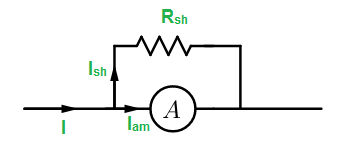
In the problem, it is given that the internal resistance of the ammeter is $0.81\Omega $ and the max current the ammeter can read is 1 ampere. We need to increase this 1 ampere range to 10 A. In order to do that we need to connect a shunt parallel to the ammeter.
Let $\text{I}$ be the maximum current in the range we need to set and ${{i}_{g}}$ be the current flowing through the ammeter. So the current flowing through the shunt is given by $I-{{i}_{g}}$.
Since the ammeter is connected in parallel with the shunt, the voltage drop across each of them is same, so we can write,
${{\text{I}}_{\text{sh}}}{{\text{R}}_{\text{sh}}}={{\text{I}}_{\text{am}}}{{\text{R}}_{\text{am}}}$
${{\text{I}}_{\text{sh}}}$ is the current across the shunt. We have calculated it as $I-{{i}_{g}}$.
${{\text{R}}_{\text{sh}}}$ is the resistance of the shunt. Which we need to find out.
${{\text{I}}_{am}}$ is the current across the ammeter. We have taken it as ${{i}_{g}}$.
${{\text{R}}_{am}}$ is the internal resistance of the ammeter.
So the resistance of the shunt can be written as,
${{R}_{sh}}=\dfrac{{{I}_{am}}{{R}_{am}}}{{{I}_{sh}}}=\dfrac{{{i}_{g}}{{R}_{am}}}{\left( I-{{i}_{g}} \right)}$
Substituting the values of ${{i}_{g}}$,${{\text{I}}_{am}}$,${{\text{R}}_{am}}$ we get,
${{R}_{sh}}=\dfrac{1A\times 0.81\Omega }{\left( 10A-1A \right)}$
${{R}_{sh}}=0.09\Omega $
Note:
In the absence of a shunt, higher current can damage an ammeter which is supposed to measure low currents. Higher currents can produce the heating effect, which will result in the burning of the ammeter coil.
A shunt provides a low resistance path for the current to flow. For proper working, the resistance of the shunt should not change with temperature.
Complete step by step answer:
In the problem, it is given that the internal resistance of the ammeter is $0.81\Omega $ and the max current the ammeter can read is 1 ampere. We need to increase this 1 ampere range to 10 A. In order to do that we need to connect a shunt parallel to the ammeter.
Let $\text{I}$ be the maximum current in the range we need to set and ${{i}_{g}}$ be the current flowing through the ammeter. So the current flowing through the shunt is given by $I-{{i}_{g}}$.
Since the ammeter is connected in parallel with the shunt, the voltage drop across each of them is same, so we can write,
${{\text{I}}_{\text{sh}}}{{\text{R}}_{\text{sh}}}={{\text{I}}_{\text{am}}}{{\text{R}}_{\text{am}}}$
${{\text{I}}_{\text{sh}}}$ is the current across the shunt. We have calculated it as $I-{{i}_{g}}$.
${{\text{R}}_{\text{sh}}}$ is the resistance of the shunt. Which we need to find out.
${{\text{I}}_{am}}$ is the current across the ammeter. We have taken it as ${{i}_{g}}$.
${{\text{R}}_{am}}$ is the internal resistance of the ammeter.
So the resistance of the shunt can be written as,
${{R}_{sh}}=\dfrac{{{I}_{am}}{{R}_{am}}}{{{I}_{sh}}}=\dfrac{{{i}_{g}}{{R}_{am}}}{\left( I-{{i}_{g}} \right)}$
Substituting the values of ${{i}_{g}}$,${{\text{I}}_{am}}$,${{\text{R}}_{am}}$ we get,
${{R}_{sh}}=\dfrac{1A\times 0.81\Omega }{\left( 10A-1A \right)}$
${{R}_{sh}}=0.09\Omega $
Note:
In the absence of a shunt, higher current can damage an ammeter which is supposed to measure low currents. Higher currents can produce the heating effect, which will result in the burning of the ammeter coil.
A shunt provides a low resistance path for the current to flow. For proper working, the resistance of the shunt should not change with temperature.
Recently Updated Pages
Basicity of sulphurous acid and sulphuric acid are

Master Class 12 Economics: Engaging Questions & Answers for Success
Master Class 12 Biology: Engaging Questions & Answers for Success
Master Class 11 English: Engaging Questions & Answers for Success
Master Class 11 Physics: Engaging Questions & Answers for Success
Master Class 11 Computer Science: Engaging Questions & Answers for Success
Trending doubts
Draw a labelled sketch of the human eye class 12 physics CBSE
The chemical formula of tear gas is A CO Cl 2 B C 10 class 12 chemistry CBSE
Draw ray diagrams each showing i myopic eye and ii class 12 physics CBSE
Which are the Top 10 Largest Countries of the World?
Differentiate between homogeneous and heterogeneous class 12 chemistry CBSE
Which is the correct genotypic ratio of mendel dihybrid class 12 biology CBSE