




An air bubble of radius r in water is at a depth h below the water surface. If P is atmospheric pressure and d and T are the density and surface tension of water respectively. The pressure inside the bubble will be:
(a). $P+hdg-\dfrac{4T}{r}$
(b). $P+hdg+\dfrac{2T}{r}$
(c). $P+hdg-\dfrac{2T}{r}$
(d). $P+hdg+\dfrac{4T}{r}$
Answer
 Verified
660.3k+ views
Hint: As the bubble is inside the water, the outside pressures which will act on it is the atmospheric pressure and the pressure due to the water column. And as the surface of the water bubble is convex in shape signifies that the pressure inside the bubble is more than outside. So, net pressure inside the bubble will be the sum total if outside pressure and the excess pressure inside the bubble.
Formulae used:
Excess pressure inside an air bubble inside a fluid $=\dfrac{2T}{R}$, where T is the surface tension and R is the radius of the bubble.
Pressure due to a liquid column of density $\rho$ and column height h, $=\rho g h$, where g is the acceleration due to gravity.
Complete step-by-step answer:
We have been given that an air bubble of radius r is at a depth h below the surface of water having density d and surface tension T.
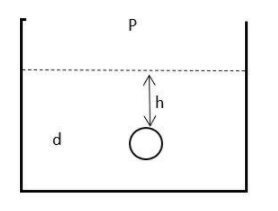
Since the air bubble have a convex surface from outside, so we can find the excess pressure inside it using the formula ${P}_{ex}=\dfrac{2T}{R}$, where T is the surface tension of water and R is the radius of the bubble.
Let us consider the pressure outside the bubble to be ${P}_{o}$ which will be the sum total of the atmospheric pressure and the pressure due to the water column of height h. Therefore, ${P}_{o}=P+hdg$
Consider the pressure inside the bubble be ${P}_{i}$ and as the surface of the bubble is convex, we can write the equation,
${P}_{i}-{P}_{o}={P}_{ex}\implies {P}_{i}={P}_{ex}+{P}_{o}=P+hdg+\dfrac{2T}{R}$
Hence, option b is the correct answer.
Additional information: A soap bubble inside a soap solution has one surface unless it is in air, where it has two surfaces. So, the excess pressure inside a soap bubble is $\dfrac{4T}{R}$, where T is the surface tension and R is the radius of the bubble.
Note: Confusion may happen while finding the excess pressure inside a bubble, so we should see in the question carefully whether it has been given a soap bubble or air bubble and medium surrounding the bubble.
Formulae used:
Excess pressure inside an air bubble inside a fluid $=\dfrac{2T}{R}$, where T is the surface tension and R is the radius of the bubble.
Pressure due to a liquid column of density $\rho$ and column height h, $=\rho g h$, where g is the acceleration due to gravity.
Complete step-by-step answer:
We have been given that an air bubble of radius r is at a depth h below the surface of water having density d and surface tension T.
Since the air bubble have a convex surface from outside, so we can find the excess pressure inside it using the formula ${P}_{ex}=\dfrac{2T}{R}$, where T is the surface tension of water and R is the radius of the bubble.
Let us consider the pressure outside the bubble to be ${P}_{o}$ which will be the sum total of the atmospheric pressure and the pressure due to the water column of height h. Therefore, ${P}_{o}=P+hdg$
Consider the pressure inside the bubble be ${P}_{i}$ and as the surface of the bubble is convex, we can write the equation,
${P}_{i}-{P}_{o}={P}_{ex}\implies {P}_{i}={P}_{ex}+{P}_{o}=P+hdg+\dfrac{2T}{R}$
Hence, option b is the correct answer.
Additional information: A soap bubble inside a soap solution has one surface unless it is in air, where it has two surfaces. So, the excess pressure inside a soap bubble is $\dfrac{4T}{R}$, where T is the surface tension and R is the radius of the bubble.
Note: Confusion may happen while finding the excess pressure inside a bubble, so we should see in the question carefully whether it has been given a soap bubble or air bubble and medium surrounding the bubble.
Recently Updated Pages
Explain the structure of megasporangium class 12 biology CBSE

Why is chloroform kept in dark coloured bottles class 12 chemistry CBSE
Derive the balancing condition of a Wheatstone bri class 12 physics CBSE
Draw VI characteristics of a pn junction diode Explain class 12 physics CBSE
Is it possible to carry pride in ones language too class 12 english CBSE
In a population at Hardy Weinberg equilibrium the allele class 12 biology CBSE
Trending doubts
Draw a labelled sketch of the human eye class 12 physics CBSE
Which are the Top 10 Largest Countries of the World?
Draw ray diagrams each showing i myopic eye and ii class 12 physics CBSE
Which is the correct genotypic ratio of mendel dihybrid class 12 biology CBSE
Differentiate between homogeneous and heterogeneous class 12 chemistry CBSE
Which animal never drinks water in its entire life class 12 biology CBSE