




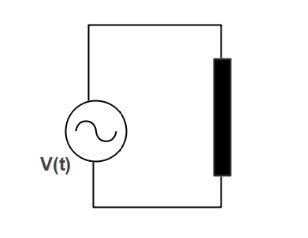
An AC voltage source is connected to a “Blackbox” which contains a circuit as shown in figure. The elements in the circuit and their arrangement, however, are unknown. Measurements outside the black box provide the following information.
$V(t) = (80V) sin wt$
$I(t) = (1.6A) sin\left( wt + \dfrac{\pi}{4} \right)$
Based on the above information we can infer:
a) The circuit is largely capacitive.
b) The circuit in the black box is in resonance.
c) The box must contain at least one resistor and one capacitor.
d) The average power delivered to the black box by the AC source is $45.25 $W.
Answer
 Verified
510.3k+ views
Hint: In circuits with essentially capacitive loads, current leads to the voltage. Current must first move to the two plates of the capacitor, where a charge is collected. Only after charge stores at the plates of a capacitor is a voltage difference set.
Complete step-by-step solution:
Given: $V(t) = (80V) sin wt$
$I(t) = (1.6A) sin\left( wt + \dfrac{\pi}{4} \right)$
As we can see, current leads to voltage.
This circuit is capacitive.
The black box contains at least one resistor and capacitor.
$\lt P_{av} \gt = \dfrac{V_{m} I_{m}}{2}$
We have, $V_{m} = 80V$
$I_{m} = 1.6A$
Put all the given values,
$\lt P_{av} \gt = \dfrac{80 \times 1.6}{2} cos\dfrac{\pi}{4}$
$\implies \lt P_{av} \gt = 45.25 W$
When capacitors are combined across a direct current DC voltage, their plates charge to the voltage value crossed; the capacitor is equal to that of the externally connected voltage. The capacitor will operate this charge regularly, acting as a transient storage device as long as the implemented voltage is kept.
Note:The movement of electrons onto the plates of a capacitor is directly proportional to the rate of change of the voltage across those plates. Then, we can observe that capacitors in AC circuits like to move current when the voltage across its plates constantly changes concerning time, such as in AC signals, but it does not like to move current when the implemented voltage is of a constant value DC signals.
Complete step-by-step solution:
Given: $V(t) = (80V) sin wt$
$I(t) = (1.6A) sin\left( wt + \dfrac{\pi}{4} \right)$
As we can see, current leads to voltage.
This circuit is capacitive.
The black box contains at least one resistor and capacitor.
$\lt P_{av} \gt = \dfrac{V_{m} I_{m}}{2}$
We have, $V_{m} = 80V$
$I_{m} = 1.6A$
Put all the given values,
$\lt P_{av} \gt = \dfrac{80 \times 1.6}{2} cos\dfrac{\pi}{4}$
$\implies \lt P_{av} \gt = 45.25 W$
When capacitors are combined across a direct current DC voltage, their plates charge to the voltage value crossed; the capacitor is equal to that of the externally connected voltage. The capacitor will operate this charge regularly, acting as a transient storage device as long as the implemented voltage is kept.
Note:The movement of electrons onto the plates of a capacitor is directly proportional to the rate of change of the voltage across those plates. Then, we can observe that capacitors in AC circuits like to move current when the voltage across its plates constantly changes concerning time, such as in AC signals, but it does not like to move current when the implemented voltage is of a constant value DC signals.
Recently Updated Pages
Master Class 12 Economics: Engaging Questions & Answers for Success

Master Class 12 Physics: Engaging Questions & Answers for Success
Master Class 12 English: Engaging Questions & Answers for Success
Master Class 12 Social Science: Engaging Questions & Answers for Success
Master Class 12 Maths: Engaging Questions & Answers for Success
Master Class 12 Business Studies: Engaging Questions & Answers for Success
Trending doubts
Which are the Top 10 Largest Countries of the World?
What are the major means of transport Explain each class 12 social science CBSE
Draw a labelled sketch of the human eye class 12 physics CBSE
Why cannot DNA pass through cell membranes class 12 biology CBSE
Differentiate between insitu conservation and exsitu class 12 biology CBSE
Draw a neat and well labeled diagram of TS of ovary class 12 biology CBSE