




Among cellulose, polyvinyl chloride, nylon, and natural rubber, the polymer in which the following intermolecular force of attraction is weakest?
A) Nylon
B) Polyvinyl chloride
C) Cellulose
D) Natural rubber
Answer
 Verified
593.4k+ views
Hint: The polymers have the same intermolecular forces that we see in small molecules. There are various intermolecular forces between the polymers. Such as dispersion forces, hydrogen bonding, van der Waals’ forces of attraction, etc. The polymers may contain the heteroatoms which increase the dipole interaction.
Complete answer:
Rubber is a naturally occurring polymer. It is obtained as latex from rubber trees.
The natural rubber is a polymer of isoprene (2-methyl buta-1, 3-diene). The structure of the monomer is as below,
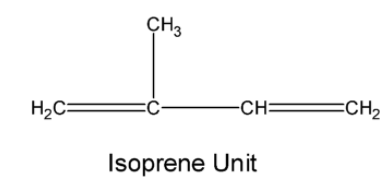
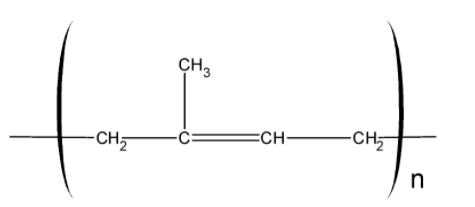
In natural rubber about 11,000 to 20,000 isoprene units are linked together in a chain-like arrangement as shown below:
It may be noted that the natural rubber is a cis-1, 4-polyisoprene and has all cis configuration about the double bond as shown below,
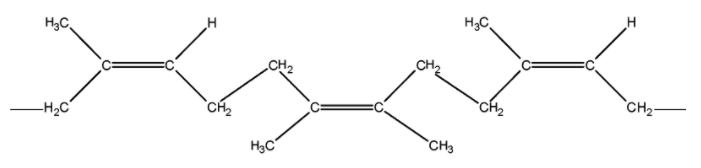
There are weak van der Waals forces and therefore, it is elastic and non-crystalline. It is a long flexible chain.
The natural rubber is made of the carbon C and hydrogen H atoms. It does not have the heteroatoms. Thus, the rubber rubber has a nonpolar $\text{ C}-\text{H }$ bond and has weak van der Waals forces of attraction.
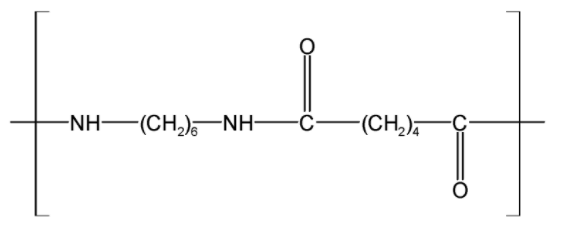
On the other hand, the nylon has a polyamide $\text{ }-\text{CONH}-\text{ }$ linkage in the chain. Due to polyamide linkage, the nylon has a polar bond. These bonds result in the dipole interaction, even hydrogen bonding. One of the simplest nylons is nylon-6, 6.
The monomer unit of a Nylon 6, 6 is as shown below,
Similarly, the cellulose and polyvinyl chloride have the heteroatoms chlorine and oxygen in it. This results in a polar bond and thus increases the attraction between the monomeric units.
The natural rubber has the weakest force of attraction between the monomeric units.
Hence, (C) is the correct option.
Note:
Note that, the cis form of the natural rubber is elastic. However, the Trans configuration has a highly regular zig-zag structure, thus they fit together well. These are highly crystalline and non-elastic because of the strong packing of chains. The extended chain structure.
Complete answer:
Rubber is a naturally occurring polymer. It is obtained as latex from rubber trees.
The natural rubber is a polymer of isoprene (2-methyl buta-1, 3-diene). The structure of the monomer is as below,
In natural rubber about 11,000 to 20,000 isoprene units are linked together in a chain-like arrangement as shown below:
It may be noted that the natural rubber is a cis-1, 4-polyisoprene and has all cis configuration about the double bond as shown below,
There are weak van der Waals forces and therefore, it is elastic and non-crystalline. It is a long flexible chain.
The natural rubber is made of the carbon C and hydrogen H atoms. It does not have the heteroatoms. Thus, the rubber rubber has a nonpolar $\text{ C}-\text{H }$ bond and has weak van der Waals forces of attraction.
On the other hand, the nylon has a polyamide $\text{ }-\text{CONH}-\text{ }$ linkage in the chain. Due to polyamide linkage, the nylon has a polar bond. These bonds result in the dipole interaction, even hydrogen bonding. One of the simplest nylons is nylon-6, 6.
The monomer unit of a Nylon 6, 6 is as shown below,
Similarly, the cellulose and polyvinyl chloride have the heteroatoms chlorine and oxygen in it. This results in a polar bond and thus increases the attraction between the monomeric units.
The natural rubber has the weakest force of attraction between the monomeric units.
Hence, (C) is the correct option.
Note:
Note that, the cis form of the natural rubber is elastic. However, the Trans configuration has a highly regular zig-zag structure, thus they fit together well. These are highly crystalline and non-elastic because of the strong packing of chains. The extended chain structure.
Recently Updated Pages
Basicity of sulphurous acid and sulphuric acid are

Master Class 12 English: Engaging Questions & Answers for Success
Master Class 12 Social Science: Engaging Questions & Answers for Success
Master Class 12 Maths: Engaging Questions & Answers for Success
Master Class 12 Economics: Engaging Questions & Answers for Success
Master Class 12 Physics: Engaging Questions & Answers for Success
Trending doubts
Which are the Top 10 Largest Countries of the World?
Draw a labelled sketch of the human eye class 12 physics CBSE
Which country did Danny Casey play for class 12 english CBSE
Give 10 examples of unisexual and bisexual flowers
Coming together federation is practiced in A India class 12 social science CBSE
Write the formula to find the shortest distance between class 12 maths CBSE