




Among $B{F_3}$, $N{(SiH{}_3)_3}$, $N{(C{H_3})_3}$ ,$O{(Si{H_3})_2}$, $C{F_3}$, $CC{l_3}^ - $the number of molecules or molecular ions which have back bonding is:
A.1
B.3
C.4
D.All
Answer
 Verified
638.7k+ views
Hint: Back bonding is a type of resonance that is exhibited by several chemical compounds. It is known to offer increased stability to chemical compounds. It is also known to affect the overall dipole moment of the molecule and its hybridization
Complete step by step answer:
Back bonding occurs between atoms in a compound in which one atom has a lone pair of electrons and the other has vacant orbital placed adjacent to each other. It makes the molecule stable as it completes the octet.
Now, due to back bonding, there is a decrease in bond length and increase in bond order.
Among the given options, $B{F_3}$ has a trigonal planar structure in which Boron has empty p-orbital and p-orbital of fluorine contains lone pair and hence, boron acts as Lewis acid and fluorine acts as Lewis base. Now, fluorine donates its lone pair to boron and this bonding is called back bonding. The structure is as shown:
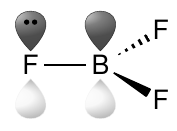
Hence, option A is correct.
Note:
Boron is the least electronegative atom in the $B{F_3}$ Lewis structure and therefore, it goes at the center of the structure. Boron is an exception and only needs six valence electrons in its outer shell. The formal charges for this structure will be zero even though B only had six electrons. This tells us that we have the best Lewis structure of$B{F_3}$.
Complete step by step answer:
Back bonding occurs between atoms in a compound in which one atom has a lone pair of electrons and the other has vacant orbital placed adjacent to each other. It makes the molecule stable as it completes the octet.
Now, due to back bonding, there is a decrease in bond length and increase in bond order.
Among the given options, $B{F_3}$ has a trigonal planar structure in which Boron has empty p-orbital and p-orbital of fluorine contains lone pair and hence, boron acts as Lewis acid and fluorine acts as Lewis base. Now, fluorine donates its lone pair to boron and this bonding is called back bonding. The structure is as shown:
Hence, option A is correct.
Note:
Boron is the least electronegative atom in the $B{F_3}$ Lewis structure and therefore, it goes at the center of the structure. Boron is an exception and only needs six valence electrons in its outer shell. The formal charges for this structure will be zero even though B only had six electrons. This tells us that we have the best Lewis structure of$B{F_3}$.
Recently Updated Pages
Basicity of sulphurous acid and sulphuric acid are

Master Class 11 English: Engaging Questions & Answers for Success
Master Class 11 Physics: Engaging Questions & Answers for Success
Master Class 11 Computer Science: Engaging Questions & Answers for Success
Master Class 11 Chemistry: Engaging Questions & Answers for Success
Master Class 11 Social Science: Engaging Questions & Answers for Success
Trending doubts
Draw a diagram of a plant cell and label at least eight class 11 biology CBSE
Proton was discovered by A Thomson B Rutherford C Chadwick class 11 chemistry CBSE
What is the purity of pure gold in carat class 11 chemistry CBSE
Can anyone list 10 advantages and disadvantages of friction
Lysosomes are known as suicidal bags of cell why class 11 biology CBSE
Derive the equation of motion by the calculus method class 11 physics CBSE