




Ammeter and voltmeter readings were recorded as 0.25A and 0.5V during the experiment to determine the resistance of a given wire using Ohm’s law. The correct value of the resistance is.
Answer
 Verified
620.4k+ views
Hint: Remember that, ammeter is used to measure current and voltmeter for measuring voltage across two points. Hence, we get the values of the voltage and current directly from the question. Now you could recall Ohm’s law and then substitute the given values to get resistance.
Formula used:
Ohm’s law,
$V=IR$
Complete step by step answer:
In every field of physics, we have certain equations that we use so often that it becomes by-heart to us. Ohm’s law is one such equation. This law was named after Georg Ohm who was a German physicist. Ohm’s law states that, the voltage difference between two points is directly proportional to current through a conductor between these two points. That is,
$V\propto I$
$V=IR$ …………………. (1)
Where, R is the constant of proportionality called the resistance. Resistance, by definition, is the opposition offered by the circuit to the flow of current. The SI unit of resistance is Ohm represented by the Greek symbol-$\Omega $. You should note that the R here in his relation is constant, that is it is independent of the current.
Let us now look at the circuit used in experimental setup for proving Ohm’s law.
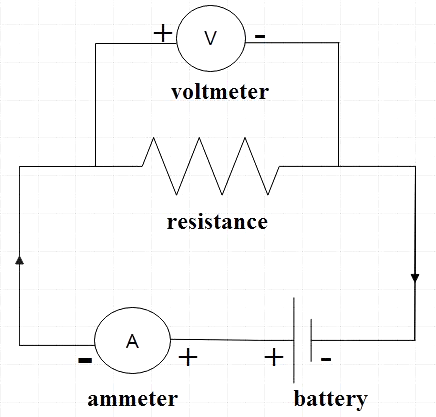
Though we now consider Ohm’s law quite obvious, there was a time when this law was very important among quantitative descriptions of the physics of electricity.
In the question, we are given the readings taken during an experiment based on Ohm’s law. We have readings from ammeter and voltmeter as 0.25A and 0.5V respectively. That is,
Voltage V as per voltmeter reading is,
$V=0.5V$
Current I as per the ammeter reading is,
$I=0.25A$
We could now substitute these values in equation (1).
$R=\dfrac{V}{I}=\dfrac{0.5V}{0.25A}$
$R=2\Omega $
Therefore, we get the resistance in the circuit as $2\Omega .$
Note:
If you knew ammeter and voltmeter is used to measure current and voltage respectively then this question is a very simple substitution problem. In addition, you have to know Ohm’s law to solve this problem which may be by heart now by heart for you. Since volt (V) and ampere (A) are the SI units of voltage and current respectively, you will directly get the resistance in its SI unit, that is, Ohm$\left( \Omega \right)$.
Formula used:
Ohm’s law,
$V=IR$
Complete step by step answer:
In every field of physics, we have certain equations that we use so often that it becomes by-heart to us. Ohm’s law is one such equation. This law was named after Georg Ohm who was a German physicist. Ohm’s law states that, the voltage difference between two points is directly proportional to current through a conductor between these two points. That is,
$V\propto I$
$V=IR$ …………………. (1)
Where, R is the constant of proportionality called the resistance. Resistance, by definition, is the opposition offered by the circuit to the flow of current. The SI unit of resistance is Ohm represented by the Greek symbol-$\Omega $. You should note that the R here in his relation is constant, that is it is independent of the current.
Let us now look at the circuit used in experimental setup for proving Ohm’s law.
Though we now consider Ohm’s law quite obvious, there was a time when this law was very important among quantitative descriptions of the physics of electricity.
In the question, we are given the readings taken during an experiment based on Ohm’s law. We have readings from ammeter and voltmeter as 0.25A and 0.5V respectively. That is,
Voltage V as per voltmeter reading is,
$V=0.5V$
Current I as per the ammeter reading is,
$I=0.25A$
We could now substitute these values in equation (1).
$R=\dfrac{V}{I}=\dfrac{0.5V}{0.25A}$
$R=2\Omega $
Therefore, we get the resistance in the circuit as $2\Omega .$
Note:
If you knew ammeter and voltmeter is used to measure current and voltage respectively then this question is a very simple substitution problem. In addition, you have to know Ohm’s law to solve this problem which may be by heart now by heart for you. Since volt (V) and ampere (A) are the SI units of voltage and current respectively, you will directly get the resistance in its SI unit, that is, Ohm$\left( \Omega \right)$.
Recently Updated Pages
Master Class 12 Business Studies: Engaging Questions & Answers for Success

Master Class 12 Biology: Engaging Questions & Answers for Success
Master Class 12 Chemistry: Engaging Questions & Answers for Success
Class 12 Question and Answer - Your Ultimate Solutions Guide
Master Class 11 English: Engaging Questions & Answers for Success
Master Class 11 Social Science: Engaging Questions & Answers for Success
Trending doubts
Which are the Top 10 Largest Countries of the World?
Draw a labelled sketch of the human eye class 12 physics CBSE
Differentiate between homogeneous and heterogeneous class 12 chemistry CBSE
Why is the cell called the structural and functional class 12 biology CBSE
Draw ray diagrams each showing i myopic eye and ii class 12 physics CBSE
Which is the correct genotypic ratio of mendel dihybrid class 12 biology CBSE