




Alkaline hydrolysis of which among the following compounds leads to the formation of a racemate?
(A) 1-bromo-1-phenylethane
(B) 1-chloro-3-methylbutane
(C) Bromo ethane
(D) 1-chloropropane
Answer
 Verified
601.2k+ views
Hint: The process of converting an optically active (d- or l-) compound refers to the racemization. This racemic modification is related to stereochemical aspects of nucleophilic substitution reactions. The relationship with haloalkanes and alkaline hydrolysis will be explained based on the racemization process.
Complete step by step answer:
Racemate or racemic mixture of a chiral compound that consists of a 50:50 mixture of two enantiomers and the racemization is to become a racemate.
The following reaction represents alkaline hydrolysis of haloalkanes will be:
$RX+KOH\to ROH+HX$
Where R =alkyl group and X = halogens
Apply the above reaction to given haloalkanes,
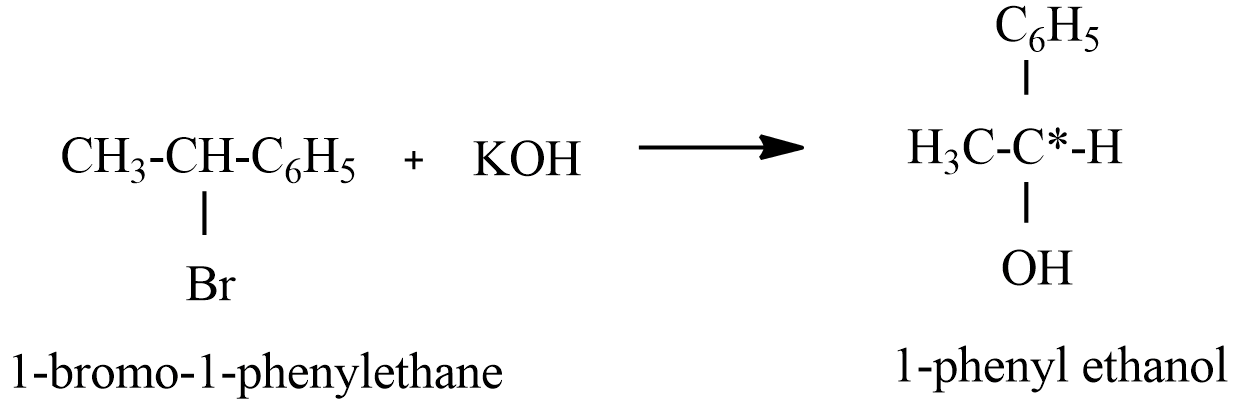
(A) 1-Bromo-1-phenylethane reaction with alkaline KOH
(B) 1-chloro-3-methyl butane reaction with alkaline KOH

(C) Bromo ethane reacts with KOH,
$C{{H}_{3}}C{{H}_{2}}Br+KOH\to C{{H}_{3}}C{{H}_{2}}OH+KBr$
(D) 1-chloro propane involves in alkaline hydrolysis
$C{{H}_{3}}C{{H}_{2}}C{{H}_{2}}Cl+KOH\to C{{H}_{3}}C{{H}_{2}}C{{H}_{2}}OH+KCl$
Since, the products of (B), (C), and (D) do not form Racemate because there is no chiral carbon atom in the products.
The product formed in reaction A having chiral carbon, this hydrolysis will lead to the formation of a racemate or racemic mixture.
Note: The conversation of half of its dextro form into levo form so that the mixture is optically inactive due to the presence of equal amounts of two enantiomers involves the racemization process. This process can be brought by the action of heat, chemical reagents, and autorecemisation. The thermodynamically favorable method is racemization and proceeds spontaneously if a suitable pathway is accessible for the interconversion of the enantiomers.
Complete step by step answer:
Racemate or racemic mixture of a chiral compound that consists of a 50:50 mixture of two enantiomers and the racemization is to become a racemate.
The following reaction represents alkaline hydrolysis of haloalkanes will be:
$RX+KOH\to ROH+HX$
Where R =alkyl group and X = halogens
Apply the above reaction to given haloalkanes,
(A) 1-Bromo-1-phenylethane reaction with alkaline KOH
(B) 1-chloro-3-methyl butane reaction with alkaline KOH
(C) Bromo ethane reacts with KOH,
$C{{H}_{3}}C{{H}_{2}}Br+KOH\to C{{H}_{3}}C{{H}_{2}}OH+KBr$
(D) 1-chloro propane involves in alkaline hydrolysis
$C{{H}_{3}}C{{H}_{2}}C{{H}_{2}}Cl+KOH\to C{{H}_{3}}C{{H}_{2}}C{{H}_{2}}OH+KCl$
Since, the products of (B), (C), and (D) do not form Racemate because there is no chiral carbon atom in the products.
The product formed in reaction A having chiral carbon, this hydrolysis will lead to the formation of a racemate or racemic mixture.
Note: The conversation of half of its dextro form into levo form so that the mixture is optically inactive due to the presence of equal amounts of two enantiomers involves the racemization process. This process can be brought by the action of heat, chemical reagents, and autorecemisation. The thermodynamically favorable method is racemization and proceeds spontaneously if a suitable pathway is accessible for the interconversion of the enantiomers.
Recently Updated Pages
Three beakers labelled as A B and C each containing 25 mL of water were taken A small amount of NaOH anhydrous CuSO4 and NaCl were added to the beakers A B and C respectively It was observed that there was an increase in the temperature of the solutions contained in beakers A and B whereas in case of beaker C the temperature of the solution falls Which one of the following statements isarecorrect i In beakers A and B exothermic process has occurred ii In beakers A and B endothermic process has occurred iii In beaker C exothermic process has occurred iv In beaker C endothermic process has occurred

Master Class 12 Social Science: Engaging Questions & Answers for Success
Master Class 12 Physics: Engaging Questions & Answers for Success
Master Class 12 Maths: Engaging Questions & Answers for Success
Master Class 12 Economics: Engaging Questions & Answers for Success
Master Class 12 Chemistry: Engaging Questions & Answers for Success
Three beakers labelled as A B and C each containing 25 mL of water were taken A small amount of NaOH anhydrous CuSO4 and NaCl were added to the beakers A B and C respectively It was observed that there was an increase in the temperature of the solutions contained in beakers A and B whereas in case of beaker C the temperature of the solution falls Which one of the following statements isarecorrect i In beakers A and B exothermic process has occurred ii In beakers A and B endothermic process has occurred iii In beaker C exothermic process has occurred iv In beaker C endothermic process has occurred
Master Class 12 Social Science: Engaging Questions & Answers for Success
Master Class 12 Physics: Engaging Questions & Answers for Success
Trending doubts
Which are the Top 10 Largest Countries of the World?
Draw a labelled sketch of the human eye class 12 physics CBSE
Differentiate between homogeneous and heterogeneous class 12 chemistry CBSE
What are the major means of transport Explain each class 12 social science CBSE
Sulphuric acid is known as the king of acids State class 12 chemistry CBSE
Why should a magnesium ribbon be cleaned before burning class 12 chemistry CBSE