




Addition of pentavalent impurity to a semiconductor creates many
(A) Free electron
(B) Holes
(C) Valence electrons
(D) Bound electrons
Answer
 Verified
639.3k+ views
Hint:Normally, the pure semiconductor does not conduct electricity, however some of the impurities must be added to donate the free electrons to it for the purpose of the conduction of the electricity. It may cause either n-type conductivity or the p-type conductivity.
Complete step by step answer:
The pure semiconductor has the atoms arranged in such a way that each atom of it is surrounded by the four atoms of itself. This type of arrangement exists because the pure semiconductor has for valence electrons in it. The pentavalent impurities have five valence electrons in it. When this impurity is added to the pure semiconductor, one atom of this impurity forms the bond with the four atoms of the semiconductor with which it is added. Hence the four atoms start bonding and the fifth electron is left free without any bonding.
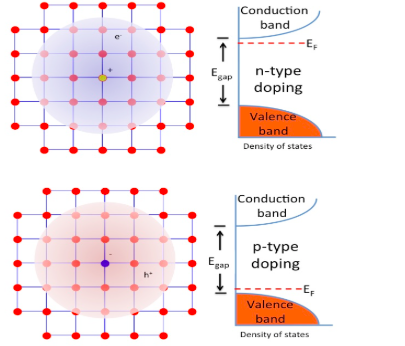
Hence this is known as free electrons that are used for the conduction. Hence when the pentavalent impurity is added with the pure semiconductor, one negative charge will be formed and this is n- type impurity. The semiconductor which joins with the n-type impurity to produce the free electrons are n-type semiconductor. Hence the addition of the pentavalent impurity to a semiconductor produces many free electrons.
Thus the option (A) is correct.
Note:The example of the n-type impurity is phosphorous, arsenic, antimony, bismuth etc. These are added with the pure semiconductors like silicon, germanium etc. The p-type semiconductors have the extra unbounded holes, this result only the trivalent impurity added with pure semiconductor. The example for this is aluminum, boron, indium etc.
Complete step by step answer:
The pure semiconductor has the atoms arranged in such a way that each atom of it is surrounded by the four atoms of itself. This type of arrangement exists because the pure semiconductor has for valence electrons in it. The pentavalent impurities have five valence electrons in it. When this impurity is added to the pure semiconductor, one atom of this impurity forms the bond with the four atoms of the semiconductor with which it is added. Hence the four atoms start bonding and the fifth electron is left free without any bonding.
Hence this is known as free electrons that are used for the conduction. Hence when the pentavalent impurity is added with the pure semiconductor, one negative charge will be formed and this is n- type impurity. The semiconductor which joins with the n-type impurity to produce the free electrons are n-type semiconductor. Hence the addition of the pentavalent impurity to a semiconductor produces many free electrons.
Thus the option (A) is correct.
Note:The example of the n-type impurity is phosphorous, arsenic, antimony, bismuth etc. These are added with the pure semiconductors like silicon, germanium etc. The p-type semiconductors have the extra unbounded holes, this result only the trivalent impurity added with pure semiconductor. The example for this is aluminum, boron, indium etc.
Recently Updated Pages
Which of the following graphs shows the variation of class 12 physics CBSE

Draw a labelled diagram of the human male reproductive class 12 biology CBSE
Describe the experiment to compare the emf of two cells class 12 physics CBSE
What is standard hydrogen electrode
What is conventional current and electric current class 12 physics CBSE
2Bromopentane is treated with an alcoholic KOH solution class 12 chemistry CBSE
Trending doubts
Draw a labelled sketch of the human eye class 12 physics CBSE
Which are the Top 10 Largest Countries of the World?
Differentiate between homogeneous and heterogeneous class 12 chemistry CBSE
Draw ray diagrams each showing i myopic eye and ii class 12 physics CBSE
Which is the correct genotypic ratio of mendel dihybrid class 12 biology CBSE
What is the Full Form of PVC, PET, HDPE, LDPE, PP and PS ?