



What is the acidity order of the following compounds?
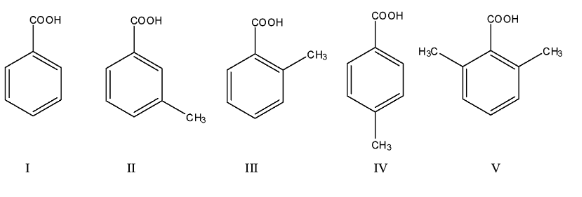
(a)- I > II > III > IV > V
(b)- II > III > IV > V > I
(c)- V > III > I > II > IV
(d)- V > III > II > I > IV
Answer
 Verified
586.2k+ views
Hint: If the benzoic acid has an electron-donating group, then the stability of the carboxylate ion will decrease, so the acidity will decrease. If the benzoic acid has an electron-withdrawing group, then the stability of the carboxylate ion will increase, so the acidity will increase. But the compound is present on the ortho position, then its acidity will be the highest regardless of the nature of the substituent.
Complete step by step answer: If the benzoic acid has an electron-donating group, then the stability of the carboxylate ion will decrease, so the acidity will decrease. If the benzoic acid has an electron-withdrawing group, then the stability of the carboxylate ion will increase, so the acidity will increase. But the compound is present on the ortho position, then its acidity will be the highest regardless of the nature of the substituent, this is known as ortho-effect.
So, in the compounds given above, there are two compounds in which the methyl group is present at the ortho position, i.e., V and III. Since V has two methyl groups at the ortho position, it will be the highest acidic compound. After that, the III will be the most acidic. Now, we know that a methyl group is an electron-donating group, therefore, II and IV are less acidic than I.
The acidic due to methyl group on the benzoic acid is due to the hyperconjugation effect, the hyperconjugation effect at the p-position has left effect than the meta position, therefore, II will be more acidic than IV.
The order will be V > III > I > II > IV.
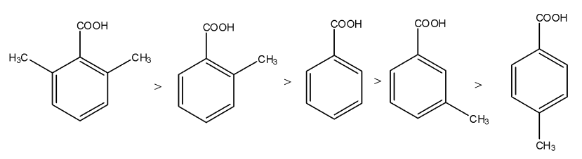
Therefore, the correct answer is an option (c).
Note: If the compounds are not at the ortho position, then the compounds like $N{{O}_{2}}$, Cl, etc will increase the acidity, and compounds like $C{{H}_{3}}$, OH, $OC{{H}_{3}}$, etc will decrease the acidity.
Complete step by step answer: If the benzoic acid has an electron-donating group, then the stability of the carboxylate ion will decrease, so the acidity will decrease. If the benzoic acid has an electron-withdrawing group, then the stability of the carboxylate ion will increase, so the acidity will increase. But the compound is present on the ortho position, then its acidity will be the highest regardless of the nature of the substituent, this is known as ortho-effect.
So, in the compounds given above, there are two compounds in which the methyl group is present at the ortho position, i.e., V and III. Since V has two methyl groups at the ortho position, it will be the highest acidic compound. After that, the III will be the most acidic. Now, we know that a methyl group is an electron-donating group, therefore, II and IV are less acidic than I.
The acidic due to methyl group on the benzoic acid is due to the hyperconjugation effect, the hyperconjugation effect at the p-position has left effect than the meta position, therefore, II will be more acidic than IV.
The order will be V > III > I > II > IV.
Therefore, the correct answer is an option (c).
Note: If the compounds are not at the ortho position, then the compounds like $N{{O}_{2}}$, Cl, etc will increase the acidity, and compounds like $C{{H}_{3}}$, OH, $OC{{H}_{3}}$, etc will decrease the acidity.
Recently Updated Pages
Basicity of sulphurous acid and sulphuric acid are

Master Class 12 Economics: Engaging Questions & Answers for Success
Master Class 12 Biology: Engaging Questions & Answers for Success
Master Class 11 English: Engaging Questions & Answers for Success
Master Class 11 Physics: Engaging Questions & Answers for Success
Master Class 11 Computer Science: Engaging Questions & Answers for Success
Trending doubts
Draw a labelled sketch of the human eye class 12 physics CBSE
The chemical formula of tear gas is A CO Cl 2 B C 10 class 12 chemistry CBSE
Draw ray diagrams each showing i myopic eye and ii class 12 physics CBSE
Which are the Top 10 Largest Countries of the World?
Differentiate between homogeneous and heterogeneous class 12 chemistry CBSE
Which is the correct genotypic ratio of mendel dihybrid class 12 biology CBSE