




Accomplish the following conversions:
(i) Nitrobenzene to benzoic acid
Answer
 Verified
617.4k+ views
Hint: The answer to this question is based on the basic concepts of organic chemistry which includes the reagents used for particular conversions and also the type of reaction that is whether oxidation, reduction or substitution reaction.
Complete step by step answer:
In our classes in organic chemistry, we have studied the named reactions and also several common reactions that include addition reaction, substitution reactions, elimination reactions and so on.
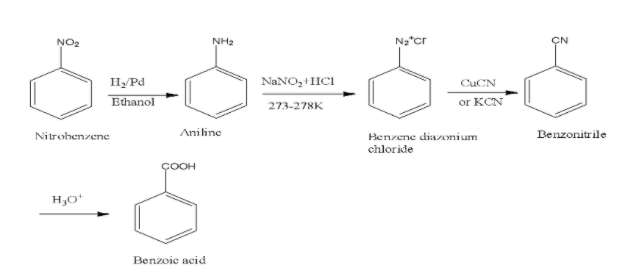
To convert nitrobenzene to benzoic acid, firstly we must know that nitro group is electron withdrawing group and thus it is reduced in first step to aniline with amine group in it in the presence of reducing agent that is \[{{H}_{2}}/Pd\] and then converting it into diazonium salt which when treated with copper cyanide and subsequent hydrolysis yields benzoic acid. The reaction is shown below,
Note: Note that several common oxidising and reducing agents are to be remembered and based on this you will be able to solve any type of such question that involve conversions from one compound to another.
Complete step by step answer:
In our classes in organic chemistry, we have studied the named reactions and also several common reactions that include addition reaction, substitution reactions, elimination reactions and so on.
To convert nitrobenzene to benzoic acid, firstly we must know that nitro group is electron withdrawing group and thus it is reduced in first step to aniline with amine group in it in the presence of reducing agent that is \[{{H}_{2}}/Pd\] and then converting it into diazonium salt which when treated with copper cyanide and subsequent hydrolysis yields benzoic acid. The reaction is shown below,
Note: Note that several common oxidising and reducing agents are to be remembered and based on this you will be able to solve any type of such question that involve conversions from one compound to another.
Recently Updated Pages
Basicity of sulphurous acid and sulphuric acid are

Master Class 12 Economics: Engaging Questions & Answers for Success
Master Class 12 Biology: Engaging Questions & Answers for Success
Master Class 11 English: Engaging Questions & Answers for Success
Master Class 11 Physics: Engaging Questions & Answers for Success
Master Class 11 Computer Science: Engaging Questions & Answers for Success
Trending doubts
Draw a labelled sketch of the human eye class 12 physics CBSE
The chemical formula of tear gas is A CO Cl 2 B C 10 class 12 chemistry CBSE
Draw ray diagrams each showing i myopic eye and ii class 12 physics CBSE
Which are the Top 10 Largest Countries of the World?
Differentiate between homogeneous and heterogeneous class 12 chemistry CBSE
Which is the correct genotypic ratio of mendel dihybrid class 12 biology CBSE