



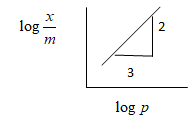
Absorption of a gas follows Freundlich adsorption isotherm $x$ is the mass of the gas adsorbed on mass $m$ of the adsorbent. The plot of $\log \dfrac{x}{m}$ versus $\log p$ is shown in the given graph $\dfrac{x}{m}$ Is proportional to:
a.) ${{P}^{\dfrac{3}{2}}}$
b.) ${{P}^{3}}$
c.) ${{P}^{\dfrac{2}{3}}}$
d.) ${{P}^{2}}$
Answer
 Verified
574.8k+ views
Hint: The relation between $\dfrac{x}{m}$ and $P$ can be shown as $\dfrac{x}{m} = K.{{P}^{\dfrac{1}{n}}}$ ,apply natural log on both sides of the above equation and try to find out the slope of the graph obtained by the equation obtained after applying the log on both sides to find the answer for the above question.
Complete step by step solution:
We are having the relation between $\dfrac{x}{m}$ and $P$ as $\dfrac{x}{m}=K.{{P}^{\dfrac{1}{n}}}$
Apply log on both sides, we obtain the following equation after applying the $\log $
$\log \dfrac{x}{m}=\log K+\dfrac{1}{n}\log P$
The graph of this equation is given as shown in the above diagram, where the slope of the graph of $\log \dfrac{x}{m}versus\log P$ is $\dfrac{1}{n}$ and the intercept is $\log K$
From the above given graph we obtained the slope as $\dfrac{1}{n}=\dfrac{2}{3}$
Put this slope in the above equation of the Freundlich adsorption isotherm
We obtain the final equation using the data given from the above graph is
$\dfrac{x}{m}=K.{{P}^{\dfrac{2}{3}}}$
This shows the relation between $\dfrac{x}{m}$ and $P$ as $\dfrac{x}{m}$ is directly proportional to ${{P}^{\dfrac{2}{3}}}$
So, the correct answer is “Option C”.
Note: From the relation $\dfrac{x}{m}=K.{{P}^{\dfrac{1}{n}}}$ it is a bit complicated to find the value of the power of $P$. We applied natural log on both sides so that we obtain a linear equation which represents the equation of a straight line. By plotting the graph of the equation we can simply calculate the slope which is nothing but the power of $P$ and further putting the value of the slope in the original relation we obtained the required answer. This is one of the easier methods of finding unknowns of this type.
Complete step by step solution:
We are having the relation between $\dfrac{x}{m}$ and $P$ as $\dfrac{x}{m}=K.{{P}^{\dfrac{1}{n}}}$
Apply log on both sides, we obtain the following equation after applying the $\log $
$\log \dfrac{x}{m}=\log K+\dfrac{1}{n}\log P$
The graph of this equation is given as shown in the above diagram, where the slope of the graph of $\log \dfrac{x}{m}versus\log P$ is $\dfrac{1}{n}$ and the intercept is $\log K$
From the above given graph we obtained the slope as $\dfrac{1}{n}=\dfrac{2}{3}$
Put this slope in the above equation of the Freundlich adsorption isotherm
We obtain the final equation using the data given from the above graph is
$\dfrac{x}{m}=K.{{P}^{\dfrac{2}{3}}}$
This shows the relation between $\dfrac{x}{m}$ and $P$ as $\dfrac{x}{m}$ is directly proportional to ${{P}^{\dfrac{2}{3}}}$
So, the correct answer is “Option C”.
Note: From the relation $\dfrac{x}{m}=K.{{P}^{\dfrac{1}{n}}}$ it is a bit complicated to find the value of the power of $P$. We applied natural log on both sides so that we obtain a linear equation which represents the equation of a straight line. By plotting the graph of the equation we can simply calculate the slope which is nothing but the power of $P$ and further putting the value of the slope in the original relation we obtained the required answer. This is one of the easier methods of finding unknowns of this type.
Recently Updated Pages
Master Class 12 Economics: Engaging Questions & Answers for Success

Master Class 12 Physics: Engaging Questions & Answers for Success
Master Class 12 English: Engaging Questions & Answers for Success
Master Class 12 Social Science: Engaging Questions & Answers for Success
Master Class 12 Maths: Engaging Questions & Answers for Success
Master Class 12 Business Studies: Engaging Questions & Answers for Success
Trending doubts
Which are the Top 10 Largest Countries of the World?
What are the major means of transport Explain each class 12 social science CBSE
Draw a labelled sketch of the human eye class 12 physics CBSE
Why cannot DNA pass through cell membranes class 12 biology CBSE
Differentiate between insitu conservation and exsitu class 12 biology CBSE
Draw a neat and well labeled diagram of TS of ovary class 12 biology CBSE