




Above structure is of Auxin that is
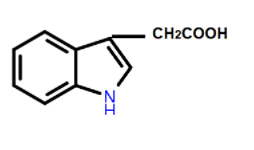
A) IAA
B) Auxin b
C) Auxin a
D) None of the above
Answer
 Verified
587.1k+ views
Hint: Auxins are the phytohormone. They are essential for plants as they regulate the growth and behavioural processes in the life cycle of the plants. The type of auxin shown in the question was isolated and the structure was determined by Kenneth V. Thimann. This auxin generates the majority of growth in the plants and is the most active native auxin.
Complete answer:
To answer this question, we must know the structure of Auxins. Auxins are the phytohormone that is present in almost all the parts of the plant. The growing parts contain a greater concentration of Auxins. All the auxins are organic compound which has aromatic ring and a carboxylic acid group.
Let us discuss the types of Auxins-
i) IAA- It stands for Indole 3 Acetic acid. It is a derivative of indole which has a carboxymethyl group. It is the most potent auxin which is widely present in the plants. It contains an amine group. It is soluble in polar organic solvents. The IAA is synthesised from the precursor molecule that is tryptophan. It is mostly present in the apex of the stem and in very young leaves. It plays a major role in signal transduction and stress tolerance.
ii) Auxin b- It is isolated from corn germ oil by Kogl, Erxlaben and Haagen. It i also called as auxinolonic acid.
iii) Auxin a- It is a carbocyclic compound. It is a derivative of pentonic acid. It is capable of donating hydrogen to acceptor.
Thus the correct answer is option ‘A’.
Note: Auxins are toxic in large concentrations. Other than natural auxins, synthetic auxins are are present which are used as herbicides and are used for controlling weeds. Some examples of synthetic auxins are Naphthalene acetic acid, Indole 3 butyric acid.
Recently Updated Pages
Which will be the least stable resonating structure class 11 chemistry CBSE

How many 5 digit telephone numbers can be construc-class-11-maths-CBSE
How do you find the angle of the resultant vector class 11 physics CBSE
Draw labelled diagram of the following i Gram seed class 11 biology CBSE
1 Quintal is equal to a 110 kg b 10 kg c 100kg d 1000 class 11 physics CBSE
What is the need and importance of classification class 11 biology CBSE
Trending doubts
Find the value of the expression given below sin 30circ class 11 maths CBSE
One Metric ton is equal to kg A 10000 B 1000 C 100 class 11 physics CBSE
10 examples of friction in our daily life
Draw a diagram of a plant cell and label at least eight class 11 biology CBSE
Difference between physical and chemical change class 11 chemistry CBSE
Proton was discovered by A Thomson B Rutherford C Chadwick class 11 chemistry CBSE