




ABCD is a square of side $ 0.2m $ . Point charges of $ + 2 \times {10^{ - 9}}C $ , $ + 4 \times {10^{ - 9}}C $ and $ + 8 \times {10^{ - 9}}C $ are located at the corners A, B and C respectively of the square. What is the work done in transferring a charge of $ + 2 \times {10^{ - 9}}C $ from D to the point of intersection of the diagonals of the square?
Answer
 Verified
627.9k+ views
Hint : To solve this question, we need to find out the potentials at the point D and at the center of the square. Then by calculating the change in potential for the two points, we can calculate the value of work done.
Formula used: The formula which is used to solve this question is given by
$ V = \dfrac{{kq}}{r} $ , here $ V $ is the potential due to a point charge of $ q $ at the point which is at a distance of $ r $ from it.
$ W = q\Delta V $ , here $ W $ is the work done in transferring a charge of $ q $ from one point to the other, between which the potential difference of $ \Delta V $ is there.
Complete step by step answer:
Consider the square ABCD of side $ 0.2m $ on which the three point charges of $ + 2 \times {10^{ - 9}}C $ , $ + 4 \times {10^{ - 9}}C $ and $ + 8 \times {10^{ - 9}}C $ are located.
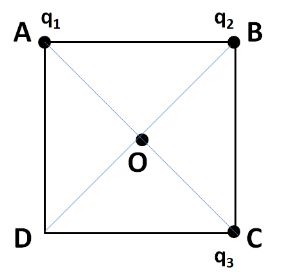
Applying Pythagoras theorem in the triangle AOD we get
$ A{O^2} + D{O^2} = A{D^2} $
We know that in a square, the distance of the centre from each vertex is equal. Therefore substituting $ DO = AO $ we get
$ 2A{O^2} = A{D^2} $
$ \Rightarrow A{O^2} = \dfrac{{A{D^2}}}{2} $
Taking square root both sides
$ AO = \dfrac{{AD}}{{\sqrt 2 }} $
The side of the square is given to be equal to $ 0.2m $ . Therefore we have
$ AO = \dfrac{{0.2}}{{\sqrt 2 }}m $
Therefore we have
$ AO = BO = CO = DO = \dfrac{{0.2}}{{\sqrt 2 }}m $ (1)
Now, we calculate the net potential at the point D.
The potential will be due to all the three charges $ {q_1} $ , $ {q_2} $ and $ {q_3} $ . So it is given by
$ {V_D} = {V_{{q_1}}} + {V_{{q_2}}} + {V_{{q_3}}} $ (2)
We know that the potential due to charge at a point is given by
$ V = \dfrac{{Kq}}{r} $
So from (2) we have
$ {V_D} = \dfrac{{K{q_1}}}{{AD}} + \dfrac{{K{q_2}}}{{BD}} + \dfrac{{K{q_3}}}{{CD}} $
$ \Rightarrow {V_D} = K\left( {\dfrac{{{q_1}}}{{AD}} + \dfrac{{{q_2}}}{{BD}} + \dfrac{{{q_3}}}{{CD}}} \right) $
Since the side of the square is $ 0.2m $ , so $ AD = BD = CD = 0.2m $ . Also according to the qe=uestion we have $ {q_1} = + 2 \times {10^{ - 9}}C $ , $ {q_2} = + 4 \times {10^{ - 9}}C $ , and $ {q_3} = + 8 \times {10^{ - 9}}C $ . Substituting these above we get
$ {V_D} = K\left( {\dfrac{{2 \times {{10}^{ - 9}}}}{{0.2}} + \dfrac{{4 \times {{10}^{ - 9}}}}{{0.2}} + \dfrac{{8 \times {{10}^{ - 9}}}}{{0.2}}} \right) $
$ \Rightarrow {V_D} = \dfrac{{2 \times {{10}^{ - 9}}}}{{0.2}}K\left( {1 + 2 + 4} \right) $
On solving we get
$ {V_D} = 70 \times {10^{ - 9}}K $ (2)
Now, we calculate the potential at the center O.
As stated above, the potential at the center will be due to the charges $ {q_1} $ , $ {q_2} $ and $ {q_3} $ . So it is given by
$ {V_O} = {V_{{q_1}}} + {V_{{q_2}}} + {V_{{q_3}}} $
$ \Rightarrow {V_O} = K\left( {\dfrac{{{q_1}}}{{AO}} + \dfrac{{{q_2}}}{{BO}} + \dfrac{{{q_3}}}{{CO}}} \right) $
From (1) $ AO = BO = CO = \dfrac{{0.2}}{{\sqrt 2 }}m $ . Also $ {q_1} = + 2 \times {10^{ - 9}}C $ , $ {q_2} = + 4 \times {10^{ - 9}}C $ , and $ {q_3} = + 8 \times {10^{ - 9}}C $ . Substituting these above we get
$ {V_O} = K\left( {\dfrac{{2\sqrt 2 \times {{10}^{ - 9}}}}{{0.2}} + \dfrac{{4\sqrt 2 \times {{10}^{ - 9}}}}{{0.2}} + \dfrac{{8\sqrt 2 \times {{10}^{ - 9}}}}{{0.2}}} \right) $
$ \Rightarrow {V_O} = \dfrac{{2\sqrt 2 \times {{10}^{ - 9}}}}{{0.2}}K\left( {1 + 2 + 4} \right) $
On solving we get
$ {V_O} = 70\sqrt 2 \times {10^{ - 9}}K $ (3)
Now, we know that the work done is given by
$ W = q\Delta V $
According to the question, the charge of $ + 2 \times {10^{ - 9}}C $ is transferred from the point D to the point O. So we get
$ W = + 2 \times {10^{ - 9}}\left( {{V_O} - {V_D}} \right) $
From (2) and (3)
$ W = + 2 \times {10^{ - 9}}\left( {70\sqrt 2 \times {{10}^{ - 9}}K - 70 \times {{10}^{ - 9}}K} \right) $
$ \Rightarrow W = 2 \times {10^{ - 9}} \times 70 \times {10^{ - 9}}K\left( {\sqrt 2 - 1} \right) $
Substituting $ K = 9 \times {10^9}\dfrac{{N{m^2}}}{{{C^2}}} $ we get
$ W = 2 \times {10^{ - 9}} \times 70 \times {10^{ - 9}} \times 9 \times {10^9}\left( {\sqrt 2 - 1} \right) $
On solving we get
$ W = 5.22 \times {10^{ - 7}}J $
Hence, the required work done is equal to $ 5.22 \times {10^{ - 7}}J $ .
Note:
This question could also be attempted by considering the system of all the four charges given in the question. Then calculate the potential energy of the system for the two configurations, with the fourth charge of $ + 2 \times {10^{ - 9}}C $ at the point D in the first configuration, and at the center O in the second configuration. Finally, calculating the change in the potential energy of the system, we will get the final answer.
Formula used: The formula which is used to solve this question is given by
$ V = \dfrac{{kq}}{r} $ , here $ V $ is the potential due to a point charge of $ q $ at the point which is at a distance of $ r $ from it.
$ W = q\Delta V $ , here $ W $ is the work done in transferring a charge of $ q $ from one point to the other, between which the potential difference of $ \Delta V $ is there.
Complete step by step answer:
Consider the square ABCD of side $ 0.2m $ on which the three point charges of $ + 2 \times {10^{ - 9}}C $ , $ + 4 \times {10^{ - 9}}C $ and $ + 8 \times {10^{ - 9}}C $ are located.
Applying Pythagoras theorem in the triangle AOD we get
$ A{O^2} + D{O^2} = A{D^2} $
We know that in a square, the distance of the centre from each vertex is equal. Therefore substituting $ DO = AO $ we get
$ 2A{O^2} = A{D^2} $
$ \Rightarrow A{O^2} = \dfrac{{A{D^2}}}{2} $
Taking square root both sides
$ AO = \dfrac{{AD}}{{\sqrt 2 }} $
The side of the square is given to be equal to $ 0.2m $ . Therefore we have
$ AO = \dfrac{{0.2}}{{\sqrt 2 }}m $
Therefore we have
$ AO = BO = CO = DO = \dfrac{{0.2}}{{\sqrt 2 }}m $ (1)
Now, we calculate the net potential at the point D.
The potential will be due to all the three charges $ {q_1} $ , $ {q_2} $ and $ {q_3} $ . So it is given by
$ {V_D} = {V_{{q_1}}} + {V_{{q_2}}} + {V_{{q_3}}} $ (2)
We know that the potential due to charge at a point is given by
$ V = \dfrac{{Kq}}{r} $
So from (2) we have
$ {V_D} = \dfrac{{K{q_1}}}{{AD}} + \dfrac{{K{q_2}}}{{BD}} + \dfrac{{K{q_3}}}{{CD}} $
$ \Rightarrow {V_D} = K\left( {\dfrac{{{q_1}}}{{AD}} + \dfrac{{{q_2}}}{{BD}} + \dfrac{{{q_3}}}{{CD}}} \right) $
Since the side of the square is $ 0.2m $ , so $ AD = BD = CD = 0.2m $ . Also according to the qe=uestion we have $ {q_1} = + 2 \times {10^{ - 9}}C $ , $ {q_2} = + 4 \times {10^{ - 9}}C $ , and $ {q_3} = + 8 \times {10^{ - 9}}C $ . Substituting these above we get
$ {V_D} = K\left( {\dfrac{{2 \times {{10}^{ - 9}}}}{{0.2}} + \dfrac{{4 \times {{10}^{ - 9}}}}{{0.2}} + \dfrac{{8 \times {{10}^{ - 9}}}}{{0.2}}} \right) $
$ \Rightarrow {V_D} = \dfrac{{2 \times {{10}^{ - 9}}}}{{0.2}}K\left( {1 + 2 + 4} \right) $
On solving we get
$ {V_D} = 70 \times {10^{ - 9}}K $ (2)
Now, we calculate the potential at the center O.
As stated above, the potential at the center will be due to the charges $ {q_1} $ , $ {q_2} $ and $ {q_3} $ . So it is given by
$ {V_O} = {V_{{q_1}}} + {V_{{q_2}}} + {V_{{q_3}}} $
$ \Rightarrow {V_O} = K\left( {\dfrac{{{q_1}}}{{AO}} + \dfrac{{{q_2}}}{{BO}} + \dfrac{{{q_3}}}{{CO}}} \right) $
From (1) $ AO = BO = CO = \dfrac{{0.2}}{{\sqrt 2 }}m $ . Also $ {q_1} = + 2 \times {10^{ - 9}}C $ , $ {q_2} = + 4 \times {10^{ - 9}}C $ , and $ {q_3} = + 8 \times {10^{ - 9}}C $ . Substituting these above we get
$ {V_O} = K\left( {\dfrac{{2\sqrt 2 \times {{10}^{ - 9}}}}{{0.2}} + \dfrac{{4\sqrt 2 \times {{10}^{ - 9}}}}{{0.2}} + \dfrac{{8\sqrt 2 \times {{10}^{ - 9}}}}{{0.2}}} \right) $
$ \Rightarrow {V_O} = \dfrac{{2\sqrt 2 \times {{10}^{ - 9}}}}{{0.2}}K\left( {1 + 2 + 4} \right) $
On solving we get
$ {V_O} = 70\sqrt 2 \times {10^{ - 9}}K $ (3)
Now, we know that the work done is given by
$ W = q\Delta V $
According to the question, the charge of $ + 2 \times {10^{ - 9}}C $ is transferred from the point D to the point O. So we get
$ W = + 2 \times {10^{ - 9}}\left( {{V_O} - {V_D}} \right) $
From (2) and (3)
$ W = + 2 \times {10^{ - 9}}\left( {70\sqrt 2 \times {{10}^{ - 9}}K - 70 \times {{10}^{ - 9}}K} \right) $
$ \Rightarrow W = 2 \times {10^{ - 9}} \times 70 \times {10^{ - 9}}K\left( {\sqrt 2 - 1} \right) $
Substituting $ K = 9 \times {10^9}\dfrac{{N{m^2}}}{{{C^2}}} $ we get
$ W = 2 \times {10^{ - 9}} \times 70 \times {10^{ - 9}} \times 9 \times {10^9}\left( {\sqrt 2 - 1} \right) $
On solving we get
$ W = 5.22 \times {10^{ - 7}}J $
Hence, the required work done is equal to $ 5.22 \times {10^{ - 7}}J $ .
Note:
This question could also be attempted by considering the system of all the four charges given in the question. Then calculate the potential energy of the system for the two configurations, with the fourth charge of $ + 2 \times {10^{ - 9}}C $ at the point D in the first configuration, and at the center O in the second configuration. Finally, calculating the change in the potential energy of the system, we will get the final answer.
Recently Updated Pages
Master Class 12 Economics: Engaging Questions & Answers for Success

Master Class 12 Social Science: Engaging Questions & Answers for Success
Master Class 12 English: Engaging Questions & Answers for Success
Master Class 12 Maths: Engaging Questions & Answers for Success
Master Class 12 Physics: Engaging Questions & Answers for Success
Master Class 12 Biology: Engaging Questions & Answers for Success
Trending doubts
Draw a labelled sketch of the human eye class 12 physics CBSE
Which are the Top 10 Largest Countries of the World?
Draw ray diagrams each showing i myopic eye and ii class 12 physics CBSE
Which is the correct genotypic ratio of mendel dihybrid class 12 biology CBSE
Differentiate between homogeneous and heterogeneous class 12 chemistry CBSE
Which animal never drinks water in its entire life class 12 biology CBSE