




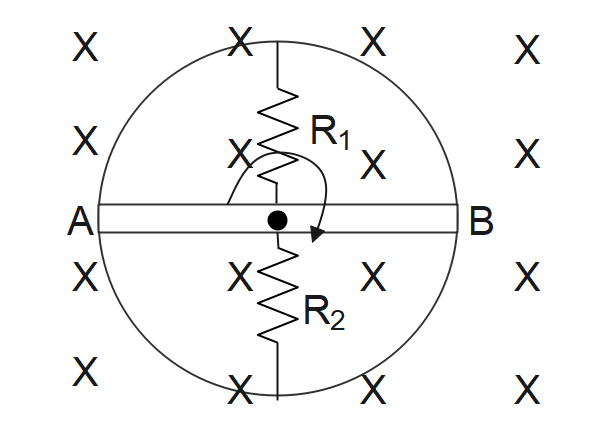
AB is resistanceless conducting rod which forms a diameter of a conducting ring of radius r rotating in a uniform magnetic field B as shown in figure , The resistor ${{R}_{1}}$ and ${{R}_{2}}$ do not rotate. Then the current through the resistor ${{R}_{1}}$ is.
A)$\dfrac{B\omega {{r}^{2}}}{2{{R}_{1}}}$
B)$\dfrac{B\omega {{r}^{2}}}{2{{R}_{2}}}$
C)$\dfrac{B\omega {{r}^{2}}}{2{{R}_{1}}{{R}_{2}}}({{R}_{1}}+{{R}_{2}})$
D)$\dfrac{B\omega {{r}^{2}}}{2({{R}_{1}}+{{R}_{2}})}$
Answer
 Verified
512.4k+ views
Hint : The space around the poles of a magnet is called the magnetic field, and is represented by magnetic lines of force. The force exerted on one magnet by another one, either of attraction or of repulsion is called the magnetic field. According to Coulomb's first law, unlike poles attract each other and like poles repel each other.
Complete step-by-step solution:
A magnetic material exhibits a magnetic field around itself. This field can be visualized in front of lines originating from the north pole of the magnet and ending at the South Pole. These hypothetical lines are called magnetic field lines. The magnetic force is caused by the motion of charges and it is the basic force responsible for attraction and repulsion.
Two magnetic lines of force cannot intersect each other because if two magnetic field lines intersect there will be two directions of magnetic field at that point which is impossible.
From the figure the EMF which is induced between A and center of circle or B is:
$E=\int\limits_{0}^{r}{B(r\omega )dr}=\dfrac{1}{2}B\omega {{r}^{2}}$
This induced EMF is also the potential difference across resistor ${{R}_{1}}$
Therefore $V=E$
Hence $\dfrac{1}{2}B\omega {{r}^{2}}=i{{R}_{1}}$
After simplifying the above equation we get the current that is passing through the resistor${{R}_{1}}$.
$i=\dfrac{B\omega {{r}^{2}}}{2{{R}_{1}}}$
So the correct option is A.
Note: Students magnetic lines of force which originate from a north pole and end at south pole and there cannot exist an isolated north pole or south pole. Magnetic monopoles do not exist in nature. Earth which produces its own magnetic field. Tesla is a unit of magnetic field strength (magnetic flux density).
Complete step-by-step solution:
A magnetic material exhibits a magnetic field around itself. This field can be visualized in front of lines originating from the north pole of the magnet and ending at the South Pole. These hypothetical lines are called magnetic field lines. The magnetic force is caused by the motion of charges and it is the basic force responsible for attraction and repulsion.
Two magnetic lines of force cannot intersect each other because if two magnetic field lines intersect there will be two directions of magnetic field at that point which is impossible.
From the figure the EMF which is induced between A and center of circle or B is:
$E=\int\limits_{0}^{r}{B(r\omega )dr}=\dfrac{1}{2}B\omega {{r}^{2}}$
This induced EMF is also the potential difference across resistor ${{R}_{1}}$
Therefore $V=E$
Hence $\dfrac{1}{2}B\omega {{r}^{2}}=i{{R}_{1}}$
After simplifying the above equation we get the current that is passing through the resistor${{R}_{1}}$.
$i=\dfrac{B\omega {{r}^{2}}}{2{{R}_{1}}}$
So the correct option is A.
Note: Students magnetic lines of force which originate from a north pole and end at south pole and there cannot exist an isolated north pole or south pole. Magnetic monopoles do not exist in nature. Earth which produces its own magnetic field. Tesla is a unit of magnetic field strength (magnetic flux density).
Recently Updated Pages
Master Class 12 Economics: Engaging Questions & Answers for Success

Master Class 12 Physics: Engaging Questions & Answers for Success
Master Class 12 English: Engaging Questions & Answers for Success
Master Class 12 Social Science: Engaging Questions & Answers for Success
Master Class 12 Maths: Engaging Questions & Answers for Success
Master Class 12 Business Studies: Engaging Questions & Answers for Success
Trending doubts
Which are the Top 10 Largest Countries of the World?
What are the major means of transport Explain each class 12 social science CBSE
Draw a labelled sketch of the human eye class 12 physics CBSE
Why cannot DNA pass through cell membranes class 12 biology CBSE
Differentiate between insitu conservation and exsitu class 12 biology CBSE
Draw a neat and well labeled diagram of TS of ovary class 12 biology CBSE