




AB is a potentiometer wire of the length 100cm and the resistance 10ohms. It is connected in the series with the resistance R = 40ohms and a battery of the emf 2V and negligible internal resistance. If a source of the unknown emf E is balanced by the 40cm length of the potentiometer wire, the value of E is:-
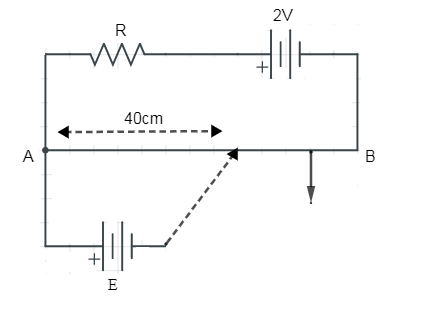
A. 0.8V
B. 1.6V
C. 0.08V
D. 0.16V
Answer
 Verified
560.7k+ views
Hint: In order to solve this question first we have to find the potential gradient then by using potential gradient we will find emf using formula of the potential gradient and emf.
Formula used:
\[\begin{align}
& P.G=\dfrac{V}{L} \\
& E=P.G.l \\
& I=\dfrac{V}{R} \\
& R={{R}_{1}}+{{R}_{2}} \\
\end{align}\]
Complete step by step solution:
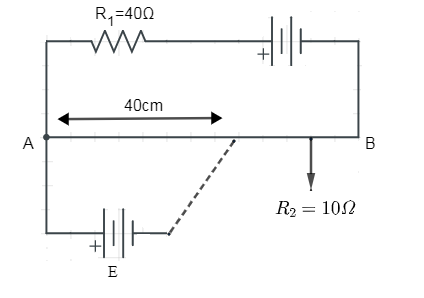
Given data,
Length of the potential wire
L = 100cm
L = 1m (converting cm to m)
Resistance of the potentiometer is ${{R}_{2}}=40\Omega $
Battery emf = V = 2V
Balance length = l = 40cm
$\begin{align}
& l=\dfrac{40}{100}m\left( \text{converting cm to m} \right) \\
& l=0.4m \\
\end{align}$
Now formula for the potential gradient is
$P.G=\dfrac{V}{L}$
We know that,
V = IR
Hence,
$P.G=\dfrac{IR}{L}...\left( 1 \right)$
Where,
P.G. = potential resistance
R = resistance in the potentiometer wire.
L = length of the potentiometer
Now we have to find total current, we know that,
$I=\dfrac{V}{{{\operatorname{R}}_{e}}}...\left( 2 \right)$
Here,
$\begin{align}
& {{\operatorname{R}}_{e}}={{R}_{1}}+{{R}_{2}} \\
& =40+10 \\
& {{R}_{e}}=50\Omega \\
& V=2V \\
\end{align}$
Substituting values in the equation (2) we get,
$I=\dfrac{2}{50}A$
Now to find the emf at 40cm length we have to use potential gradient formula for the 40cm length
$\begin{align}
& P.G.=\dfrac{E}{l} \\
& \therefore E=P.G.\times l....\left( 3 \right) \\
\end{align}$
Substitute formula of the equation (1) in the equation (3)
$E=\dfrac{I{{R}_{2}}}{L}\times l......\left( 4 \right)$
Now put all the values in the equation (4)
$\begin{align}
& \Rightarrow E=\dfrac{2}{50}\dfrac{\times }{\times }\dfrac{10}{1}\times 0.4 \\
& \therefore E=0.16V \\
\end{align}$
Hence, the correct answer is option (D).
Additional information:
Resistance: When current flows through any conductor, the conductor offers some obstruction to the current and this obstruction is known as electrical resistance and is denoted by R.
Resistivity: Electric resistivity is defined as the electrical resistance offered per unit length and unit cross-sectional area at a specific temperature.
It is denoted by $\rho $ .
Note:
First we have to convert the length of the potentiometer from cm to m and when we write an equation for 100cm length then we have to put the values of the resistance as the potentiometer resistance don’t mistaken as total or equivalent resistance of the circuit.
Formula used:
\[\begin{align}
& P.G=\dfrac{V}{L} \\
& E=P.G.l \\
& I=\dfrac{V}{R} \\
& R={{R}_{1}}+{{R}_{2}} \\
\end{align}\]
Complete step by step solution:
Given data,
Length of the potential wire
L = 100cm
L = 1m (converting cm to m)
Resistance of the potentiometer is ${{R}_{2}}=40\Omega $
Battery emf = V = 2V
Balance length = l = 40cm
$\begin{align}
& l=\dfrac{40}{100}m\left( \text{converting cm to m} \right) \\
& l=0.4m \\
\end{align}$
Now formula for the potential gradient is
$P.G=\dfrac{V}{L}$
We know that,
V = IR
Hence,
$P.G=\dfrac{IR}{L}...\left( 1 \right)$
Where,
P.G. = potential resistance
R = resistance in the potentiometer wire.
L = length of the potentiometer
Now we have to find total current, we know that,
$I=\dfrac{V}{{{\operatorname{R}}_{e}}}...\left( 2 \right)$
Here,
$\begin{align}
& {{\operatorname{R}}_{e}}={{R}_{1}}+{{R}_{2}} \\
& =40+10 \\
& {{R}_{e}}=50\Omega \\
& V=2V \\
\end{align}$
Substituting values in the equation (2) we get,
$I=\dfrac{2}{50}A$
Now to find the emf at 40cm length we have to use potential gradient formula for the 40cm length
$\begin{align}
& P.G.=\dfrac{E}{l} \\
& \therefore E=P.G.\times l....\left( 3 \right) \\
\end{align}$
Substitute formula of the equation (1) in the equation (3)
$E=\dfrac{I{{R}_{2}}}{L}\times l......\left( 4 \right)$
Now put all the values in the equation (4)
$\begin{align}
& \Rightarrow E=\dfrac{2}{50}\dfrac{\times }{\times }\dfrac{10}{1}\times 0.4 \\
& \therefore E=0.16V \\
\end{align}$
Hence, the correct answer is option (D).
Additional information:
Resistance: When current flows through any conductor, the conductor offers some obstruction to the current and this obstruction is known as electrical resistance and is denoted by R.
Resistivity: Electric resistivity is defined as the electrical resistance offered per unit length and unit cross-sectional area at a specific temperature.
It is denoted by $\rho $ .
Note:
First we have to convert the length of the potentiometer from cm to m and when we write an equation for 100cm length then we have to put the values of the resistance as the potentiometer resistance don’t mistaken as total or equivalent resistance of the circuit.
Recently Updated Pages
Master Class 12 Economics: Engaging Questions & Answers for Success

Master Class 12 Physics: Engaging Questions & Answers for Success
Master Class 12 English: Engaging Questions & Answers for Success
Master Class 12 Social Science: Engaging Questions & Answers for Success
Master Class 12 Maths: Engaging Questions & Answers for Success
Master Class 12 Business Studies: Engaging Questions & Answers for Success
Trending doubts
Which are the Top 10 Largest Countries of the World?
What are the major means of transport Explain each class 12 social science CBSE
Draw a labelled sketch of the human eye class 12 physics CBSE
Why cannot DNA pass through cell membranes class 12 biology CBSE
Differentiate between insitu conservation and exsitu class 12 biology CBSE
Draw a neat and well labeled diagram of TS of ovary class 12 biology CBSE