




(a) write the IUPAC name and structural formula of methyl n- propyl ether.
(b) give equations for preparations of ether by the following reactions:
(i) dehydration of alcohols
(ii) Williamson synthesis
(c) Write the resonance structures of alkoxy benzene.
Answer
 Verified
599.4k+ views
Hint: IUPAC has made certain norms and standards for naming of compounds. Ethers can be prepared by the removal of water from alcohol. Resonance structures are the possible forms of a compound that have no real existence. Alkoxy benzene is a form of ether.
Complete answer:
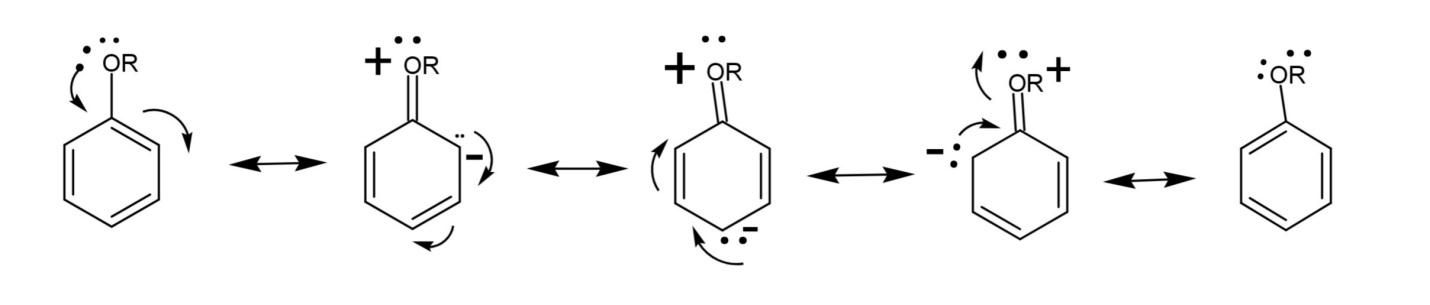
(a)The IUPAC name of methyl n- propyl ether is 1-methoxy propane. It consists of an ether and around this group one methyl and one propyl group, hence its name. the structure of methyl n- propyl ether is,
(b) ethers are prepared by 2 methods,
(i) dehydration of alcohol.
Ethers are prepared by the alcohols, treated with concentrated sulphuric acid at high temperature which acts as a dehydrating agent and removes water molecules. The reaction is:
$C{{H}_{3}}C{{H}_{2}}OH\xrightarrow[413K]{conc.{{H}_{2}}S{{O}_{4}}}C{{H}_{3}}C{{H}_{2}}OC{{H}_{2}}C{{H}_{3}}$
Ethanol on dehydration gives ethoxy ethane.
(ii) Williamson synthesis
This method is the lab method to prepare ethers. It involves the reaction between an alkyl halide and sodium alkoxide to obtain ethers. The reaction followed here is ${{S}_{N}}^{2}$ mechanism for a better yield. The reaction is:
${{C}_{2}}{{H}_{5}}Br+{{C}_{2}}{{H}_{5}}ONa\to {{C}_{2}}{{H}_{5}}-O-{{C}_{2}}{{H}_{5}}+NaBr$
Bromoethane reacts with sodium ethoxide to form ethoxy ethane and sodium bromide.
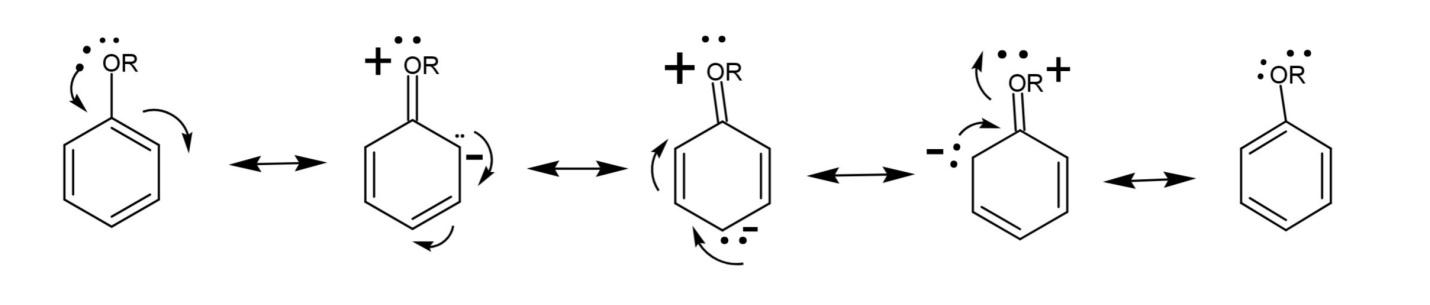
(c) Resonance structures of alkoxy benzene.
Alkoxy benzene has a benzene ring attached with an alkyl group and oxygen, forming an ether. The lone pair on oxygen is in conjugation with the ring, the oxygen atom acquires positive charge, creating partial negative charges on ortho and para positions. The resonance structures are:
Note:
Williamson synthesis is employed to form unsymmetrical as well as symmetrical ethers. When sodium alkoxide used can be of $1{}^\circ ,2{}^\circ ,$ or $3{}^\circ $. For preparing aromatic ethers only sodium phenoxide is used as the reactant. In dehydration of alcohol, the substitution of the alkyl chain from alcohol happens to create the alkyl part of ethers.
Complete answer:
(a)The IUPAC name of methyl n- propyl ether is 1-methoxy propane. It consists of an ether and around this group one methyl and one propyl group, hence its name. the structure of methyl n- propyl ether is,
(b) ethers are prepared by 2 methods,
(i) dehydration of alcohol.
Ethers are prepared by the alcohols, treated with concentrated sulphuric acid at high temperature which acts as a dehydrating agent and removes water molecules. The reaction is:
$C{{H}_{3}}C{{H}_{2}}OH\xrightarrow[413K]{conc.{{H}_{2}}S{{O}_{4}}}C{{H}_{3}}C{{H}_{2}}OC{{H}_{2}}C{{H}_{3}}$
Ethanol on dehydration gives ethoxy ethane.
(ii) Williamson synthesis
This method is the lab method to prepare ethers. It involves the reaction between an alkyl halide and sodium alkoxide to obtain ethers. The reaction followed here is ${{S}_{N}}^{2}$ mechanism for a better yield. The reaction is:
${{C}_{2}}{{H}_{5}}Br+{{C}_{2}}{{H}_{5}}ONa\to {{C}_{2}}{{H}_{5}}-O-{{C}_{2}}{{H}_{5}}+NaBr$
Bromoethane reacts with sodium ethoxide to form ethoxy ethane and sodium bromide.
(c) Resonance structures of alkoxy benzene.
Alkoxy benzene has a benzene ring attached with an alkyl group and oxygen, forming an ether. The lone pair on oxygen is in conjugation with the ring, the oxygen atom acquires positive charge, creating partial negative charges on ortho and para positions. The resonance structures are:
Note:
Williamson synthesis is employed to form unsymmetrical as well as symmetrical ethers. When sodium alkoxide used can be of $1{}^\circ ,2{}^\circ ,$ or $3{}^\circ $. For preparing aromatic ethers only sodium phenoxide is used as the reactant. In dehydration of alcohol, the substitution of the alkyl chain from alcohol happens to create the alkyl part of ethers.
Recently Updated Pages
Which of the following graphs shows the variation of class 12 physics CBSE

Draw a labelled diagram of the human male reproductive class 12 biology CBSE
Describe the experiment to compare the emf of two cells class 12 physics CBSE
What is standard hydrogen electrode
What is conventional current and electric current class 12 physics CBSE
2Bromopentane is treated with an alcoholic KOH solution class 12 chemistry CBSE
Trending doubts
Draw a labelled sketch of the human eye class 12 physics CBSE
Which are the Top 10 Largest Countries of the World?
Differentiate between homogeneous and heterogeneous class 12 chemistry CBSE
Draw ray diagrams each showing i myopic eye and ii class 12 physics CBSE
Which is the correct genotypic ratio of mendel dihybrid class 12 biology CBSE
What is the Full Form of PVC, PET, HDPE, LDPE, PP and PS ?