




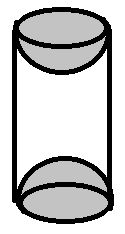
A wooden article was made by scooping out a hemisphere from each end of a solid cylinder, as shown in figure. If the height of the cylinder is 10cm and its base is of radius 3.5cm. Find the total surface area of the article.
Answer
 Verified
689.1k+ views
Hint: As the hemispheres are scooped out, the total surface area will be different in this case. Try to find the curved surface area of the cylinder and two hemispheres using formula $2\pi {{r}^{2}}$ where $r$ is radius, then add to get the desired result.
Complete Step-by-Step solution:
In the given question we are given a wooden article which was made by scooping out a hemisphere from each end of a solid cylinder, with given information about dimensions given that the height of the cylinder is $10cm$ and its base radius is $3.5cm$.
In the figure it is drawn as
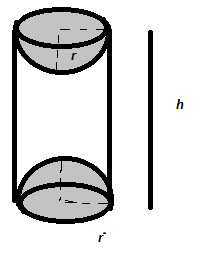
Here $r$ is base radius which is given as $3.5cm$ and $h$ is height of cylinder which is $10cm$.
We are asked to find the surface area of the figure of the cylinder with hemispheres scooped.
Instead of finding total surface area we will find their curved surface which will get the asked result.
So, the curved surface of the cylinder can be found using the formula $2\pi rh$ where ‘$r$’ is the radius of its base and ‘$h$’ is the height of the cylinder.
$\Rightarrow $ As it is given the radius of cylinder is $3.5cm$ and height is 10cm, by using formula $2\pi rh$ we get,
Curved surface area of cylinder
$=2\pi rh$
$=2\times \pi \times 3.5\times 10$
Here putting value of $\pi $ as $\dfrac{22}{7}$ we get,
$=2\times \dfrac{22}{7}\times 3.5\times 10$
$=220c{{m}^{2}}$.
The curved surface of the cylinder is $220c{{m}^{2}}$.
Now we will find curved surface area of ‘1’ hemisphere curve or surface on one of the end of cylinder using formula $2\pi {{r}^{2}}$ where ‘$r$’ is radius of base of cylinder from which is scooped out.
Curved surface of $1$ hemisphere
$=2\pi {{r}^{2}}$
Substituting the values, we get
$=2\pi \times {{\left( 3.5 \right)}^{2}}$
Here putting $\pi $ as $\dfrac{22}{7}$ we get,
$=2\times \dfrac{22}{7}\times \dfrac{49}{4}=77c{{m}^{2}}$
For two hemispheres it will be,
$77\times 2=154c{{m}^{2}}$.
Therefore the total area of wooden article will be sum of all the curved surface area so we get,
Total surface area $=220+154=374c{{m}^{2}}$
Note: Students should be well versed with the formulas of curved surface area of 3D figures, as they are used in the problems. They also should be careful about calculations to avoid many mistakes.
General mistake usually made by students is by seeing the total surface area in the question they apply the surface area formula which will give the wrong result.
Complete Step-by-Step solution:
In the given question we are given a wooden article which was made by scooping out a hemisphere from each end of a solid cylinder, with given information about dimensions given that the height of the cylinder is $10cm$ and its base radius is $3.5cm$.
In the figure it is drawn as
Here $r$ is base radius which is given as $3.5cm$ and $h$ is height of cylinder which is $10cm$.
We are asked to find the surface area of the figure of the cylinder with hemispheres scooped.
Instead of finding total surface area we will find their curved surface which will get the asked result.
So, the curved surface of the cylinder can be found using the formula $2\pi rh$ where ‘$r$’ is the radius of its base and ‘$h$’ is the height of the cylinder.
$\Rightarrow $ As it is given the radius of cylinder is $3.5cm$ and height is 10cm, by using formula $2\pi rh$ we get,
Curved surface area of cylinder
$=2\pi rh$
$=2\times \pi \times 3.5\times 10$
Here putting value of $\pi $ as $\dfrac{22}{7}$ we get,
$=2\times \dfrac{22}{7}\times 3.5\times 10$
$=220c{{m}^{2}}$.
The curved surface of the cylinder is $220c{{m}^{2}}$.
Now we will find curved surface area of ‘1’ hemisphere curve or surface on one of the end of cylinder using formula $2\pi {{r}^{2}}$ where ‘$r$’ is radius of base of cylinder from which is scooped out.
Curved surface of $1$ hemisphere
$=2\pi {{r}^{2}}$
Substituting the values, we get
$=2\pi \times {{\left( 3.5 \right)}^{2}}$
Here putting $\pi $ as $\dfrac{22}{7}$ we get,
$=2\times \dfrac{22}{7}\times \dfrac{49}{4}=77c{{m}^{2}}$
For two hemispheres it will be,
$77\times 2=154c{{m}^{2}}$.
Therefore the total area of wooden article will be sum of all the curved surface area so we get,
Total surface area $=220+154=374c{{m}^{2}}$
Note: Students should be well versed with the formulas of curved surface area of 3D figures, as they are used in the problems. They also should be careful about calculations to avoid many mistakes.
General mistake usually made by students is by seeing the total surface area in the question they apply the surface area formula which will give the wrong result.
Recently Updated Pages
Master Class 10 Computer Science: Engaging Questions & Answers for Success

Differentiate between voluntary action and reflex class 10 biology CBSE
The uses of bleaching powder are A It is used bleaching class 10 chemistry CBSE
Fill in the blanks with abstract nouns of the words class 10 english CBSE
How many threedigit numbers are there class 10 maths CBSE
What is a reflex arc class 10 biology CBSE
Trending doubts
Explain the Treaty of Vienna of 1815 class 10 social science CBSE
10 examples of evaporation in daily life with explanations
What is the full form of POSCO class 10 social science CBSE
Make a sketch of the human nerve cell What function class 10 biology CBSE
GST is a direct or indirect tax?
The sum of all even numbers between 21 and 51 is a class 10 maths CBSE