




A wire of resistance $20\Omega $ is bent to form a closed square. What is the resistance across a diagonal of the square.
Answer
 Verified
560.1k+ views
Hint: Resistance is defined as the property of a conductor to oppose current flow. It is denoted by R. So, in this question we will first find the resistance of all sides of the square and then we will solve the circuit in the manner so that we can get the resistance across the diagonal of the square.
Complete step-by-step answer:
We already know that the number of resistances present depends on how many sides are there in a square. So, we know that a square have 4 sides that-is-why, the wire resistance will be divided by 4.
${{R} ^ {'}} =\dfrac {20} {4} =5\Omega $
Here, R = resistance of a wire
$\therefore $ All sides of square will have a resistance of$5\Omega $.
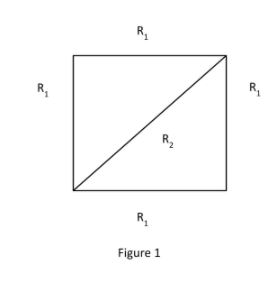
Let, Resistance of all sides of square is R1 and resistance of diagonal of the square be R2 as shown in figure 1.
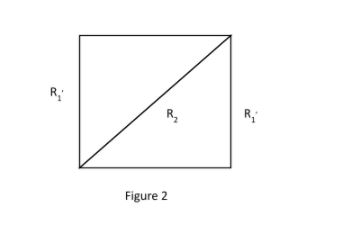
So, by solving figure i.e. by solving 2 resistances in series, we get –
${{R} _ {1}} ^ {'} =\, 5+5=10\Omega $ and,
${{R}_{2}}=\sqrt{{{5}^{2}}+{{5}^{2}}}=5\sqrt{2}$
Now from figure 2, we get to see that the resistances R2 and R1’ are in parallel, so we can write:
$\begin{align}
& \dfrac{1}{R}=\dfrac{1}{{{R}_{1}}}+\dfrac{1}{{{R}_{2}}} \\
& \Rightarrow \dfrac{1}{R}=\dfrac{1}{10}+\dfrac{1}{5\sqrt{2}} \\
& \Rightarrow \dfrac {1} {R} =\dfrac {(\sqrt{2}+\sqrt{2})}{10\times \sqrt{2}} \\
& \Rightarrow \dfrac{1}{R}=\dfrac{2}{10} \\
& \Rightarrow \dfrac{1}{R}=\dfrac{1}{5} \\
& \Rightarrow R=5\Omega \\
\end{align}$
Hence, the resistance of the diagonal of a square will be $R=5\Omega $
Note: We should know the basics of resistance. The most important concept of resistance is its series and parallel operation, we must memorize its formula. In parallel connection of resistances, we add the reciprocal of two or more resistances and in series connection of resistances, we simply add two or more resistances together.
Complete step-by-step answer:
We already know that the number of resistances present depends on how many sides are there in a square. So, we know that a square have 4 sides that-is-why, the wire resistance will be divided by 4.
${{R} ^ {'}} =\dfrac {20} {4} =5\Omega $
Here, R = resistance of a wire
$\therefore $ All sides of square will have a resistance of$5\Omega $.
Let, Resistance of all sides of square is R1 and resistance of diagonal of the square be R2 as shown in figure 1.
So, by solving figure i.e. by solving 2 resistances in series, we get –
${{R} _ {1}} ^ {'} =\, 5+5=10\Omega $ and,
${{R}_{2}}=\sqrt{{{5}^{2}}+{{5}^{2}}}=5\sqrt{2}$
Now from figure 2, we get to see that the resistances R2 and R1’ are in parallel, so we can write:
$\begin{align}
& \dfrac{1}{R}=\dfrac{1}{{{R}_{1}}}+\dfrac{1}{{{R}_{2}}} \\
& \Rightarrow \dfrac{1}{R}=\dfrac{1}{10}+\dfrac{1}{5\sqrt{2}} \\
& \Rightarrow \dfrac {1} {R} =\dfrac {(\sqrt{2}+\sqrt{2})}{10\times \sqrt{2}} \\
& \Rightarrow \dfrac{1}{R}=\dfrac{2}{10} \\
& \Rightarrow \dfrac{1}{R}=\dfrac{1}{5} \\
& \Rightarrow R=5\Omega \\
\end{align}$
Hence, the resistance of the diagonal of a square will be $R=5\Omega $
Note: We should know the basics of resistance. The most important concept of resistance is its series and parallel operation, we must memorize its formula. In parallel connection of resistances, we add the reciprocal of two or more resistances and in series connection of resistances, we simply add two or more resistances together.
Recently Updated Pages
Master Class 12 Business Studies: Engaging Questions & Answers for Success

Master Class 12 Biology: Engaging Questions & Answers for Success
Master Class 12 Chemistry: Engaging Questions & Answers for Success
Class 12 Question and Answer - Your Ultimate Solutions Guide
Master Class 11 Social Science: Engaging Questions & Answers for Success
Master Class 11 English: Engaging Questions & Answers for Success
Trending doubts
Which are the Top 10 Largest Countries of the World?
Draw a labelled sketch of the human eye class 12 physics CBSE
Differentiate between homogeneous and heterogeneous class 12 chemistry CBSE
Sulphuric acid is known as the king of acids State class 12 chemistry CBSE
Why is the cell called the structural and functional class 12 biology CBSE
Which is the correct genotypic ratio of mendel dihybrid class 12 biology CBSE