




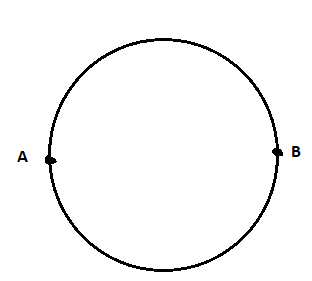
A wire of resistance $12$ ohms per meter is bent to form a complete circle of radius $10\,{\text{cm}}$. The resistance between its two diametrically opposite points, $A$ and $B$ as shown in the figure, is:
A. $6{\Omega}$
B. $0.6{\Omega }$
C. $3{\Omega }$
D. $6\pi {\Omega }$
Answer
 Verified
611.4k+ views
Hint: First of all, we will find out the circumference of the circular wire loop and then will find the total resistance of the loop. The two halves of the circular wire seem to be connected in parallel. We will manipulate accordingly to obtain the result.
Complete step by step answer:
In the given solution, we are supplied with the following data:
The resistance of the wire is given as $12$ ohms per meter.
It is bent to form a complete circle.
The radius of the circle is $10\,{\text{cm}}$ .
We are asked to find out the resistance between the two diametrically opposite points.
To begin with, we will first find the total resistance of the wire. For this we need to find the circumference of the circular wire.
We will now find the circumference of the wire by applying the formula:
$C = 2\pi r$ …… (1)
Where,
$C$ indicates the circumference of the wire.
$r$ indicates the radius of the wire.
For this, first we will convert the unit of the radius which is given in the C.G.S system, to the S.I system.
We know,
$1\,{\text{cm}} = {10^{ - 2}}\,{\text{m}}$
So,
$10\,{\text{cm}} = 10 \times {10^{ - 2}}\,{\text{m}} \\
10\,{\text{cm}} = 0.1\,{\text{m}} \\$
Now, we substitute the required values in the equation (1), we get:
$C = 2\pi r \\
\implies C = 2 \times \pi \times 0.1 \\
\implies C = 0.2\pi \\$
Therefore, the circumference of the circular wire is $0.2\pi $ .
Now we need to find the total resistance of the wire, so we will do the following:
We will multiply the resistance per unit length and the total length to find the total resistance of the wire.
$R = 12 {\Omega }{{\text{m}}^{ - 1}} \times 0.2\,\pi {\text{m}} \\
R = 2.4\pi {\Omega } \\$
Therefore, the total resistance of the wire is found to be $2.4\pi{\Omega }$ .
But when we take the diametrically opposite points then the whole circular wire will be divided into two parts of equal resistance.
So, resistance of each part is:
${R_1} = {R_2} = \dfrac{{2.4\pi {\Omega }}}{2} \\
{R_1} = {R_2} = 1.2\pi {\Omega } \\$
Since, these two parts are parallel about the diameter, so we will apply the formula of equivalent resistance for a parallel connection:
$\dfrac{1}{{{\operatorname{R} _{{\text{eq}}}}}} = \dfrac{1}{{{R_1}}} + \dfrac{1}{{{R_2}}} \\
\dfrac{1}{{{\operatorname{R} _{{\text{eq}}}}}} = \dfrac{1}{{1.2\pi }} + \dfrac{1}{{1.2\pi }} \\
\dfrac{1}{{{\operatorname{R} _{{\text{eq}}}}}} = \dfrac{2}{{1.2\pi }} \\
{\operatorname{R} _{{\text{eq}}}} = \dfrac{{1.2\pi }}{2} \\$
Again, we simplify further and we get:
${\operatorname{R} _{{\text{eq}}}} = 0.6\pi {\Omega }$
Hence, the equivalent resistance between its two diametrically opposite points, $A$ and $B$ is ${\operatorname{R} _{{\text{eq}}}} = 0.6\pi {\Omega }$ .
So, the correct answer is “Option B”.
Note:
Many students tend to make mistakes in choosing the type of connection of the resistance. It is indeed a parallel connection as the two resistances will be at same potential, but however the current flow will be divided into the two branches. Again, the common mistake they do is by choosing the resistance per unit length as the total resistance of the wire loop. Don’t get confused between resistance per unit length and only resistance.
Complete step by step answer:
In the given solution, we are supplied with the following data:
The resistance of the wire is given as $12$ ohms per meter.
It is bent to form a complete circle.
The radius of the circle is $10\,{\text{cm}}$ .
We are asked to find out the resistance between the two diametrically opposite points.
To begin with, we will first find the total resistance of the wire. For this we need to find the circumference of the circular wire.
We will now find the circumference of the wire by applying the formula:
$C = 2\pi r$ …… (1)
Where,
$C$ indicates the circumference of the wire.
$r$ indicates the radius of the wire.
For this, first we will convert the unit of the radius which is given in the C.G.S system, to the S.I system.
We know,
$1\,{\text{cm}} = {10^{ - 2}}\,{\text{m}}$
So,
$10\,{\text{cm}} = 10 \times {10^{ - 2}}\,{\text{m}} \\
10\,{\text{cm}} = 0.1\,{\text{m}} \\$
Now, we substitute the required values in the equation (1), we get:
$C = 2\pi r \\
\implies C = 2 \times \pi \times 0.1 \\
\implies C = 0.2\pi \\$
Therefore, the circumference of the circular wire is $0.2\pi $ .
Now we need to find the total resistance of the wire, so we will do the following:
We will multiply the resistance per unit length and the total length to find the total resistance of the wire.
$R = 12 {\Omega }{{\text{m}}^{ - 1}} \times 0.2\,\pi {\text{m}} \\
R = 2.4\pi {\Omega } \\$
Therefore, the total resistance of the wire is found to be $2.4\pi{\Omega }$ .
But when we take the diametrically opposite points then the whole circular wire will be divided into two parts of equal resistance.
So, resistance of each part is:
${R_1} = {R_2} = \dfrac{{2.4\pi {\Omega }}}{2} \\
{R_1} = {R_2} = 1.2\pi {\Omega } \\$
Since, these two parts are parallel about the diameter, so we will apply the formula of equivalent resistance for a parallel connection:
$\dfrac{1}{{{\operatorname{R} _{{\text{eq}}}}}} = \dfrac{1}{{{R_1}}} + \dfrac{1}{{{R_2}}} \\
\dfrac{1}{{{\operatorname{R} _{{\text{eq}}}}}} = \dfrac{1}{{1.2\pi }} + \dfrac{1}{{1.2\pi }} \\
\dfrac{1}{{{\operatorname{R} _{{\text{eq}}}}}} = \dfrac{2}{{1.2\pi }} \\
{\operatorname{R} _{{\text{eq}}}} = \dfrac{{1.2\pi }}{2} \\$
Again, we simplify further and we get:
${\operatorname{R} _{{\text{eq}}}} = 0.6\pi {\Omega }$
Hence, the equivalent resistance between its two diametrically opposite points, $A$ and $B$ is ${\operatorname{R} _{{\text{eq}}}} = 0.6\pi {\Omega }$ .
So, the correct answer is “Option B”.
Note:
Many students tend to make mistakes in choosing the type of connection of the resistance. It is indeed a parallel connection as the two resistances will be at same potential, but however the current flow will be divided into the two branches. Again, the common mistake they do is by choosing the resistance per unit length as the total resistance of the wire loop. Don’t get confused between resistance per unit length and only resistance.
Recently Updated Pages
Master Class 12 Economics: Engaging Questions & Answers for Success

Master Class 12 English: Engaging Questions & Answers for Success
Master Class 12 Social Science: Engaging Questions & Answers for Success
Master Class 12 Maths: Engaging Questions & Answers for Success
Master Class 12 Physics: Engaging Questions & Answers for Success
Master Class 9 General Knowledge: Engaging Questions & Answers for Success
Trending doubts
Which are the Top 10 Largest Countries of the World?
Draw a labelled sketch of the human eye class 12 physics CBSE
Differentiate between homogeneous and heterogeneous class 12 chemistry CBSE
Sulphuric acid is known as the king of acids State class 12 chemistry CBSE
Why is the cell called the structural and functional class 12 biology CBSE
Draw ray diagrams each showing i myopic eye and ii class 12 physics CBSE