




A wire of resistance $10\,ohm$ is bent in the form of closed circle. What is effective resistance between two points at the end of any diameter of the circle.
A. $0.4\,ohm$
B. $0\,ohm$
C. $2.5\,ohm$
D. $10\,ohm$
Answer
 Verified
595.5k+ views
Hint: The circular wire will be divided into two resistances. Assuming the distribution to be uniform throughout the wire and also uniform area of cross section and uniform resistivity throughout the wire.
The resistance of $10\,ohm$ will be divided into two equal resistance of $5\,\,ohm$ connected in a parallel connection between two endpoints across any diameter of the circular wire in this way the effective resistance can be found out.
Complete step-by-step answer:
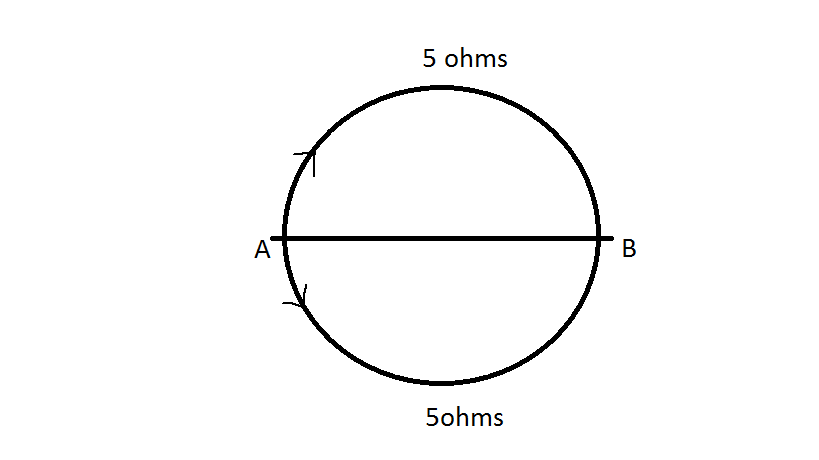
From the figure it is visible that the effective resistance will be a parallel combination of upper and lower resistance each of value 5ohm across the diametrically opposite points $A$ and $B$.
We came to know that the effective combination will be parallel by looking at point $A$ when current will enter point $A$ it will be divided equally into two parts along the upper and lower equal valued resistance.
And we know that current divides in a parallel combination of resistors
The effective combination of two resistance ${{R}_{1}}$and ${{R}_{2}}$ connected in parallel is,
$\dfrac{1}{{{R}_{eff}}}=\dfrac{1}{{{R}_{1}}}+\dfrac{1}{{{R}_{2}}}$
In our case,
${{R}_{1}}=5\,ohm$
${{R}_{2}}=5\,ohm$
Putting the values,
$\dfrac{1}{{{R}_{eff}}}=\dfrac{1}{5}+\dfrac{1}{5}$
$\dfrac{1}{{{R}_{eff}}}=\dfrac{2}{5}$
$\Rightarrow {{R}_{eff}}=2.5\,ohms$
So the correct answer is $2.5\,ohms$ which is option C.
So, the correct answer is “Option C”.
Note: There are many connections in which the resistances can be arranged but two most commonly used are series and parallel connections. Many circuits involves both of series and parallel combinations
Metals generally are good conductors of current and hence have low resistance to the path of current.
Ohm’s law connecting resistance, voltage and current forms most fundamental law for solving electric circuits
The resistance of $10\,ohm$ will be divided into two equal resistance of $5\,\,ohm$ connected in a parallel connection between two endpoints across any diameter of the circular wire in this way the effective resistance can be found out.
Complete step-by-step answer:
From the figure it is visible that the effective resistance will be a parallel combination of upper and lower resistance each of value 5ohm across the diametrically opposite points $A$ and $B$.
We came to know that the effective combination will be parallel by looking at point $A$ when current will enter point $A$ it will be divided equally into two parts along the upper and lower equal valued resistance.
And we know that current divides in a parallel combination of resistors
The effective combination of two resistance ${{R}_{1}}$and ${{R}_{2}}$ connected in parallel is,
$\dfrac{1}{{{R}_{eff}}}=\dfrac{1}{{{R}_{1}}}+\dfrac{1}{{{R}_{2}}}$
In our case,
${{R}_{1}}=5\,ohm$
${{R}_{2}}=5\,ohm$
Putting the values,
$\dfrac{1}{{{R}_{eff}}}=\dfrac{1}{5}+\dfrac{1}{5}$
$\dfrac{1}{{{R}_{eff}}}=\dfrac{2}{5}$
$\Rightarrow {{R}_{eff}}=2.5\,ohms$
So the correct answer is $2.5\,ohms$ which is option C.
So, the correct answer is “Option C”.
Note: There are many connections in which the resistances can be arranged but two most commonly used are series and parallel connections. Many circuits involves both of series and parallel combinations
Metals generally are good conductors of current and hence have low resistance to the path of current.
Ohm’s law connecting resistance, voltage and current forms most fundamental law for solving electric circuits
Recently Updated Pages
Master Class 12 Business Studies: Engaging Questions & Answers for Success

Master Class 12 Biology: Engaging Questions & Answers for Success
Master Class 12 Chemistry: Engaging Questions & Answers for Success
Class 12 Question and Answer - Your Ultimate Solutions Guide
Master Class 11 Social Science: Engaging Questions & Answers for Success
Master Class 11 English: Engaging Questions & Answers for Success
Trending doubts
Which is more stable and why class 12 chemistry CBSE
Which are the Top 10 Largest Countries of the World?
Draw a labelled sketch of the human eye class 12 physics CBSE
Differentiate between homogeneous and heterogeneous class 12 chemistry CBSE
What are the major means of transport Explain each class 12 social science CBSE
Sulphuric acid is known as the king of acids State class 12 chemistry CBSE