




A wire of length $L = 20cm$, is bent into a semi-circular arc. If the two equal halves, of the arc, were each to be uniformly charged with charges $ \pm Q$, $\left| Q \right| = {10^3}{\varepsilon _0}$ coulomb where ${\varepsilon _o}$ is the permittivity (in SI unit) of free space. Find the net electric field at the centre O of the semicircular ark.
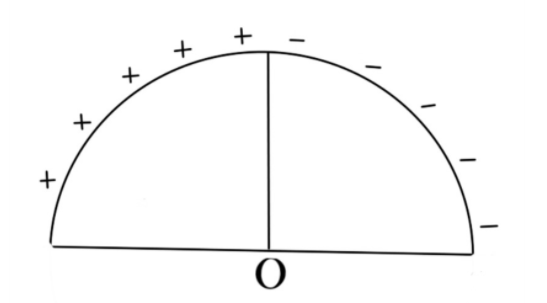
a. $\left( {25 \times {{10}^3}N/C} \right)i$
b. $\left( {25 \times {{10}^3}N/C} \right)j$
c. $\left( {50 \times {{10}^3}N/C} \right)i$
d. $\left( {50 \times {{10}^3}N/C} \right)j$
Answer
 Verified
611.7k+ views
Hint: Use the formula for the electric field by an arc of the loop. Here you have to find the linear charge density by dividing the total charge on the arc to the total length of the arc that is given as L.
Complete step by step answer:
First, we will calculate the electric field by a semicircle.
$E = \dfrac{{2k\lambda }}{r}\sin \dfrac{\theta }{2}$
Where,
$k = \dfrac{1}{{4\pi {\varepsilon _0}}}$
$\lambda = $linear charge density$ = \dfrac{Q}{L} = \dfrac{{2 \times {{10}^3}{\varepsilon _0}}}{{0.2}}C/m$
$r = $radius of loop$ = \dfrac{1}{{5\pi }}$
$L = \pi r \Rightarrow r = \dfrac{L}{\pi } = \dfrac{{0.2}}{\pi }$
$\theta = $arc angle$ = \dfrac{\pi }{2}$
Electric field is given by
$E = \dfrac{{2\dfrac{1}{{4\pi {\varepsilon _0}}}\dfrac{{2 \times {{10}^3}{\varepsilon _0}}}{{0.2}}}}{{\dfrac{1}{{5\pi }}}}\sin \dfrac{\pi }{2}$
$E = 25 \times {10^3}N/C$
We know that, electric field emerges from positive charge and terminates at negative charge. So electric field by positive arc at centre is away from arc and electric field by negative arc at the centre is towards the negative arc as shown in the figure below.
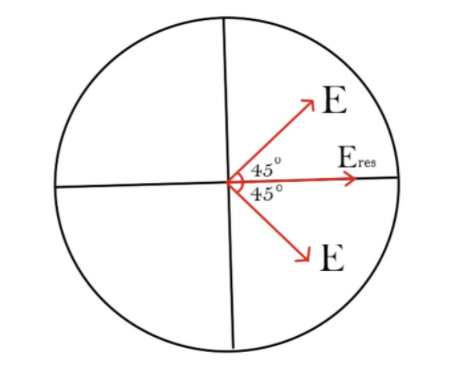
The direction of the resultant electric field is in the positive x direction as shown in the figure.
$E = \left( {25 \times {{10}^3}N/C} \right)i$, is correct
Note: Sometimes students replace the charged arcs with point charges with the same magnitude which is wrong concept because electric field also depends on the distribution of the charge in space.
Complete step by step answer:
First, we will calculate the electric field by a semicircle.
$E = \dfrac{{2k\lambda }}{r}\sin \dfrac{\theta }{2}$
Where,
$k = \dfrac{1}{{4\pi {\varepsilon _0}}}$
$\lambda = $linear charge density$ = \dfrac{Q}{L} = \dfrac{{2 \times {{10}^3}{\varepsilon _0}}}{{0.2}}C/m$
$r = $radius of loop$ = \dfrac{1}{{5\pi }}$
$L = \pi r \Rightarrow r = \dfrac{L}{\pi } = \dfrac{{0.2}}{\pi }$
$\theta = $arc angle$ = \dfrac{\pi }{2}$
Electric field is given by
$E = \dfrac{{2\dfrac{1}{{4\pi {\varepsilon _0}}}\dfrac{{2 \times {{10}^3}{\varepsilon _0}}}{{0.2}}}}{{\dfrac{1}{{5\pi }}}}\sin \dfrac{\pi }{2}$
$E = 25 \times {10^3}N/C$
We know that, electric field emerges from positive charge and terminates at negative charge. So electric field by positive arc at centre is away from arc and electric field by negative arc at the centre is towards the negative arc as shown in the figure below.
The direction of the resultant electric field is in the positive x direction as shown in the figure.
$E = \left( {25 \times {{10}^3}N/C} \right)i$, is correct
Note: Sometimes students replace the charged arcs with point charges with the same magnitude which is wrong concept because electric field also depends on the distribution of the charge in space.
Recently Updated Pages
Master Class 12 Social Science: Engaging Questions & Answers for Success

Master Class 12 Physics: Engaging Questions & Answers for Success
Master Class 12 Maths: Engaging Questions & Answers for Success
Master Class 12 Economics: Engaging Questions & Answers for Success
Master Class 12 Chemistry: Engaging Questions & Answers for Success
Master Class 12 Business Studies: Engaging Questions & Answers for Success
Trending doubts
Which are the Top 10 Largest Countries of the World?
Draw a labelled sketch of the human eye class 12 physics CBSE
Explain the structure of megasporangium class 12 biology CBSE
What are the major means of transport Explain each class 12 social science CBSE
How many chromosomes are found in human ovum a 46 b class 12 biology CBSE
The diagram of the section of a maize grain is given class 12 biology CBSE