




A wire of $3$ ohm resistance and $10cm$ length is stretched to $30cm$ length. Let us assume that it has a uniform cross section, what can be its new resistance?
$\begin{align}
& A.27\Omega \\
& B.9\Omega \\
& C.3\Omega \\
& D.30\Omega \\
\end{align}$
Answer
 Verified
590.7k+ views
Hint: When a wire is stretched into a particular length, both its length as well as the area of cross-section will get changed. Even though its volume will always be constant. The area is given by the volume divided by the length of the wire. Substitute this in the equation of resistance and then find out the relation between the resistance of a wire and the length of the wire. Using this, find the new resistance. These all may help you to solve this question.
Complete step by step answer:
First of all let us mention what all are given in the question. The resistance of the wire originally is given as,
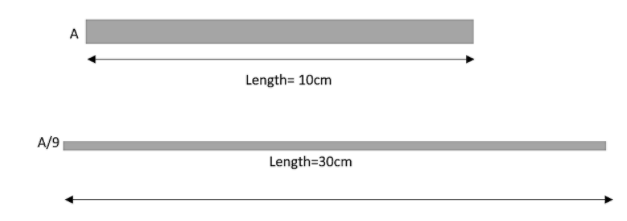
${{R}_{1}}=3\Omega $
Length of the wire at this condition is given as,
${{l}_{1}}=10cm$
In the second condition, the length has been changed where the new length is given as,
${{l}_{2}}=30cm$
This can be written in terms of original length as,
\[{{l}_{2}}=3{{l}_{1}}\]
Even though the length and area of the wire changes, the volume of the wire will remain constant.
The area can be expressed in terms of volume as,
\[A=\dfrac{V}{l}\]
Where \[V\] be the volume of the wire.
The resistance of a wire can be found using the equation,
\[R=\dfrac{\rho l}{A}\]
Where \[\rho \]be the resistivity of material.
Substituting the equation of area in this equation in will give,
\[R=\dfrac{\rho {{l}^{2}}}{V}\]
From this relation as the volume and resistivity are constant, we can see that,
\[R\propto {{l}^{2}}\]
Therefore we can write that,
\[\dfrac{{{R}_{1}}}{{{R}_{2}}}={{\left( \dfrac{{{l}_{1}}}{{{l}_{2}}} \right)}^{2}}\]
As we already mentioned,
\[{{l}_{2}}=3{{l}_{1}}\]
Substituting this in the equation will give,
\[\dfrac{{{R}_{1}}}{{{R}_{2}}}={{\left( \dfrac{{{l}_{1}}}{3{{l}_{1}}} \right)}^{2}}=\dfrac{1}{9}\]
From this we can see that the resistance of the wire increased \[9\]times than the original one. Therefore the final resistance will be,
\[{{R}_{2}}=9{{R}_{1}}=9\times 3=27\Omega \]
Therefore the correct answer is option A.
Note:
The resistance of a wire is a constant for a given area of cross section and length of wire. If the length of wire is increased, then the resistance also gets increased. If the area of the cross section is increased, the resistance will decrease.
Complete step by step answer:
First of all let us mention what all are given in the question. The resistance of the wire originally is given as,
${{R}_{1}}=3\Omega $
Length of the wire at this condition is given as,
${{l}_{1}}=10cm$
In the second condition, the length has been changed where the new length is given as,
${{l}_{2}}=30cm$
This can be written in terms of original length as,
\[{{l}_{2}}=3{{l}_{1}}\]
Even though the length and area of the wire changes, the volume of the wire will remain constant.
The area can be expressed in terms of volume as,
\[A=\dfrac{V}{l}\]
Where \[V\] be the volume of the wire.
The resistance of a wire can be found using the equation,
\[R=\dfrac{\rho l}{A}\]
Where \[\rho \]be the resistivity of material.
Substituting the equation of area in this equation in will give,
\[R=\dfrac{\rho {{l}^{2}}}{V}\]
From this relation as the volume and resistivity are constant, we can see that,
\[R\propto {{l}^{2}}\]
Therefore we can write that,
\[\dfrac{{{R}_{1}}}{{{R}_{2}}}={{\left( \dfrac{{{l}_{1}}}{{{l}_{2}}} \right)}^{2}}\]
As we already mentioned,
\[{{l}_{2}}=3{{l}_{1}}\]
Substituting this in the equation will give,
\[\dfrac{{{R}_{1}}}{{{R}_{2}}}={{\left( \dfrac{{{l}_{1}}}{3{{l}_{1}}} \right)}^{2}}=\dfrac{1}{9}\]
From this we can see that the resistance of the wire increased \[9\]times than the original one. Therefore the final resistance will be,
\[{{R}_{2}}=9{{R}_{1}}=9\times 3=27\Omega \]
Therefore the correct answer is option A.
Note:
The resistance of a wire is a constant for a given area of cross section and length of wire. If the length of wire is increased, then the resistance also gets increased. If the area of the cross section is increased, the resistance will decrease.
Recently Updated Pages
Basicity of sulphurous acid and sulphuric acid are

Master Class 12 English: Engaging Questions & Answers for Success
Master Class 12 Social Science: Engaging Questions & Answers for Success
Master Class 12 Maths: Engaging Questions & Answers for Success
Master Class 12 Economics: Engaging Questions & Answers for Success
Master Class 12 Physics: Engaging Questions & Answers for Success
Trending doubts
Which are the Top 10 Largest Countries of the World?
Draw a labelled sketch of the human eye class 12 physics CBSE
Which state in the country is at the forefront in controlling class 12 social science CBSE
Where is the largest hydroelectric power station located class 12 biology CBSE
Which country did Danny Casey play for class 12 english CBSE
Coming together federation is practiced in A India class 12 social science CBSE