




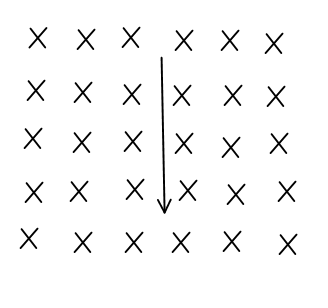
A wire is carrying convention current down a page in a uniform magnetic field that is directed into the page as shown above. What is the direction of the magnetic force on the wire
A) Into the page.
B) Out of the page.
C) To the left.
D) To the right.
E) There is no magnetic force.
Answer
 Verified
610.5k+ views
Hint: The direction of the force experienced by the current-carrying wire can be found by the use of the right-hand rule also it can be determined by the formula of the magnetic force on the current-carrying wire.
Formula used:
The formula of the force on the wire carrying current is given by,
$F = I\left( {\vec l \times \vec B} \right)$
Where $I$ is the current $l$ is the length of wire and $B$ is the magnetic field.
Complete step by step answer:
In this problem, it is given that a wire with current I and length l is under the influence of a magnetic field B and we need to find the direction in which the force on the wire will be experienced.
Since the diagram says that the length is in the direction $ - \hat j$ and the direction of the magnetic field is $ - \hat k$ using this information we can determine the direction in which the wire carrying current will experience force.
As the formula of the force on the wire carrying current is given by,
$F = I\left( {\vec l \times \vec B} \right)$
Where $I$ is the current $l$ is the length of wire and $B$ is the magnetic field.
The magnetic field is equal to $\vec B = - B\hat k$ and the length of the wire is equal to $\vec l = - l\hat j$, therefore, the force equals to,
$ \Rightarrow F = I\left( {\vec l \times \vec B} \right)$
$ \Rightarrow F = I\left( { - l\hat j \times - B\hat k} \right)$
$ \Rightarrow F = I\left( {l\hat j \times B\hat k} \right)$
$ \Rightarrow F = IlB\hat i$
$\therefore $ The force on the wire will be in the right direction. The correct option for this problem is option D.
Note:
The direction of the force applied on the current-carrying wire by an external magnetic field depends on the direction of the flow of the current in the wire and also the direction of the flow of the magnetic field.
Formula used:
The formula of the force on the wire carrying current is given by,
$F = I\left( {\vec l \times \vec B} \right)$
Where $I$ is the current $l$ is the length of wire and $B$ is the magnetic field.
Complete step by step answer:
In this problem, it is given that a wire with current I and length l is under the influence of a magnetic field B and we need to find the direction in which the force on the wire will be experienced.
Since the diagram says that the length is in the direction $ - \hat j$ and the direction of the magnetic field is $ - \hat k$ using this information we can determine the direction in which the wire carrying current will experience force.
As the formula of the force on the wire carrying current is given by,
$F = I\left( {\vec l \times \vec B} \right)$
Where $I$ is the current $l$ is the length of wire and $B$ is the magnetic field.
The magnetic field is equal to $\vec B = - B\hat k$ and the length of the wire is equal to $\vec l = - l\hat j$, therefore, the force equals to,
$ \Rightarrow F = I\left( {\vec l \times \vec B} \right)$
$ \Rightarrow F = I\left( { - l\hat j \times - B\hat k} \right)$
$ \Rightarrow F = I\left( {l\hat j \times B\hat k} \right)$
$ \Rightarrow F = IlB\hat i$
$\therefore $ The force on the wire will be in the right direction. The correct option for this problem is option D.
Note:
The direction of the force applied on the current-carrying wire by an external magnetic field depends on the direction of the flow of the current in the wire and also the direction of the flow of the magnetic field.
Recently Updated Pages
Master Class 12 Business Studies: Engaging Questions & Answers for Success

Master Class 12 Chemistry: Engaging Questions & Answers for Success
Master Class 12 Biology: Engaging Questions & Answers for Success
Class 12 Question and Answer - Your Ultimate Solutions Guide
Master Class 11 Social Science: Engaging Questions & Answers for Success
Master Class 11 Chemistry: Engaging Questions & Answers for Success
Trending doubts
Which are the Top 10 Largest Countries of the World?
Draw a labelled sketch of the human eye class 12 physics CBSE
Name the crygenes that control cotton bollworm and class 12 biology CBSE
Differentiate between homogeneous and heterogeneous class 12 chemistry CBSE
Ribosomal RNA is actively synthesised in A Nucleoplasm class 12 biology CBSE
How many molecules of ATP and NADPH are required information class 12 biology CBSE