




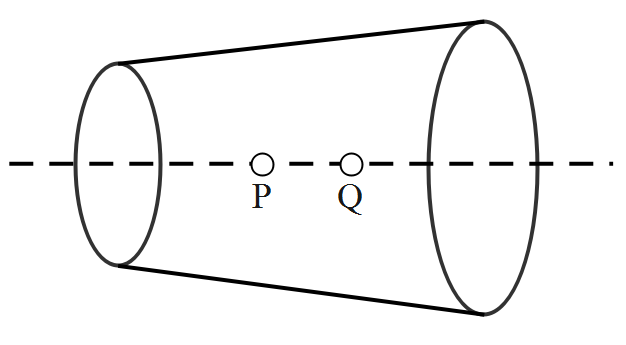
A wire has non-uniform cross-section as shown in figure. A steady current flows through it. The drift speed of electrons at points P and Q is\[{{v}_{P}}\] and\[{{v}_{Q}}\].
Answer
 Verified
598.5k+ views
Hint: The relation between the drift velocity and the area of the conductor is given by the drift velocity formula that is equal to the product of the number of electrons, the electron charge, the drift velocity and the area of the conductor.
Complete step-by-step solution:
Theoretical explanation:
The drift velocity of the electrons is given by the formula as follows.
\[i=nevA\]
The drift speed of electrons is inversely proportional to the radius of cross section.
\[v\propto \dfrac{1}{A}\]
Thus here the cross sectional area at point P is smaller than the cross sectional area at point Q.
\[{{A}_{P}}<{{A}_{Q}}\]
Hence, the drift velocity is large for smaller areas and small for larger areas.
\[\begin{align}
& {{A}_{P}}<{{A}_{Q}} \\
& \therefore {{v}_{P}}>{{v}_{Q}} \\
\end{align}\]
The drift speed will relate as per the relation given below,
\[{{v}_{P}}>{{v}_{Q}}\]
Mathematical representation.
The drift velocity of the electrons is given as follows.
\[i=nevA\]
As the current ‘i’, the number of electrons ‘n’ and the charge on the electron ‘e’ are constant, thus, the relation between the drift velocity and the area of cross section is given as follows.
\[{{v}_{1}}{{A}_{1}}={{v}_{2}}{{A}_{2}}\]
The representation of the above equation in terms of the velocity and the area of P and Q is,
\[{{v}_{P}}{{A}_{P}}={{v}_{Q}}{{A}_{Q}}\]
The area of the cross section of Q is more than that of P.
\[\dfrac{{{v}_{P}}}{{{v}_{Q}}}=\dfrac{{{A}_{Q}}}{{{A}_{P}}}\,\,\,\,\,\,\,({{A}_{Q}}>{{A}_{P}})\]
\[\therefore \dfrac{{{v}_{P}}}{{{v}_{Q}}}>1\]
The drift speed will relate as per the relation given below,
\[\therefore {{v}_{P}}>{{v}_{Q}}\]
\[\therefore \] For the drift speed of electrons at points P and Q is\[{{v}_{P}}\] and\[{{v}_{Q}}\]is, \[{{v}_{P}}>{{v}_{Q}}\].
Note: The only equation or formula that gives the relation between the drift velocity of electrons and the area of cross section is the drift velocity of electrons. The current, the number of electrons and the charge on the electron always remain constant.
Complete step-by-step solution:
Theoretical explanation:
The drift velocity of the electrons is given by the formula as follows.
\[i=nevA\]
The drift speed of electrons is inversely proportional to the radius of cross section.
\[v\propto \dfrac{1}{A}\]
Thus here the cross sectional area at point P is smaller than the cross sectional area at point Q.
\[{{A}_{P}}<{{A}_{Q}}\]
Hence, the drift velocity is large for smaller areas and small for larger areas.
\[\begin{align}
& {{A}_{P}}<{{A}_{Q}} \\
& \therefore {{v}_{P}}>{{v}_{Q}} \\
\end{align}\]
The drift speed will relate as per the relation given below,
\[{{v}_{P}}>{{v}_{Q}}\]
Mathematical representation.
The drift velocity of the electrons is given as follows.
\[i=nevA\]
As the current ‘i’, the number of electrons ‘n’ and the charge on the electron ‘e’ are constant, thus, the relation between the drift velocity and the area of cross section is given as follows.
\[{{v}_{1}}{{A}_{1}}={{v}_{2}}{{A}_{2}}\]
The representation of the above equation in terms of the velocity and the area of P and Q is,
\[{{v}_{P}}{{A}_{P}}={{v}_{Q}}{{A}_{Q}}\]
The area of the cross section of Q is more than that of P.
\[\dfrac{{{v}_{P}}}{{{v}_{Q}}}=\dfrac{{{A}_{Q}}}{{{A}_{P}}}\,\,\,\,\,\,\,({{A}_{Q}}>{{A}_{P}})\]
\[\therefore \dfrac{{{v}_{P}}}{{{v}_{Q}}}>1\]
The drift speed will relate as per the relation given below,
\[\therefore {{v}_{P}}>{{v}_{Q}}\]
\[\therefore \] For the drift speed of electrons at points P and Q is\[{{v}_{P}}\] and\[{{v}_{Q}}\]is, \[{{v}_{P}}>{{v}_{Q}}\].
Note: The only equation or formula that gives the relation between the drift velocity of electrons and the area of cross section is the drift velocity of electrons. The current, the number of electrons and the charge on the electron always remain constant.
Recently Updated Pages
Explain the structure of megasporangium class 12 biology CBSE

Why is chloroform kept in dark coloured bottles class 12 chemistry CBSE
Derive the balancing condition of a Wheatstone bri class 12 physics CBSE
Draw VI characteristics of a pn junction diode Explain class 12 physics CBSE
Is it possible to carry pride in ones language too class 12 english CBSE
In a population at Hardy Weinberg equilibrium the allele class 12 biology CBSE
Trending doubts
Draw a labelled sketch of the human eye class 12 physics CBSE
Which are the Top 10 Largest Countries of the World?
Draw ray diagrams each showing i myopic eye and ii class 12 physics CBSE
One megawatt is equal to how many units of electri class 12 physics CBSE
Which is the correct genotypic ratio of mendel dihybrid class 12 biology CBSE
Give 10 examples of unisexual and bisexual flowers