




A window is in the shape of a rectangle surmounted by a semicircle opening. The total perimeter of the window is $10m$ . Find the dimension of the window to admit maximum through the whole opening.
Answer
 Verified
602.4k+ views
Hint: The word surmounted means it is on top of a rectangular window that has a semi-circle top. If a function is double differentiated then it can give you a maximum or minimum point and the perimeter of the circle is $(\pi r)$ , whereas that of the rectangle is $(length + base)$ .
Complete step-by-step solution:
Given: Perimeter of the window is $10m$ .
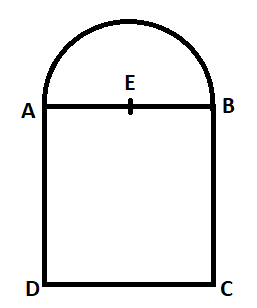
Let the radius of the semi-circle, length and breadth of the rectangle be $r,x$ and $y$ respectively.
Therefore, from the figure we can determine that
$AE = r$
$AB = x = 2r$ , since the semi-circle is mounted over the rectangle ---- (1)
$AD = y$
Now, according to the question,
Perimeter of the window is $10m$.
$
\Rightarrow x + 2y + \pi r = 10 \\
\Rightarrow (2r + \pi r) - 10 = - 2y \\
\Rightarrow 2y = 10 - (\pi + 2)r \\
$
$y = \dfrac{{\left( {10 - (\pi + 2)r} \right)}}{2}$ -------- (2)
To admit the maximum amount of light, the area of the window should be maximum. Assuming the area of the window as, area of the rectangle $+$ area of the semicircle.
$
A = xy + \dfrac{{\pi {r^2}}}{2} \\
\Rightarrow A = (2r)\left( {\dfrac{{10 - (\pi + 2)r}}{2}} \right) + \dfrac{{\pi {r^2}}}{2} \\
\Rightarrow A = 10r - \pi {r^2} - 2{r^2} + \dfrac{{\pi {r^2}}}{2} \\
\Rightarrow A = 10r - 2{r^2} - \dfrac{{\pi {r^2}}}{2} \\
$
Condition for maxima and minima is to differentiate the area,
$
\dfrac{{dA}}{{dr}} = 0 \\
\Rightarrow 10 - 4r - \pi r = 0 \\
\Rightarrow r = \dfrac{{10}}{{4 + \pi }} \\
$
Now, double differentiating the area, we have
$\dfrac{{{d^2}A}}{{d{r^2}}} = - 4 - \pi < 0$
For the $r = \dfrac{{10}}{{(4 + \pi )}}$ , $A$ will be maximum here $A$ stands for area.
Length of the rectangular part $ = \dfrac{{20}}{{(4 + \pi )}}m$ [from equation (1)]
Breadth of the rectangular part \[ = \dfrac{{10 - (\pi + 2)r}}{2}m\] [from equation (2)]
$
\Rightarrow y = \dfrac{{10 - \dfrac{{(\pi + 2)10}}{{4 + \pi }}}}{2} \\
\Rightarrow y = \dfrac{{10}}{{4 + \pi }} \\
$
Thus, the dimension of the window which will admit the maximum amount of light is
$x = \dfrac{{20}}{{4 + \pi }}m$ and $y = \dfrac{{10}}{{4 + \pi }}m$
Note: In this type of questions students often make the mistake that they do not double differentiate and take the area of the rectangle part as $2(x + y)$ which is incorrect. Do not make this mistake.
Complete step-by-step solution:
Given: Perimeter of the window is $10m$ .
Let the radius of the semi-circle, length and breadth of the rectangle be $r,x$ and $y$ respectively.
Therefore, from the figure we can determine that
$AE = r$
$AB = x = 2r$ , since the semi-circle is mounted over the rectangle ---- (1)
$AD = y$
Now, according to the question,
Perimeter of the window is $10m$.
$
\Rightarrow x + 2y + \pi r = 10 \\
\Rightarrow (2r + \pi r) - 10 = - 2y \\
\Rightarrow 2y = 10 - (\pi + 2)r \\
$
$y = \dfrac{{\left( {10 - (\pi + 2)r} \right)}}{2}$ -------- (2)
To admit the maximum amount of light, the area of the window should be maximum. Assuming the area of the window as, area of the rectangle $+$ area of the semicircle.
$
A = xy + \dfrac{{\pi {r^2}}}{2} \\
\Rightarrow A = (2r)\left( {\dfrac{{10 - (\pi + 2)r}}{2}} \right) + \dfrac{{\pi {r^2}}}{2} \\
\Rightarrow A = 10r - \pi {r^2} - 2{r^2} + \dfrac{{\pi {r^2}}}{2} \\
\Rightarrow A = 10r - 2{r^2} - \dfrac{{\pi {r^2}}}{2} \\
$
Condition for maxima and minima is to differentiate the area,
$
\dfrac{{dA}}{{dr}} = 0 \\
\Rightarrow 10 - 4r - \pi r = 0 \\
\Rightarrow r = \dfrac{{10}}{{4 + \pi }} \\
$
Now, double differentiating the area, we have
$\dfrac{{{d^2}A}}{{d{r^2}}} = - 4 - \pi < 0$
For the $r = \dfrac{{10}}{{(4 + \pi )}}$ , $A$ will be maximum here $A$ stands for area.
Length of the rectangular part $ = \dfrac{{20}}{{(4 + \pi )}}m$ [from equation (1)]
Breadth of the rectangular part \[ = \dfrac{{10 - (\pi + 2)r}}{2}m\] [from equation (2)]
$
\Rightarrow y = \dfrac{{10 - \dfrac{{(\pi + 2)10}}{{4 + \pi }}}}{2} \\
\Rightarrow y = \dfrac{{10}}{{4 + \pi }} \\
$
Thus, the dimension of the window which will admit the maximum amount of light is
$x = \dfrac{{20}}{{4 + \pi }}m$ and $y = \dfrac{{10}}{{4 + \pi }}m$
Note: In this type of questions students often make the mistake that they do not double differentiate and take the area of the rectangle part as $2(x + y)$ which is incorrect. Do not make this mistake.
Recently Updated Pages
Master Class 12 Social Science: Engaging Questions & Answers for Success

Master Class 12 Physics: Engaging Questions & Answers for Success
Master Class 12 Maths: Engaging Questions & Answers for Success
Master Class 12 Economics: Engaging Questions & Answers for Success
Master Class 12 Chemistry: Engaging Questions & Answers for Success
Master Class 12 Business Studies: Engaging Questions & Answers for Success
Trending doubts
Which are the Top 10 Largest Countries of the World?
Draw a labelled sketch of the human eye class 12 physics CBSE
Explain the structure of megasporangium class 12 biology CBSE
What are the major means of transport Explain each class 12 social science CBSE
How many chromosomes are found in human ovum a 46 b class 12 biology CBSE
The diagram of the section of a maize grain is given class 12 biology CBSE