




(a) Which physical quantity has its S.I. unit (1) Cm (Coulomb metre) and (2) N/C.
(b) Two point charges q and –q is placed at a distance ‘2a’ apart. Calculate the electric field at a point situated at a distance ‘r’ along the perpendicular bisector of the line joining the charges. What is the electric field when r>>a? Also, give the direction of the electric field w.r.t electric dipole moment?
Answer
 Verified
617.4k+ views
Hint: The S.I. unit plays a very important role in determining the value of a physics quantity. Sometimes they are unique for different physical quantities and sometimes could be the same as well. Also, electric dipole is a setup of two charges in which two charges of equal magnitude are placed at a very small distance from each other.
Formula used:
$E = \dfrac{Kq}{d^2};\ K=\dfrac{1}{4\pi \epsilon_{\circ}}$
Complete step by step answer:
By observing the S.I. units, we can say that
(1) Cm is the product of charge and distance. Hence its S.I. unit of dipole moment.
(2) $\dfrac NC$ is the ratio of S.I. units of Force (N, newton) and charge (C, coulomb). Hence it is the force per unit charge which is the definition of Electric field. Hence it’s the S.I. units of electric field.
Now, we will find the expression for the electric field at the equatorial position of a dipole.
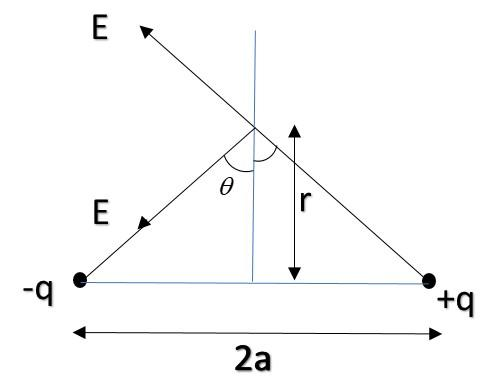
By symmetry, we can say that the field will only be in –x direction and not in y direction.
Now, electric field due to both charges can be resolved as $E_{net}$ as shown in the figure below:
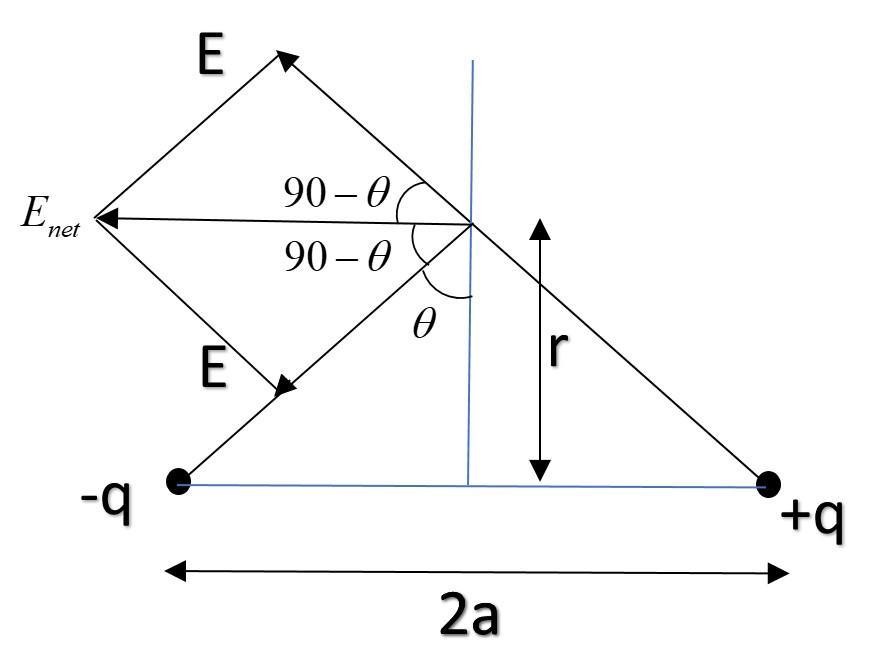
Now, $E = \dfrac{Kq}{d^2}$where $d^2 = r^2 + a^2$ [Using Pythagoras theorem]
Hence, $E = \dfrac{Kq}{r^2+a^2}$
Also, $E_{net} = E cos(90 - \theta) + Ecos(90 - \theta) = 2Esin\theta$
Now, in the figure,$sin\theta = \dfrac a{\sqrt{a^2+r^2}}$
Hence putting $E_{net} = 2\times \dfrac{Kq}{r^2+a^2} \times \dfrac a{\sqrt{a^2+r^2}} = \dfrac{2Kqa}{(r^2+a^2)^{3/2}}$
Now, if r>>a, $r^2+a^2 \approx r^2 and (r^2+a^2)^{3/2} \approx (r^2)^{3/2} = r^3$
Thus, $E_{net} = \dfrac{2Kqa}{r^3}$
Now, we know that dipole moment $\vec P$is the product of charge and distance between them, i.e. $P =q(2a)$
Hence $\vec E_{net} = \dfrac{K(2qa)}{r^3} = \dfrac{K\vec P}{r^3} = \dfrac{1}{4\pi\epsilon_{\circ}} \dfrac{\vec P}{r^3}$, hence its direction is in the direction of dipole moment (from +q to -q), which is perpendicular to the bisector.
Note:
Students should note that in the definition of dipole moment, we use to take the distance of charge from the centre of dipole. And in the formula, we take charge of any one and distance between them. Dipole moment is defined for charges of the same magnitude. It is a vector quantity with direction from +q to –q.
Formula used:
$E = \dfrac{Kq}{d^2};\ K=\dfrac{1}{4\pi \epsilon_{\circ}}$
Complete step by step answer:
By observing the S.I. units, we can say that
(1) Cm is the product of charge and distance. Hence its S.I. unit of dipole moment.
(2) $\dfrac NC$ is the ratio of S.I. units of Force (N, newton) and charge (C, coulomb). Hence it is the force per unit charge which is the definition of Electric field. Hence it’s the S.I. units of electric field.
Now, we will find the expression for the electric field at the equatorial position of a dipole.
By symmetry, we can say that the field will only be in –x direction and not in y direction.
Now, electric field due to both charges can be resolved as $E_{net}$ as shown in the figure below:
Now, $E = \dfrac{Kq}{d^2}$where $d^2 = r^2 + a^2$ [Using Pythagoras theorem]
Hence, $E = \dfrac{Kq}{r^2+a^2}$
Also, $E_{net} = E cos(90 - \theta) + Ecos(90 - \theta) = 2Esin\theta$
Now, in the figure,$sin\theta = \dfrac a{\sqrt{a^2+r^2}}$
Hence putting $E_{net} = 2\times \dfrac{Kq}{r^2+a^2} \times \dfrac a{\sqrt{a^2+r^2}} = \dfrac{2Kqa}{(r^2+a^2)^{3/2}}$
Now, if r>>a, $r^2+a^2 \approx r^2 and (r^2+a^2)^{3/2} \approx (r^2)^{3/2} = r^3$
Thus, $E_{net} = \dfrac{2Kqa}{r^3}$
Now, we know that dipole moment $\vec P$is the product of charge and distance between them, i.e. $P =q(2a)$
Hence $\vec E_{net} = \dfrac{K(2qa)}{r^3} = \dfrac{K\vec P}{r^3} = \dfrac{1}{4\pi\epsilon_{\circ}} \dfrac{\vec P}{r^3}$, hence its direction is in the direction of dipole moment (from +q to -q), which is perpendicular to the bisector.
Note:
Students should note that in the definition of dipole moment, we use to take the distance of charge from the centre of dipole. And in the formula, we take charge of any one and distance between them. Dipole moment is defined for charges of the same magnitude. It is a vector quantity with direction from +q to –q.
Recently Updated Pages
Master Class 12 Economics: Engaging Questions & Answers for Success

Master Class 12 English: Engaging Questions & Answers for Success
Master Class 12 Social Science: Engaging Questions & Answers for Success
Master Class 12 Maths: Engaging Questions & Answers for Success
Master Class 12 Physics: Engaging Questions & Answers for Success
Master Class 12 Business Studies: Engaging Questions & Answers for Success
Trending doubts
Which are the Top 10 Largest Countries of the World?
Draw a labelled sketch of the human eye class 12 physics CBSE
Differentiate between homogeneous and heterogeneous class 12 chemistry CBSE
Why is the cell called the structural and functional class 12 biology CBSE
Draw ray diagrams each showing i myopic eye and ii class 12 physics CBSE
Which is the correct genotypic ratio of mendel dihybrid class 12 biology CBSE