




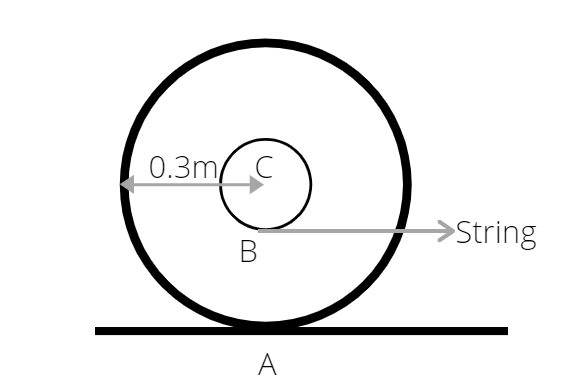
A wheel is made to roll without slipping, towards right, by pulling a string wrapped around a coaxial spool as shown in figure. With what velocity(in m/s) the string should be pulled so that the centre of the wheel moves with a velocity of 3 m/s?
Answer
 Verified
588k+ views
Hint:Rolling without slipping is a combination of translation and rotation where the point of contact is instantly at rest. When an object experiences pure translational motion, all of its points move with the same speed as the center of mass, which is in the same direction and with the same speed.
Complete step by step solution:
In the given figure for Position A
$\eqalign{
& {\text{V = R}}\omega \cr
& \Rightarrow \omega {\text{ = }}\dfrac{{\text{V}}}{{\text{R}}} \cr
& \Rightarrow \omega {\text{ = }}\dfrac{3}{{0.3}} \cr
& \therefore \omega {\text{ = 10}} \cr
& {\text{So, velocity of string = 3 - r}}\omega \cr
& \Rightarrow {\text{velocity of string = 3 - 1}} \cr
& \therefore {\text{velocity of string = 2}} \cr} $
Additional Information:When we slide an object across a surface (say, a book on a table), it will normally slow down rapidly due to frictional forces. When we do the same with a round object, like a water bottle, it may initially slide a bit (especially if we press it hard), but it will start to spin quickly. We can easily check that when rotating, the object loses much less kinetic energy to work than when sliding. Now we will take the same bottle of water, either on its bottom (only sliding) or sideways (a little more sliding), push it with the same initial force, and release, the rolling bottle goes much further. However, ironically, the bottle can only roll because of friction. To start rolling, we need to change its angular momentum, which requires torque, which is provided by the friction force acting on the bottle.
When a bottle (or ball, or any round object) rolls, the instantaneous velocity of the point that it touches the surface on which it rolls is zero.
Consequently, its speed of rotation $\omega$, the speed of translation of its center of rotation ${V_r}$ (where r indicates rolling) are related by
${V_r}$ = $\omega$ R
where, R is the relevant radius of our object. If the object's center of rotation is moving faster than Vr , the rotation cannot "keep up" and the object is sliding on the surface. We call this type of movement sliding. Due to friction, objects that undergo sliding motion generally slow down rapidly to Vr, at which point they roll without slipping.
Note:The wheel rolls without slipping only if there is no horizontal movement of the wheel at the contact point(relative to the surface / ground). Therefore, the contact point must also have zero horizontal movement (with respect to the surface / ground).
Complete step by step solution:
In the given figure for Position A
$\eqalign{
& {\text{V = R}}\omega \cr
& \Rightarrow \omega {\text{ = }}\dfrac{{\text{V}}}{{\text{R}}} \cr
& \Rightarrow \omega {\text{ = }}\dfrac{3}{{0.3}} \cr
& \therefore \omega {\text{ = 10}} \cr
& {\text{So, velocity of string = 3 - r}}\omega \cr
& \Rightarrow {\text{velocity of string = 3 - 1}} \cr
& \therefore {\text{velocity of string = 2}} \cr} $
Additional Information:When we slide an object across a surface (say, a book on a table), it will normally slow down rapidly due to frictional forces. When we do the same with a round object, like a water bottle, it may initially slide a bit (especially if we press it hard), but it will start to spin quickly. We can easily check that when rotating, the object loses much less kinetic energy to work than when sliding. Now we will take the same bottle of water, either on its bottom (only sliding) or sideways (a little more sliding), push it with the same initial force, and release, the rolling bottle goes much further. However, ironically, the bottle can only roll because of friction. To start rolling, we need to change its angular momentum, which requires torque, which is provided by the friction force acting on the bottle.
When a bottle (or ball, or any round object) rolls, the instantaneous velocity of the point that it touches the surface on which it rolls is zero.
Consequently, its speed of rotation $\omega$, the speed of translation of its center of rotation ${V_r}$ (where r indicates rolling) are related by
${V_r}$ = $\omega$ R
where, R is the relevant radius of our object. If the object's center of rotation is moving faster than Vr , the rotation cannot "keep up" and the object is sliding on the surface. We call this type of movement sliding. Due to friction, objects that undergo sliding motion generally slow down rapidly to Vr, at which point they roll without slipping.
Note:The wheel rolls without slipping only if there is no horizontal movement of the wheel at the contact point(relative to the surface / ground). Therefore, the contact point must also have zero horizontal movement (with respect to the surface / ground).
Recently Updated Pages
Master Class 11 English: Engaging Questions & Answers for Success

Master Class 11 Maths: Engaging Questions & Answers for Success
Class 11 Question and Answer - Your Ultimate Solutions Guide
Master Class 11 Biology: Engaging Questions & Answers for Success
Master Class 11 Physics: Engaging Questions & Answers for Success
Master Class 11 Accountancy: Engaging Questions & Answers for Success
Trending doubts
Differentiate between an exothermic and an endothermic class 11 chemistry CBSE
One Metric ton is equal to kg A 10000 B 1000 C 100 class 11 physics CBSE
In what year Guru Nanak Dev ji was born A15 April 1469 class 11 social science CBSE
Difference Between Prokaryotic Cells and Eukaryotic Cells
Draw a diagram of a plant cell and label at least eight class 11 biology CBSE
1 Quintal is equal to a 110 kg b 10 kg c 100kg d 1000 class 11 physics CBSE