




(a) What is a solar cell? Draw the labelled diagram of a solar cell.
(b) Name the semiconductor material which is usually used for making solar cells.
(c) Write the uses of solar cells.
Answer
 Verified
563.9k+ views
Hint : Solar cells are used in solar panels because of their capability to convert solar energy into electrical energy. Different semiconductor materials that have capacity of absorbing radiation from the sun and then using the properties of doped semiconductors converts it into electricity.
Complete step by step answer
(a) A solar cell is an electrical device that converts the energy of light directly into electricity by the photovoltaic effect that is exhibited by semiconductors. Individual solar cell devices can be combined to form solar panels which are commonly used for commercial and residential purposes to convert solar energy into electrical energy.
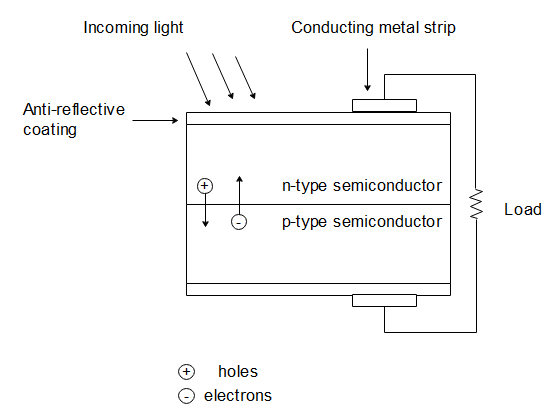
(b) Solar panels are made up of silicon which is a semiconductor. Two types of semiconductors are used in solar cells – n-type and p-type semiconductors. The bottom layer in the image is doped so it has few electrons and more holes. It's called p-type semiconductor silicon. The top layer is doped the opposite way, that is it has slightly more electrons which are also known as the n-type semiconductor silicon.
(c) A few uses of solar cells are,
- Solar cells are very useful in powering space machines such as satellites and telescopes. They provide a very economical and reliable way of powering instruments that would otherwise need expensive and weight heavy fuel liquid or gaseous fuel sources.
-Solar cells are also used in commercial and residential buildings recently to lower the demands of electricity produced from coal and petroleum so that less pollution is done and we have alternate sources that are sustainable sources of energy.
Note
While solar energy is very beneficial, it has a low efficiency generally around $ 20\% $ which means it converts only $ 20\% $ of the solar light it receives from the sun. Recently discovered newer semiconductors other than silicon have higher efficiency however they are still too expensive for viable commercial purposes.
Complete step by step answer
(a) A solar cell is an electrical device that converts the energy of light directly into electricity by the photovoltaic effect that is exhibited by semiconductors. Individual solar cell devices can be combined to form solar panels which are commonly used for commercial and residential purposes to convert solar energy into electrical energy.
(b) Solar panels are made up of silicon which is a semiconductor. Two types of semiconductors are used in solar cells – n-type and p-type semiconductors. The bottom layer in the image is doped so it has few electrons and more holes. It's called p-type semiconductor silicon. The top layer is doped the opposite way, that is it has slightly more electrons which are also known as the n-type semiconductor silicon.
(c) A few uses of solar cells are,
- Solar cells are very useful in powering space machines such as satellites and telescopes. They provide a very economical and reliable way of powering instruments that would otherwise need expensive and weight heavy fuel liquid or gaseous fuel sources.
-Solar cells are also used in commercial and residential buildings recently to lower the demands of electricity produced from coal and petroleum so that less pollution is done and we have alternate sources that are sustainable sources of energy.
Note
While solar energy is very beneficial, it has a low efficiency generally around $ 20\% $ which means it converts only $ 20\% $ of the solar light it receives from the sun. Recently discovered newer semiconductors other than silicon have higher efficiency however they are still too expensive for viable commercial purposes.
Recently Updated Pages
Master Class 12 Business Studies: Engaging Questions & Answers for Success

Master Class 12 Biology: Engaging Questions & Answers for Success
Master Class 12 Chemistry: Engaging Questions & Answers for Success
Class 12 Question and Answer - Your Ultimate Solutions Guide
Master Class 11 English: Engaging Questions & Answers for Success
Master Class 11 Social Science: Engaging Questions & Answers for Success
Trending doubts
Which are the Top 10 Largest Countries of the World?
Draw a labelled sketch of the human eye class 12 physics CBSE
Differentiate between homogeneous and heterogeneous class 12 chemistry CBSE
Why is the cell called the structural and functional class 12 biology CBSE
Draw ray diagrams each showing i myopic eye and ii class 12 physics CBSE
Which is the correct genotypic ratio of mendel dihybrid class 12 biology CBSE