




(a) What is a magnetic field?
(b) Draw magnetic field lines around a bar magnet.
(c) Write down four characteristics of magnetic field lines.
(d) State the rule for finding the direction of magnetic field associated with a current carrying conductor.
Answer
 Verified
630.9k+ views
Hint: To get the answers of all the questions you need to know that the range of effect of a magnet is denoted by the lines called magnetic fields. They are closed loops. They can attract the object with greater force if the magnetic field due the object is aligning with it, similarly it can repel the object as well. With the help of the fingers of our right hand we can find the direction of the current carrying magnetic field.
Complete step-by-step answer:
(a) Magnetic field:
The magnetic field is the area around a magnet in which there is magnetic force. Moving electric charges can make magnetic fields. In physics, the magnetic field is a field that passes through space and which makes a magnetic force move electric charges and magnetic dipoles.
(b) Magnetic lines around bar magnet:
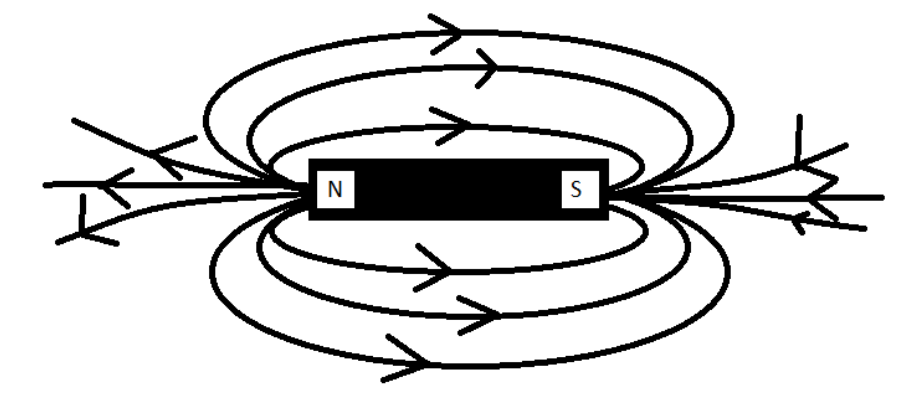
This is the respective diagram of a bar magnet with magnetic field lines.
The lines originate from the north pole and terminate on the south pole of the bas magnet.
The magnetic field lines make closed loops.
(c) Characteristics of magnetic field lines:
The lines originate from the north pole and terminate on the south pole of the bas magnet.
The strength of the magnetic field is proportional to the density of lines.
Magnetic field lines cannot cross each other.
Magnetic field lines are continuous loops.
(d) The thumb in the right hand rule indicates the direction of current in the straight conductor held by curled fingers, whereas the thumb in Fleming's left-hand rule gives the direction of force experienced by the current carrying conductor placed in an external magnetic field.
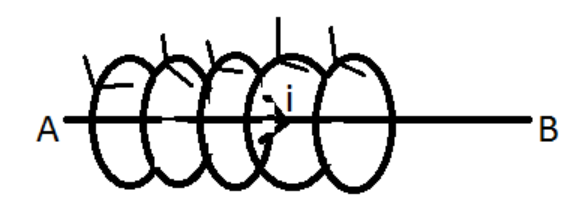
This diagram is of right hand thumb rule.
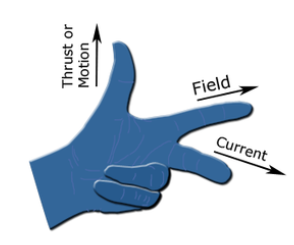
This figure is of Fleming’s left hand rule.
Note: The magnetic field lines travel from the north pole of the magnet, looping back around to go back in toward the south pole. At each pole, the magnetic field lines are nearly vertical. Earth's magnetic field has been weakening across a wide stretch of area for reasons unknown. Scientists have found the magnetic field from Africa to South America to be gradually weakening. Knowing these things will enhance your knowledge. Other things are mentioned in the solution itself.
Complete step-by-step answer:
(a) Magnetic field:
The magnetic field is the area around a magnet in which there is magnetic force. Moving electric charges can make magnetic fields. In physics, the magnetic field is a field that passes through space and which makes a magnetic force move electric charges and magnetic dipoles.
(b) Magnetic lines around bar magnet:
This is the respective diagram of a bar magnet with magnetic field lines.
The lines originate from the north pole and terminate on the south pole of the bas magnet.
The magnetic field lines make closed loops.
(c) Characteristics of magnetic field lines:
The lines originate from the north pole and terminate on the south pole of the bas magnet.
The strength of the magnetic field is proportional to the density of lines.
Magnetic field lines cannot cross each other.
Magnetic field lines are continuous loops.
(d) The thumb in the right hand rule indicates the direction of current in the straight conductor held by curled fingers, whereas the thumb in Fleming's left-hand rule gives the direction of force experienced by the current carrying conductor placed in an external magnetic field.
This diagram is of right hand thumb rule.
This figure is of Fleming’s left hand rule.
Note: The magnetic field lines travel from the north pole of the magnet, looping back around to go back in toward the south pole. At each pole, the magnetic field lines are nearly vertical. Earth's magnetic field has been weakening across a wide stretch of area for reasons unknown. Scientists have found the magnetic field from Africa to South America to be gradually weakening. Knowing these things will enhance your knowledge. Other things are mentioned in the solution itself.
Recently Updated Pages
Master Class 12 Business Studies: Engaging Questions & Answers for Success

Master Class 12 Biology: Engaging Questions & Answers for Success
Master Class 12 Chemistry: Engaging Questions & Answers for Success
Class 12 Question and Answer - Your Ultimate Solutions Guide
Master Class 11 English: Engaging Questions & Answers for Success
Master Class 11 Social Science: Engaging Questions & Answers for Success
Trending doubts
Which are the Top 10 Largest Countries of the World?
Draw a labelled sketch of the human eye class 12 physics CBSE
Differentiate between homogeneous and heterogeneous class 12 chemistry CBSE
Why is the cell called the structural and functional class 12 biology CBSE
Draw ray diagrams each showing i myopic eye and ii class 12 physics CBSE
Which is the correct genotypic ratio of mendel dihybrid class 12 biology CBSE