




A wave is represented as \[\varepsilon =10\sin ({{10}^{8}}+6\sin 1250t)\]. Then the modulating index is –
A) 10
B) 1250
C) 1000
D) 6
Answer
 Verified
600.3k+ views
Hint: The modulating index is the ratio of the amplitude of the modulating wave to the amplitude of the carrier wave. We can find the amplitudes of both these waves very easily from the given wave equation which is the resultant wave after modulation.
Complete answer:
We know that most of the signals which we come across today are modulated to avoid the loss of the signal during its propagation through the large noisy atmosphere. The speciality of modulation is that the modulated wave or the signal which is to be carried from one place to another does not lose its identity when it is modulated with the carrier wave.
We can see a wave which is to be modulated as –
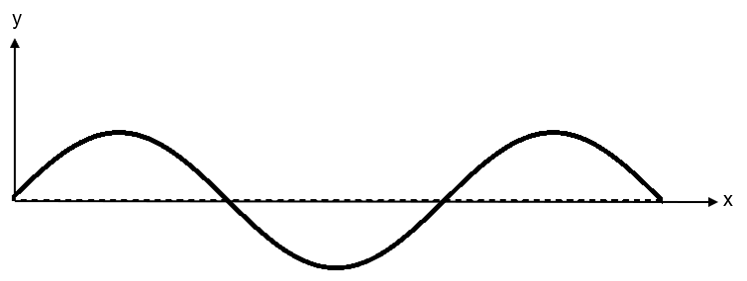
The equation of the wave is –
\[{{y}_{m}}={{a}_{m}}\sin (2\pi {{f}_{m}}t)\text{ --(1)}\]
The carrier wave is given as –
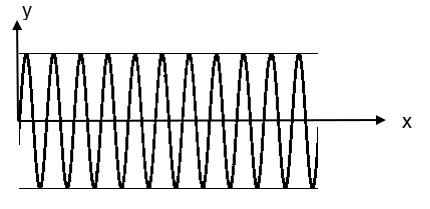
The equation of the wave is –
\[{{y}_{c}}={{a}_{c}}\sin (2\pi {{f}_{c}}t)\text{ --(2)}\]
From (1) and (2), we can derive the equation of the amplitude modulated wave as –
\[\begin{align}
& y={{y}_{m}}\sin \omega t+{{y}_{c}} \\
& \Rightarrow \text{ }y=[{{a}_{m}}\sin (2\pi {{f}_{m}}t)+{{a}_{c}}]\sin (2\pi {{f}_{c}}t) \\
\end{align}\]
This is because the modulated wave is embedded inside the carrier wave. So the modulating index can derived from the above equation as –
\[y=[1+\dfrac{{{a}_{m}}}{{{a}_{c}}}\sin (2\pi {{f}_{m}}t)]\sin (2\pi {{f}_{c}}t)\text{ --(3)}\]
We can compare the given equation and (3) to find the modulating index of the given wave.
The given wave equation is –
\[\varepsilon =10\sin ({{10}^{8}}+6\sin 1250t)\]
\[\Rightarrow \text{ }\varepsilon ={{10}^{9}}\sin \omega t(1+6\sin 1250t)\]
Comparing (3) with the above equation gives that 6 is the modulating index of the given amplitude modulated wave.
So, the correct answer is “Option D”.
Note:
The wave can be either modulated in amplitude or frequency. We can recognise them from the equation involved in the modulated wave. The frequency modulated waves are much more advantageous than the amplitude modulated waves.
Complete answer:
We know that most of the signals which we come across today are modulated to avoid the loss of the signal during its propagation through the large noisy atmosphere. The speciality of modulation is that the modulated wave or the signal which is to be carried from one place to another does not lose its identity when it is modulated with the carrier wave.
We can see a wave which is to be modulated as –
The equation of the wave is –
\[{{y}_{m}}={{a}_{m}}\sin (2\pi {{f}_{m}}t)\text{ --(1)}\]
The carrier wave is given as –
The equation of the wave is –
\[{{y}_{c}}={{a}_{c}}\sin (2\pi {{f}_{c}}t)\text{ --(2)}\]
From (1) and (2), we can derive the equation of the amplitude modulated wave as –
\[\begin{align}
& y={{y}_{m}}\sin \omega t+{{y}_{c}} \\
& \Rightarrow \text{ }y=[{{a}_{m}}\sin (2\pi {{f}_{m}}t)+{{a}_{c}}]\sin (2\pi {{f}_{c}}t) \\
\end{align}\]
This is because the modulated wave is embedded inside the carrier wave. So the modulating index can derived from the above equation as –
\[y=[1+\dfrac{{{a}_{m}}}{{{a}_{c}}}\sin (2\pi {{f}_{m}}t)]\sin (2\pi {{f}_{c}}t)\text{ --(3)}\]
We can compare the given equation and (3) to find the modulating index of the given wave.
The given wave equation is –
\[\varepsilon =10\sin ({{10}^{8}}+6\sin 1250t)\]
\[\Rightarrow \text{ }\varepsilon ={{10}^{9}}\sin \omega t(1+6\sin 1250t)\]
Comparing (3) with the above equation gives that 6 is the modulating index of the given amplitude modulated wave.
So, the correct answer is “Option D”.
Note:
The wave can be either modulated in amplitude or frequency. We can recognise them from the equation involved in the modulated wave. The frequency modulated waves are much more advantageous than the amplitude modulated waves.
Recently Updated Pages
Three beakers labelled as A B and C each containing 25 mL of water were taken A small amount of NaOH anhydrous CuSO4 and NaCl were added to the beakers A B and C respectively It was observed that there was an increase in the temperature of the solutions contained in beakers A and B whereas in case of beaker C the temperature of the solution falls Which one of the following statements isarecorrect i In beakers A and B exothermic process has occurred ii In beakers A and B endothermic process has occurred iii In beaker C exothermic process has occurred iv In beaker C endothermic process has occurred

Master Class 12 Social Science: Engaging Questions & Answers for Success
Master Class 12 Physics: Engaging Questions & Answers for Success
Master Class 12 Maths: Engaging Questions & Answers for Success
Master Class 12 Economics: Engaging Questions & Answers for Success
Master Class 12 Chemistry: Engaging Questions & Answers for Success
Three beakers labelled as A B and C each containing 25 mL of water were taken A small amount of NaOH anhydrous CuSO4 and NaCl were added to the beakers A B and C respectively It was observed that there was an increase in the temperature of the solutions contained in beakers A and B whereas in case of beaker C the temperature of the solution falls Which one of the following statements isarecorrect i In beakers A and B exothermic process has occurred ii In beakers A and B endothermic process has occurred iii In beaker C exothermic process has occurred iv In beaker C endothermic process has occurred
Master Class 12 Social Science: Engaging Questions & Answers for Success
Master Class 12 Physics: Engaging Questions & Answers for Success
Trending doubts
Which are the Top 10 Largest Countries of the World?
Draw a labelled sketch of the human eye class 12 physics CBSE
What are the major means of transport Explain each class 12 social science CBSE
Differentiate between homogeneous and heterogeneous class 12 chemistry CBSE
Sulphuric acid is known as the king of acids State class 12 chemistry CBSE
Why should a magnesium ribbon be cleaned before burning class 12 chemistry CBSE