




A voltmeter is always connected in ……. In the circuit to measure the potential difference between two points.
A. Series
B. Parallel
C. Series and parallel both
D. None of these
Answer
 Verified
600k+ views
Hint: To measure the electric potential difference, the instrument used for measurement must not draw any electric current from the circuit. Examine what will happen if the voltmeter is connected in series and then in parallel across the electric component.
Complete step by step answer:
We know that the internal resistance of voltmeter is very high. For the instrument to accurately measure the electric potential difference between the two points, the current passing through it must be zero.
According to Ohm’s law, the current in the circuit is proportional to the resistance. We consider the voltmeter connected in the series circuit as shown in the figure below,
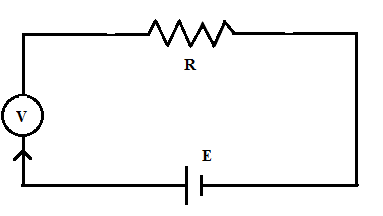
Since the voltmeter has very high resistance, no current will pass through it. Therefore, we cannot determine the potential difference across the two points in the circuit if there is no current flowing through these points.
Now we connect the voltmeter across the resistor to determine the potential difference across it two terminals as shown in the figure below.
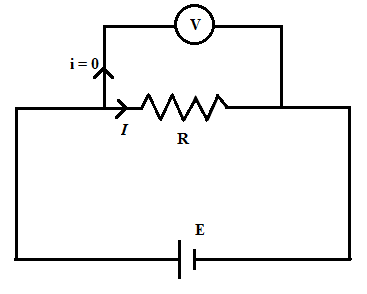
Since the voltmeters have very high resistance, no current will pass through it and the total current supplied by the cell will now only pass through the resistor. Therefore, the voltmeter will give accurate measurement of the potential difference across the terminals of the resistor.
The potential difference across the resistor R is given as,
\[\Delta V = IR\]
Here, I am the current passing through the resistor.
So, the correct answer is “Option B”.
Note:
To answer these types of questions, students should remember the internal resistance of voltmeter and ammeter. The voltmeter has very high internal resistance while the ammeter has negligible resistance. Note that there should be an electrical component between the two points across which the electric potential is to be measured. The voltmeter measures potential difference when there is voltage drop across that component.
Complete step by step answer:
We know that the internal resistance of voltmeter is very high. For the instrument to accurately measure the electric potential difference between the two points, the current passing through it must be zero.
According to Ohm’s law, the current in the circuit is proportional to the resistance. We consider the voltmeter connected in the series circuit as shown in the figure below,
Since the voltmeter has very high resistance, no current will pass through it. Therefore, we cannot determine the potential difference across the two points in the circuit if there is no current flowing through these points.
Now we connect the voltmeter across the resistor to determine the potential difference across it two terminals as shown in the figure below.
Since the voltmeters have very high resistance, no current will pass through it and the total current supplied by the cell will now only pass through the resistor. Therefore, the voltmeter will give accurate measurement of the potential difference across the terminals of the resistor.
The potential difference across the resistor R is given as,
\[\Delta V = IR\]
Here, I am the current passing through the resistor.
So, the correct answer is “Option B”.
Note:
To answer these types of questions, students should remember the internal resistance of voltmeter and ammeter. The voltmeter has very high internal resistance while the ammeter has negligible resistance. Note that there should be an electrical component between the two points across which the electric potential is to be measured. The voltmeter measures potential difference when there is voltage drop across that component.
Recently Updated Pages
Master Class 10 Computer Science: Engaging Questions & Answers for Success

Master Class 10 General Knowledge: Engaging Questions & Answers for Success
Master Class 10 English: Engaging Questions & Answers for Success
Master Class 10 Social Science: Engaging Questions & Answers for Success
Master Class 10 Maths: Engaging Questions & Answers for Success
Master Class 10 Science: Engaging Questions & Answers for Success
Trending doubts
Which is more stable and why class 12 chemistry CBSE
Which are the Top 10 Largest Countries of the World?
Draw a labelled sketch of the human eye class 12 physics CBSE
Differentiate between homogeneous and heterogeneous class 12 chemistry CBSE
What are the major means of transport Explain each class 12 social science CBSE
Sulphuric acid is known as the king of acids State class 12 chemistry CBSE