




A vibratory motion is represented by$x = 2A\cos \omega t + A\cos \left( {\omega t + \dfrac{\pi }{2}} \right) + A\cos \left( {\omega t + \pi } \right) + \dfrac{A}{2}\cos \left( {\omega t + \dfrac{{3\pi }}{2}} \right)$. The resultant amplitude of the motion is
A. 9A/2
B. $\dfrac{{\sqrt 5 A}}{2}$
C. 5A/2
D. 2A
Answer
 Verified
591k+ views
Hint: In this question, we need to determine the resultant amplitude of the vibratory motion which is represented by the given equation. For this, we will find the resultant vector by following the properties of the vectors.
Complete step by step answer:
We can solve it by a vector method using a phasor diagram. First we will find the resultant vectors along the x and the y axes and then apply the vector rule to determine the resultant of the amplitude of the given function.
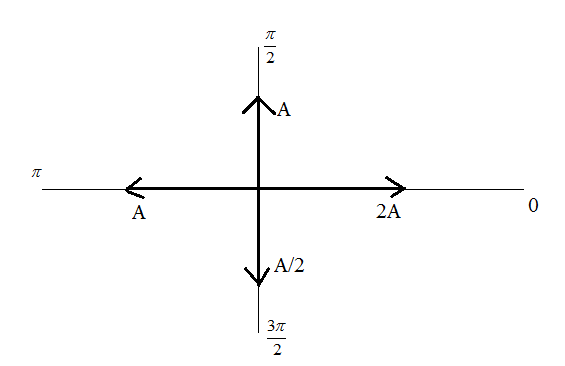
Resultant on horizontal axis is given as: \[2A - A = A\]and the resultant on vertical axis is given as: \[A - \left( {\dfrac{A}{2}} \right) = \dfrac{A}{2}\]
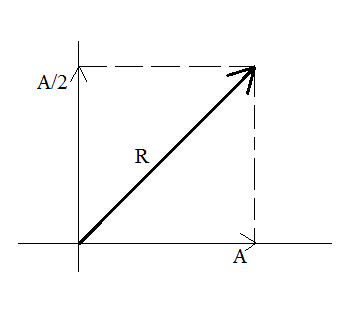
The resultant vector is given by parallelogram law as:
$
R = \sqrt {{A^2} + {B^2} + 2AB\cos \theta } \\
R = \sqrt {{A^2} + {B^2}} {\text{ }}\left[ {\theta = {{90}^ \circ } \Rightarrow \cos \theta = 0} \right] \\
$
So, the resultant amplitude is given as:
$
\sqrt {{A^2} + {{\left( {\dfrac{A}{2}} \right)}^2}} \\
= \sqrt {{A^2} + \dfrac{{{A^2}}}{4}} \\
= \sqrt {\dfrac{5}{4}A} \\
$
$
Amp = \sqrt {{A^2} + {{\left( {\dfrac{A}{2}} \right)}^2}} \\
= \sqrt {{A^2} + \dfrac{{{A^2}}}{4}} \\
= \sqrt {\dfrac{5}{4}{A^2}} \\
= \dfrac{{A\sqrt 5 }}{2} \\
$
Hence, the resultant amplitude of the vibratory motion which is defined by the equation $x = 2A\cos \omega t + A\cos \left( {\omega t + \dfrac{\pi }{2}} \right) + A\cos \left( {\omega t + \pi } \right) + \dfrac{A}{2}\cos \left( {\omega t + \dfrac{{3\pi }}{2}} \right)$
x= $\dfrac{{A\sqrt 5 }}{2}$.
So, the correct answer is “Option B”.
Note:
It should be noted down here that the vectors should not be added or subtracted like simple algebra, use vector addition methods always. Moreover, many times students got confused with the problem and carried out the simple arithmetic operations on the vector identities also, which led them to a wrong answer. Here, as all the vectors are displaced by certain factors of $\dfrac{\pi }{2}$ and the angle between any two axes is $\dfrac{\pi }{2}$ so, we have taken $\theta = \dfrac{\pi }{2}$.
Complete step by step answer:
We can solve it by a vector method using a phasor diagram. First we will find the resultant vectors along the x and the y axes and then apply the vector rule to determine the resultant of the amplitude of the given function.
Resultant on horizontal axis is given as: \[2A - A = A\]and the resultant on vertical axis is given as: \[A - \left( {\dfrac{A}{2}} \right) = \dfrac{A}{2}\]
The resultant vector is given by parallelogram law as:
$
R = \sqrt {{A^2} + {B^2} + 2AB\cos \theta } \\
R = \sqrt {{A^2} + {B^2}} {\text{ }}\left[ {\theta = {{90}^ \circ } \Rightarrow \cos \theta = 0} \right] \\
$
So, the resultant amplitude is given as:
$
\sqrt {{A^2} + {{\left( {\dfrac{A}{2}} \right)}^2}} \\
= \sqrt {{A^2} + \dfrac{{{A^2}}}{4}} \\
= \sqrt {\dfrac{5}{4}A} \\
$
$
Amp = \sqrt {{A^2} + {{\left( {\dfrac{A}{2}} \right)}^2}} \\
= \sqrt {{A^2} + \dfrac{{{A^2}}}{4}} \\
= \sqrt {\dfrac{5}{4}{A^2}} \\
= \dfrac{{A\sqrt 5 }}{2} \\
$
Hence, the resultant amplitude of the vibratory motion which is defined by the equation $x = 2A\cos \omega t + A\cos \left( {\omega t + \dfrac{\pi }{2}} \right) + A\cos \left( {\omega t + \pi } \right) + \dfrac{A}{2}\cos \left( {\omega t + \dfrac{{3\pi }}{2}} \right)$
x= $\dfrac{{A\sqrt 5 }}{2}$.
So, the correct answer is “Option B”.
Note:
It should be noted down here that the vectors should not be added or subtracted like simple algebra, use vector addition methods always. Moreover, many times students got confused with the problem and carried out the simple arithmetic operations on the vector identities also, which led them to a wrong answer. Here, as all the vectors are displaced by certain factors of $\dfrac{\pi }{2}$ and the angle between any two axes is $\dfrac{\pi }{2}$ so, we have taken $\theta = \dfrac{\pi }{2}$.
Recently Updated Pages
Basicity of sulphurous acid and sulphuric acid are

Master Class 11 Business Studies: Engaging Questions & Answers for Success
Master Class 11 Computer Science: Engaging Questions & Answers for Success
Master Class 11 Economics: Engaging Questions & Answers for Success
Master Class 11 Social Science: Engaging Questions & Answers for Success
Master Class 11 English: Engaging Questions & Answers for Success
Trending doubts
The largest wind power cluster is located in the state class 11 social science CBSE
Explain zero factorial class 11 maths CBSE
Which among the following are examples of coming together class 11 social science CBSE
Can anyone list 10 advantages and disadvantages of friction
State the laws of reflection of light
Draw a diagram of a plant cell and label at least eight class 11 biology CBSE