




A very long straight wire of radius r carries current I. Intensity of magnetic field B at a point, lying at a perpendicular distance ‘a’ from the axis is $\propto$___________.
A. ${a}^{2}$
B. $\dfrac {1}{{a}^{2}}$
C. $\dfrac {1}{a}$
D. a
Answer
 Verified
606.3k+ views
Hint: This problem can be solved using the Biot-Savart law which gives the expression for magnetic field in a long current carrying wire. Biot-Savart law helps us to calculate the magnetic field due to a steady current. From the expression for Biot-Savart law, we can infer that the magnetic field in a long current carrying wire is independent of the relative angular position of the point of observation. But it depends on the perpendicular distance from the wire.
Formula used:
$B=\dfrac { { \mu }_{ 0 }I }{ 2\pi r }$
Complete answer:
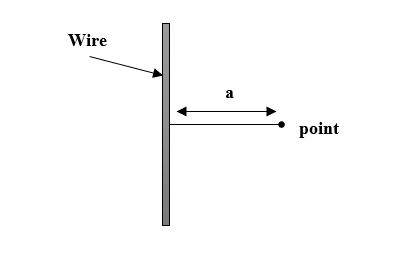
According to Biot-Savart’s law, magnetic field due to a very long straight wire is given by,
$B=\dfrac { { \mu }_{ 0 }I }{ 2\pi r }$ …(1)
Where, ${mu}_{0}$ is the constant
r is the distance from the wire
I is the current flowing through the wire
It is given that the perpendicular distance of the point from the wire is a.
Substituting this in the equation. (1) we get,
$B=\dfrac { { \mu }_{ 0 }I }{ 2\pi a }$
From above equation it can be inferred that,
$B \propto \dfrac {1}{a}$
Hence, intensity of a magnetic field at a perpendicular distance from a very long current carrying wire is proportional to $\dfrac {1}{a}$.
So, the correct answer is “Option C”.
Note:
Students may think that the electrons never stop moving, so it will always produce an electric field and hence the magnetic field. But in reality, this does not happen. Electrons move in a random direction in a conductor and thus, they get cancelled. Hence, the net electric field and magnetic field will be zero. When potential difference is applied across the terminals of the wire, electrons move in a specific direction. Hence, it will constitute current. As long as the potential difference exists, current through the wire exists and thus magnetic field exists for that same duration.
Formula used:
$B=\dfrac { { \mu }_{ 0 }I }{ 2\pi r }$
Complete answer:
According to Biot-Savart’s law, magnetic field due to a very long straight wire is given by,
$B=\dfrac { { \mu }_{ 0 }I }{ 2\pi r }$ …(1)
Where, ${mu}_{0}$ is the constant
r is the distance from the wire
I is the current flowing through the wire
It is given that the perpendicular distance of the point from the wire is a.
Substituting this in the equation. (1) we get,
$B=\dfrac { { \mu }_{ 0 }I }{ 2\pi a }$
From above equation it can be inferred that,
$B \propto \dfrac {1}{a}$
Hence, intensity of a magnetic field at a perpendicular distance from a very long current carrying wire is proportional to $\dfrac {1}{a}$.
So, the correct answer is “Option C”.
Note:
Students may think that the electrons never stop moving, so it will always produce an electric field and hence the magnetic field. But in reality, this does not happen. Electrons move in a random direction in a conductor and thus, they get cancelled. Hence, the net electric field and magnetic field will be zero. When potential difference is applied across the terminals of the wire, electrons move in a specific direction. Hence, it will constitute current. As long as the potential difference exists, current through the wire exists and thus magnetic field exists for that same duration.
Recently Updated Pages
Master Class 12 Business Studies: Engaging Questions & Answers for Success

Master Class 12 Biology: Engaging Questions & Answers for Success
Master Class 12 Chemistry: Engaging Questions & Answers for Success
Class 12 Question and Answer - Your Ultimate Solutions Guide
Master Class 11 Social Science: Engaging Questions & Answers for Success
Master Class 11 English: Engaging Questions & Answers for Success
Trending doubts
Which is more stable and why class 12 chemistry CBSE
Which are the Top 10 Largest Countries of the World?
Draw a labelled sketch of the human eye class 12 physics CBSE
Differentiate between homogeneous and heterogeneous class 12 chemistry CBSE
What are the major means of transport Explain each class 12 social science CBSE
Sulphuric acid is known as the king of acids State class 12 chemistry CBSE