




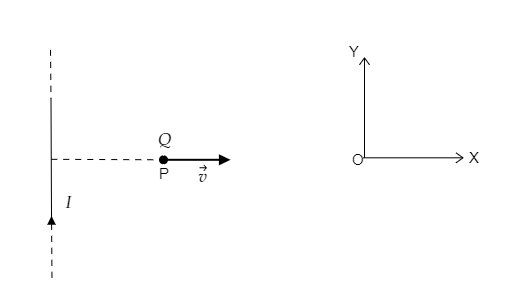
A very long straight wire carries a current $I$. At the instant the charge $ + Q$ at point P has a velocity $\vec v$ as shown in the figure, the force on the charge is :
A. along OX
B. opposite to OY
C. along OY
D. opposite to OX
Answer
 Verified
617.1k+ views
Hint:- From the given figure, the direction of the magnetic field at point P due to the current in the wire can be determined by the right-hand thumb rule. Then Flemming’s left-hand rule will provide us with the direction of the force on the charge at P as the direction of the magnetic field and that of the charge will be known.
Complete step-by-step solution:
Step 1: Describe the right-hand thumb rule to determine the direction of the magnetic field at P.
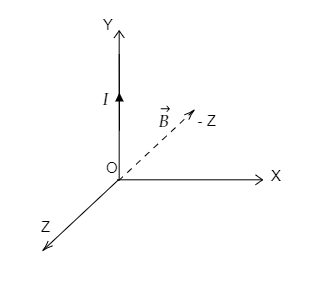
The current in the wire is along the positive y-axis. The direction of the field at P due to this current can be obtained using the right-hand thumb rule. The rule gives the direction of the magnetic field to be along the direction in which the figures curl around the right thumb which points in the direction of the current.
So as the right thumb points upwards in this scenario, we see that the fingers curl inwards around the thumb. Thus the direction of the magnetic field will be into the plane or along the negative z-direction. This is shown in the figure given below.
Step 2: Describe Flemming’s left-hand rule to determine the direction of the force on the charge.
Flemming’s left-hand rule gives the direction of the force to be in the direction in which the left thumb points when the direction of the magnetic field is given by the index finger and the direction in which the charge moves is given by the middle finger.
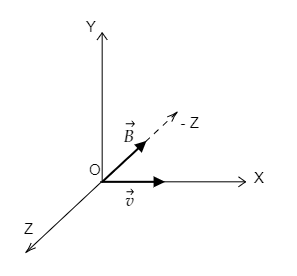
From the above figure, it is clear that the charge moves along OX and we have already established that the magnetic field is along the negative z-direction. So here the index finger points into the plane of the paper and the middle finger points to the right. This gives the direction of the force in the upward direction i.e., along OY.
So the correct option is C.
Note:-
Alternate method-
The direction of the magnetic field at P can be obtained to be along the negative z-direction using the right-hand thumb rule as mentioned above. The direction of the force on the charge can be determined by the formula for the magnetic force at P given by, $\vec F = Q\left( {\vec v \times \vec B} \right)$.
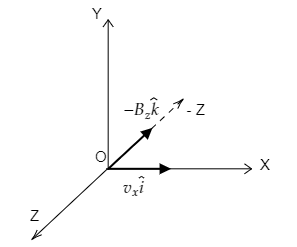
From the above figure, we have $\vec v = {v_x}\hat i$ and $\vec B = - {B_z}\hat k$.
Then, $\vec v \times \vec B = {v_x}\hat i \times - {B_z}\hat k = {v_x}{B_z}\hat j$ since $\hat i \times - \hat k = \hat j$.
$ \Rightarrow \vec F = Q{v_x}{B_z}\hat j$
So the force on the charge will be along OY.
Complete step-by-step solution:
Step 1: Describe the right-hand thumb rule to determine the direction of the magnetic field at P.
The current in the wire is along the positive y-axis. The direction of the field at P due to this current can be obtained using the right-hand thumb rule. The rule gives the direction of the magnetic field to be along the direction in which the figures curl around the right thumb which points in the direction of the current.
So as the right thumb points upwards in this scenario, we see that the fingers curl inwards around the thumb. Thus the direction of the magnetic field will be into the plane or along the negative z-direction. This is shown in the figure given below.
Step 2: Describe Flemming’s left-hand rule to determine the direction of the force on the charge.
Flemming’s left-hand rule gives the direction of the force to be in the direction in which the left thumb points when the direction of the magnetic field is given by the index finger and the direction in which the charge moves is given by the middle finger.
From the above figure, it is clear that the charge moves along OX and we have already established that the magnetic field is along the negative z-direction. So here the index finger points into the plane of the paper and the middle finger points to the right. This gives the direction of the force in the upward direction i.e., along OY.
So the correct option is C.
Note:-
Alternate method-
The direction of the magnetic field at P can be obtained to be along the negative z-direction using the right-hand thumb rule as mentioned above. The direction of the force on the charge can be determined by the formula for the magnetic force at P given by, $\vec F = Q\left( {\vec v \times \vec B} \right)$.
From the above figure, we have $\vec v = {v_x}\hat i$ and $\vec B = - {B_z}\hat k$.
Then, $\vec v \times \vec B = {v_x}\hat i \times - {B_z}\hat k = {v_x}{B_z}\hat j$ since $\hat i \times - \hat k = \hat j$.
$ \Rightarrow \vec F = Q{v_x}{B_z}\hat j$
So the force on the charge will be along OY.
Recently Updated Pages
Master Class 12 Business Studies: Engaging Questions & Answers for Success

Master Class 12 Chemistry: Engaging Questions & Answers for Success
Master Class 12 Biology: Engaging Questions & Answers for Success
Class 12 Question and Answer - Your Ultimate Solutions Guide
Master Class 11 English: Engaging Questions & Answers for Success
Master Class 11 Social Science: Engaging Questions & Answers for Success
Trending doubts
Which are the Top 10 Largest Countries of the World?
Draw a labelled sketch of the human eye class 12 physics CBSE
Differentiate between homogeneous and heterogeneous class 12 chemistry CBSE
In order to find out the different types of gametes class 12 biology NEET_UG
Why is the cell called the structural and functional class 12 biology CBSE
Draw ray diagrams each showing i myopic eye and ii class 12 physics CBSE