




A variable inductor is connected to an AC source. When inductance increases. Then reactance
A. And current remain same
B. Increases but current remains same
C. Increases but current decreases
D. Increases and current also increases
Answer
 Verified
625.2k+ views
Hint: In order to solve this problem, assume an inductor of some inductance. For this, you can give the relation between the reactance of the inductor and inductance. This will give you an idea of how reactance is changing with respect to the inductance. Similarly, find the relation between inductor current and reactance then you can know how the current varies in the inductor.
Formula used:
$\eqalign{
& {X_L} = L\omega \cr
& {V_L} = L\dfrac{{d{i_L}}}{{dt}} \cr
& {I_m} = \dfrac{{{V_m}}}{{{X_L}}} \cr} $
Complete answer:
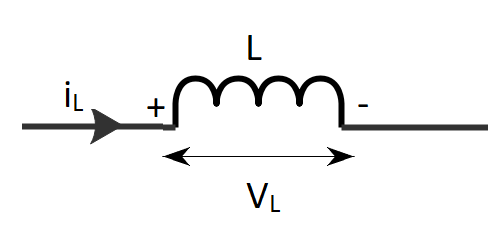
Let us consider that initially, the inductance of the inductor coil is L. They’ve given in the question that L has been increased. Let us say that the new inductance of the inductor coil is L’. They’ve given that, $L' > L$.
Now the reactance of an inductor coil is given by ${X_L} = L\omega $. Where L is the inductance and ω is the angular frequency. Now, reactance XL is directly proportional to L. When the ω is kept constant, the reactance XL will increase with an increase in L.
If the current in the circuit ${i_L}$ is given by
${i_L} = {I_m}\sin \left( {\omega t + \theta } \right)$
Where,
Im is the peak current
The voltage across the inductor will be given by
${V_L} = L\dfrac{{d{i_L}}}{{dt}} = L\dfrac{{d{I_m}\sin \left( {\omega t + \theta } \right)}}{{dt}} = {I_m}L\omega \cos \left( {\omega t + \theta } \right)$
So, the peak voltage is
$\eqalign{
& {V_m} = {I_m} \times L\omega \cr
& \Rightarrow {I_m} = \dfrac{{{V_m}}}{{L\omega }} \cr
& \Rightarrow {I_m} = \dfrac{{{V_m}}}{{{X_L}}} \cr} $
We have seen that the reactance of the inductor increases with the increase in inductance. Here, the current is inversely proportional to the reactance of the coil. This means that with an increase in impedance the current will decrease.
Therefore, with an increase in the inductance the reactance increases, and the current in the circuit decreases, when the voltage is kept constant.
So, the correct answer is “Option C”.
Note:
You can also solve this problem by assuming the values for the inductance and the ac voltage across the inductor. It will get you through the confusion and give you a clear idea of how they are changing. Here, you must also remember how the voltage and current of an inductor are related, to avoid ambiguity as the quantities are not directly mentioned in the problem.
Formula used:
$\eqalign{
& {X_L} = L\omega \cr
& {V_L} = L\dfrac{{d{i_L}}}{{dt}} \cr
& {I_m} = \dfrac{{{V_m}}}{{{X_L}}} \cr} $
Complete answer:
Let us consider that initially, the inductance of the inductor coil is L. They’ve given in the question that L has been increased. Let us say that the new inductance of the inductor coil is L’. They’ve given that, $L' > L$.
Now the reactance of an inductor coil is given by ${X_L} = L\omega $. Where L is the inductance and ω is the angular frequency. Now, reactance XL is directly proportional to L. When the ω is kept constant, the reactance XL will increase with an increase in L.
If the current in the circuit ${i_L}$ is given by
${i_L} = {I_m}\sin \left( {\omega t + \theta } \right)$
Where,
Im is the peak current
The voltage across the inductor will be given by
${V_L} = L\dfrac{{d{i_L}}}{{dt}} = L\dfrac{{d{I_m}\sin \left( {\omega t + \theta } \right)}}{{dt}} = {I_m}L\omega \cos \left( {\omega t + \theta } \right)$
So, the peak voltage is
$\eqalign{
& {V_m} = {I_m} \times L\omega \cr
& \Rightarrow {I_m} = \dfrac{{{V_m}}}{{L\omega }} \cr
& \Rightarrow {I_m} = \dfrac{{{V_m}}}{{{X_L}}} \cr} $
We have seen that the reactance of the inductor increases with the increase in inductance. Here, the current is inversely proportional to the reactance of the coil. This means that with an increase in impedance the current will decrease.
Therefore, with an increase in the inductance the reactance increases, and the current in the circuit decreases, when the voltage is kept constant.
So, the correct answer is “Option C”.
Note:
You can also solve this problem by assuming the values for the inductance and the ac voltage across the inductor. It will get you through the confusion and give you a clear idea of how they are changing. Here, you must also remember how the voltage and current of an inductor are related, to avoid ambiguity as the quantities are not directly mentioned in the problem.
Recently Updated Pages
Master Class 12 Business Studies: Engaging Questions & Answers for Success

Master Class 12 Chemistry: Engaging Questions & Answers for Success
Master Class 12 Biology: Engaging Questions & Answers for Success
Class 12 Question and Answer - Your Ultimate Solutions Guide
Master Class 11 English: Engaging Questions & Answers for Success
Master Class 11 Social Science: Engaging Questions & Answers for Success
Trending doubts
Which are the Top 10 Largest Countries of the World?
Draw a labelled sketch of the human eye class 12 physics CBSE
Differentiate between homogeneous and heterogeneous class 12 chemistry CBSE
Differentiate between Pyramid of energy and pyramid class 12 biology CBSE
Why is the cell called the structural and functional class 12 biology CBSE
Draw the diagram of the pyramid of energy Explain In class 12 biology CBSE