




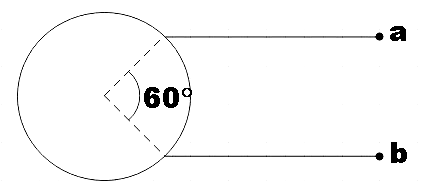
A uniform wire of resistance $18\Omega $ is bent in the form of a circle. The effective resistance across the points $a$ and $b$ is:
A. $3\Omega $
B. $2\Omega $
C.$2.5\Omega $
D. $6\Omega $
Answer
 Verified
580.8k+ views
Hint: As a first step, you could divide the full circle into two resistors of different resistances. You could then find the combination formed by them across the terminals. Then, you could find the resistance of arc that subtends $1{}^\circ $ at the centre and thereby the resistances of the arcs that subtends $60{}^\circ $ and $300{}^\circ $ at the centre. After that you could find the effective resistance of the combination.
Formula used:
Effective resistance of resistors connected in parallel,
${{R}_{eff}}=\dfrac{{{R}_{1}}{{R}_{2}}}{{{R}_{1}}+{{R}_{2}}}$
Complete Step by step solution:
In the question, we are given a uniform wire of resistance $18\Omega $. This wire is being bent in the form of a circle. If two terminals $a$ and $b$ are connected at points that subtend $60{}^\circ $ at the centre of the circle then, we are asked to find the effective resistance across the terminals $a$ and $b$.
We see that the terminals divide the circle into two arcs, one bigger than the other. Let the resistance of the bigger arc be ${{R}_{1}}$ and let the resistance of the smaller arc be ${{R}_{2}}$, then, it would be equivalent to two resistors connected in parallel to each other.
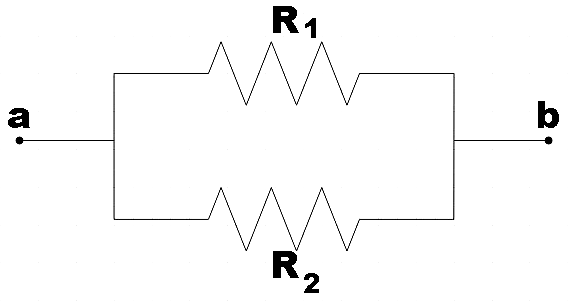
So the effective resistance would be given by,
${{R}_{eff}}=\dfrac{{{R}_{1}}{{R}_{2}}}{{{R}_{1}}+{{R}_{2}}}$ ………………………………………………………. (1)
Now let us find the resistances of each resistor, that is, each arc.
The whole circle is said to have a resistance of$18\Omega $.
$360{}^\circ \to 18\Omega $
$\Rightarrow 1{}^\circ \to \dfrac{18}{360}\Omega $
As the bigger arc subtends $300{}^\circ $ at the centre of the circle, its resistance would be given by,
${{R}_{1}}=\dfrac{18}{360}\times 300=15\Omega $ …………………………………………… (2)
Now the smaller arc subtends $60{}^\circ $ and its resistance could be given by,
${{R}_{2}}=\dfrac{18}{360}\times 60=3\Omega $…………………………………………… (3)
Substituting (2) and (3) in (1), we get,
${{R}_{eff}}=\dfrac{15\times 3}{15+3}$
$\therefore {{R}_{eff}}=2.5\Omega $
Therefore, we found the effective resistance across the terminals to be,
${{R}_{eff}}=2.5\Omega $
Hence, option C is found to be the correct answer.
Note:
Chances are there that you may get the combination formed by the arcs wrong. This happens because the arcs are seen to form continuous circles and this may appear to be connected in series. But the terminals are actually connected in parallel as their two ends are connected at the two terminals.
Formula used:
Effective resistance of resistors connected in parallel,
${{R}_{eff}}=\dfrac{{{R}_{1}}{{R}_{2}}}{{{R}_{1}}+{{R}_{2}}}$
Complete Step by step solution:
In the question, we are given a uniform wire of resistance $18\Omega $. This wire is being bent in the form of a circle. If two terminals $a$ and $b$ are connected at points that subtend $60{}^\circ $ at the centre of the circle then, we are asked to find the effective resistance across the terminals $a$ and $b$.
We see that the terminals divide the circle into two arcs, one bigger than the other. Let the resistance of the bigger arc be ${{R}_{1}}$ and let the resistance of the smaller arc be ${{R}_{2}}$, then, it would be equivalent to two resistors connected in parallel to each other.
So the effective resistance would be given by,
${{R}_{eff}}=\dfrac{{{R}_{1}}{{R}_{2}}}{{{R}_{1}}+{{R}_{2}}}$ ………………………………………………………. (1)
Now let us find the resistances of each resistor, that is, each arc.
The whole circle is said to have a resistance of$18\Omega $.
$360{}^\circ \to 18\Omega $
$\Rightarrow 1{}^\circ \to \dfrac{18}{360}\Omega $
As the bigger arc subtends $300{}^\circ $ at the centre of the circle, its resistance would be given by,
${{R}_{1}}=\dfrac{18}{360}\times 300=15\Omega $ …………………………………………… (2)
Now the smaller arc subtends $60{}^\circ $ and its resistance could be given by,
${{R}_{2}}=\dfrac{18}{360}\times 60=3\Omega $…………………………………………… (3)
Substituting (2) and (3) in (1), we get,
${{R}_{eff}}=\dfrac{15\times 3}{15+3}$
$\therefore {{R}_{eff}}=2.5\Omega $
Therefore, we found the effective resistance across the terminals to be,
${{R}_{eff}}=2.5\Omega $
Hence, option C is found to be the correct answer.
Note:
Chances are there that you may get the combination formed by the arcs wrong. This happens because the arcs are seen to form continuous circles and this may appear to be connected in series. But the terminals are actually connected in parallel as their two ends are connected at the two terminals.
Recently Updated Pages
Three beakers labelled as A B and C each containing 25 mL of water were taken A small amount of NaOH anhydrous CuSO4 and NaCl were added to the beakers A B and C respectively It was observed that there was an increase in the temperature of the solutions contained in beakers A and B whereas in case of beaker C the temperature of the solution falls Which one of the following statements isarecorrect i In beakers A and B exothermic process has occurred ii In beakers A and B endothermic process has occurred iii In beaker C exothermic process has occurred iv In beaker C endothermic process has occurred

Master Class 12 Social Science: Engaging Questions & Answers for Success
Master Class 12 Physics: Engaging Questions & Answers for Success
Master Class 12 Maths: Engaging Questions & Answers for Success
Master Class 12 Economics: Engaging Questions & Answers for Success
Master Class 12 Chemistry: Engaging Questions & Answers for Success
Three beakers labelled as A B and C each containing 25 mL of water were taken A small amount of NaOH anhydrous CuSO4 and NaCl were added to the beakers A B and C respectively It was observed that there was an increase in the temperature of the solutions contained in beakers A and B whereas in case of beaker C the temperature of the solution falls Which one of the following statements isarecorrect i In beakers A and B exothermic process has occurred ii In beakers A and B endothermic process has occurred iii In beaker C exothermic process has occurred iv In beaker C endothermic process has occurred
Master Class 12 Social Science: Engaging Questions & Answers for Success
Master Class 12 Physics: Engaging Questions & Answers for Success
Trending doubts
Which are the Top 10 Largest Countries of the World?
Draw a labelled sketch of the human eye class 12 physics CBSE
Differentiate between homogeneous and heterogeneous class 12 chemistry CBSE
What are the major means of transport Explain each class 12 social science CBSE
Sulphuric acid is known as the king of acids State class 12 chemistry CBSE
Why should a magnesium ribbon be cleaned before burning class 12 chemistry CBSE