




A uniform thin bar of mass 6m and length 2l is bent to make a regular hexagon. Its moment of inertia about an axis passing through the centre of mass and perpendicular to the plane of the hexagon is:
\[A.\,\,\dfrac{5}{9}m{{l}^{2}}\]
\[B.\,\,5m{{l}^{2}}\]
\[C.\,\,4m{{l}^{2}}\]
\[D.\,\,\dfrac{1}{12}m{{l}^{2}}\]
Answer
 Verified
533.4k+ views
Hint: In this problem, as the hexagon was earlier a uniform thin bar, so the formula for calculating the moment of inertia of the rod should be used. In this case, the total moment of inertia is the sum of moment of inertia at the centre and moment of inertia at the perpendicular distance.
Formula used:
\[I=\dfrac{m{{L}^{2}}}{12}\]
Complete answer:
From given, we have,
The mass of a thin bar = 6m
The length of a thin bar = 2l
As the length of the uniform thin bar is 2l, the length of each segment of the hexagon will be,
\[\dfrac{2l}{6}=\dfrac{l}{3}\]
The moment of inertia of a rod is given by the formula,
\[I=\dfrac{m{{L}^{2}}}{12}\]
Where m is the mass of the rod and L is the length of the rod.
Substitute the values of the mass and length of the rod in the above equation. So, we get,
\[\begin{align}
& I=\dfrac{1}{12}(6m){{\left( \dfrac{l}{3} \right)}^{2}} \\
& \Rightarrow I=\left( \dfrac{6m}{12} \right)\left( \dfrac{{{l}^{2}}}{9} \right) \\
& \Rightarrow I=\dfrac{6m{{l}^{2}}}{108} \\
& \Rightarrow I=\dfrac{m{{l}^{2}}}{18} \\
\end{align}\]
The distance between the centre of the hexagon and the centre of the rod is calculated as,
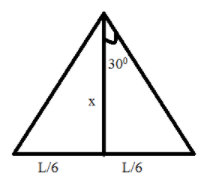
Let x be the distance between the centre of the hexagon and the centre of the rod.
\[\begin{align}
& \tan 30{}^\circ =\dfrac{{}^{l}/{}_{6}}{x} \\
& \dfrac{l}{6x}=\dfrac{1}{\sqrt{3}} \\
& x=\dfrac{\sqrt{3}l}{6} \\
\end{align}\]
Using the parallel axis theorem the moment of inertia about the axis is,
\[\begin{align}
& I'=\dfrac{m{{l}^{2}}}{18}+6m{{\left( \dfrac{\sqrt{3}l}{6} \right)}^{2}} \\
& \Rightarrow I'=\dfrac{m{{l}^{2}}}{18}+6m\left( \dfrac{3{{l}^{2}}}{36} \right) \\
& \Rightarrow I'=\dfrac{m{{l}^{2}}}{18}+\dfrac{3m{{l}^{2}}}{6} \\
& \Rightarrow I'=\dfrac{m{{l}^{2}}}{18}+\dfrac{m{{l}^{2}}}{2} \\
& \Rightarrow I'=\dfrac{5}{9}m{{l}^{2}} \\
\end{align}\]
As the moment of inertia of a uniform thin bar about an axis passing through the centre of mass and perpendicular to the plane of the hexagon is equal to \[\dfrac{5}{9}m{{l}^{2}}\].
Thus, the option (A) is correct.
Note:
The things to be on your finger-tips for further information on solving these types of problems are: The distance between the centre of the hexagon and the centre of the rod should be calculated cautiously, as this part also becomes important to find the total moment of inertia.
Formula used:
\[I=\dfrac{m{{L}^{2}}}{12}\]
Complete answer:
From given, we have,
The mass of a thin bar = 6m
The length of a thin bar = 2l
As the length of the uniform thin bar is 2l, the length of each segment of the hexagon will be,
\[\dfrac{2l}{6}=\dfrac{l}{3}\]
The moment of inertia of a rod is given by the formula,
\[I=\dfrac{m{{L}^{2}}}{12}\]
Where m is the mass of the rod and L is the length of the rod.
Substitute the values of the mass and length of the rod in the above equation. So, we get,
\[\begin{align}
& I=\dfrac{1}{12}(6m){{\left( \dfrac{l}{3} \right)}^{2}} \\
& \Rightarrow I=\left( \dfrac{6m}{12} \right)\left( \dfrac{{{l}^{2}}}{9} \right) \\
& \Rightarrow I=\dfrac{6m{{l}^{2}}}{108} \\
& \Rightarrow I=\dfrac{m{{l}^{2}}}{18} \\
\end{align}\]
The distance between the centre of the hexagon and the centre of the rod is calculated as,
Let x be the distance between the centre of the hexagon and the centre of the rod.
\[\begin{align}
& \tan 30{}^\circ =\dfrac{{}^{l}/{}_{6}}{x} \\
& \dfrac{l}{6x}=\dfrac{1}{\sqrt{3}} \\
& x=\dfrac{\sqrt{3}l}{6} \\
\end{align}\]
Using the parallel axis theorem the moment of inertia about the axis is,
\[\begin{align}
& I'=\dfrac{m{{l}^{2}}}{18}+6m{{\left( \dfrac{\sqrt{3}l}{6} \right)}^{2}} \\
& \Rightarrow I'=\dfrac{m{{l}^{2}}}{18}+6m\left( \dfrac{3{{l}^{2}}}{36} \right) \\
& \Rightarrow I'=\dfrac{m{{l}^{2}}}{18}+\dfrac{3m{{l}^{2}}}{6} \\
& \Rightarrow I'=\dfrac{m{{l}^{2}}}{18}+\dfrac{m{{l}^{2}}}{2} \\
& \Rightarrow I'=\dfrac{5}{9}m{{l}^{2}} \\
\end{align}\]
As the moment of inertia of a uniform thin bar about an axis passing through the centre of mass and perpendicular to the plane of the hexagon is equal to \[\dfrac{5}{9}m{{l}^{2}}\].
Thus, the option (A) is correct.
Note:
The things to be on your finger-tips for further information on solving these types of problems are: The distance between the centre of the hexagon and the centre of the rod should be calculated cautiously, as this part also becomes important to find the total moment of inertia.
Recently Updated Pages
Basicity of sulphurous acid and sulphuric acid are

Master Class 12 English: Engaging Questions & Answers for Success
Master Class 12 Social Science: Engaging Questions & Answers for Success
Master Class 12 Maths: Engaging Questions & Answers for Success
Master Class 12 Economics: Engaging Questions & Answers for Success
Master Class 12 Physics: Engaging Questions & Answers for Success
Trending doubts
Which are the Top 10 Largest Countries of the World?
Draw a labelled sketch of the human eye class 12 physics CBSE
Which country did Danny Casey play for class 12 english CBSE
Give 10 examples of unisexual and bisexual flowers
Coming together federation is practiced in A India class 12 social science CBSE
Write the formula to find the shortest distance between class 12 maths CBSE