




A uniform sphere of charge of radius $a$ has electric potential at distance $\dfrac{3a}{2}$ from its centre equal to half of its value at distance $x$ from its centre. Then, what is the value of $x$?
A. Zero
B. $\dfrac{a}{2}$
C. $\dfrac{a}{\sqrt{2}}$
D. $\dfrac{a}{\sqrt{3}}$
Answer
 Verified
580.5k+ views
Hint: First, assume the charge on the sphere to be $q$ and find the expression of electric potential at distance $\dfrac{3a}{2}$ and $x$ from its centre. Then use the given relation between electric potential at distance $x$ and distance $\dfrac{3a}{2}$ from centre to obtain the magnitude of $x$.
Formula used:
Electric potential due to a point charge $V=\dfrac{kQ}{r}$
Complete answer:
Electric potential due to a point charge is given by
$V=\dfrac{kQ}{r}$
Where $k=\dfrac{1}{4\pi {{\epsilon }_{0}}}$ and $r$ is the distance of the point from the centre of the sphere.
For a uniformly charged sphere, electric field outside the sphere is equivalent to that from a point charge. This means, outside the sphere the potential is also the same as that from a point charge.
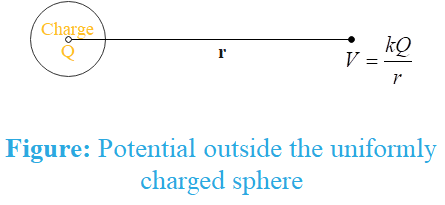
Let us assume charge on the sphere is $Q$. Then electric potential at distance $\dfrac{3a}{2}$ from centre of the sphere is
${{V}_{3a/2}}=\dfrac{kQ}{3a/2}=\dfrac{2kQ}{3a}$
Electric potential at distance $x$ from centre is given by
${{V}_{x}}=\dfrac{kQ}{x}$
Since, this value of potential is equal to half of its value at distance $x$ from its centre. This implies that
$\dfrac{1}{2}{{V}_{3a/2}}={{V}_{x}}\Rightarrow {{V}_{3a/2}}=2{{V}_{x}}$
Substituting the corresponding values, we have
$\dfrac{2kQ}{3a}=2\dfrac{kQ}{x}$
We rearrange and simplify this equation and obtain,
$x=\dfrac{a}{2}$
So, the correct answer is “Option B”.
Note:
Read the question carefully as sometimes students may get confused about the relation between the value of electric potential at distance $x$ and $\dfrac{3a}{2}$ from centre.
For a point inside the uniformly charged sphere, electric potential is
$V=\dfrac{kQ}{{{R}^{3}}}{{r}^{2}}$where $r$is the distance of point from centre and R is the radius of sphere.
Alternatively, this question can also be solved without assuming any charge on the sphere by using inverse proportionality of electric potential on distance for the same charge.
$V\propto \dfrac{1}{r}$
From this, we have
$\dfrac{{{V}_{3a/2}}}{{{V}_{x}}}=\dfrac{{{r}_{x}}}{{{r}_{3a/2}}}$
Substituting ${{r}_{x}}=x$ and ${{r}_{3a/2}}=\dfrac{3a}{2}$, we get
$\dfrac{{{V}_{1}}}{{{V}_{2}}}=\dfrac{3a}{2x}$
As $\dfrac{{{V}_{3a/2}}}{{{V}_{x}}}=2$, we get
$x=\dfrac{a}{2}$
Formula used:
Electric potential due to a point charge $V=\dfrac{kQ}{r}$
Complete answer:
Electric potential due to a point charge is given by
$V=\dfrac{kQ}{r}$
Where $k=\dfrac{1}{4\pi {{\epsilon }_{0}}}$ and $r$ is the distance of the point from the centre of the sphere.
For a uniformly charged sphere, electric field outside the sphere is equivalent to that from a point charge. This means, outside the sphere the potential is also the same as that from a point charge.
Let us assume charge on the sphere is $Q$. Then electric potential at distance $\dfrac{3a}{2}$ from centre of the sphere is
${{V}_{3a/2}}=\dfrac{kQ}{3a/2}=\dfrac{2kQ}{3a}$
Electric potential at distance $x$ from centre is given by
${{V}_{x}}=\dfrac{kQ}{x}$
Since, this value of potential is equal to half of its value at distance $x$ from its centre. This implies that
$\dfrac{1}{2}{{V}_{3a/2}}={{V}_{x}}\Rightarrow {{V}_{3a/2}}=2{{V}_{x}}$
Substituting the corresponding values, we have
$\dfrac{2kQ}{3a}=2\dfrac{kQ}{x}$
We rearrange and simplify this equation and obtain,
$x=\dfrac{a}{2}$
So, the correct answer is “Option B”.
Note:
Read the question carefully as sometimes students may get confused about the relation between the value of electric potential at distance $x$ and $\dfrac{3a}{2}$ from centre.
For a point inside the uniformly charged sphere, electric potential is
$V=\dfrac{kQ}{{{R}^{3}}}{{r}^{2}}$where $r$is the distance of point from centre and R is the radius of sphere.
Alternatively, this question can also be solved without assuming any charge on the sphere by using inverse proportionality of electric potential on distance for the same charge.
$V\propto \dfrac{1}{r}$
From this, we have
$\dfrac{{{V}_{3a/2}}}{{{V}_{x}}}=\dfrac{{{r}_{x}}}{{{r}_{3a/2}}}$
Substituting ${{r}_{x}}=x$ and ${{r}_{3a/2}}=\dfrac{3a}{2}$, we get
$\dfrac{{{V}_{1}}}{{{V}_{2}}}=\dfrac{3a}{2x}$
As $\dfrac{{{V}_{3a/2}}}{{{V}_{x}}}=2$, we get
$x=\dfrac{a}{2}$
Recently Updated Pages
Complete reduction of benzene diazonium chloride with class 12 chemistry CBSE

How can you identify optical isomers class 12 chemistry CBSE
The coating formed on the metals such as iron silver class 12 chemistry CBSE
Metals are refined by using different methods Which class 12 chemistry CBSE
What do you understand by denaturation of proteins class 12 chemistry CBSE
Assertion Nitrobenzene is used as a solvent in FriedelCrafts class 12 chemistry CBSE
Trending doubts
Which are the Top 10 Largest Countries of the World?
What are the major means of transport Explain each class 12 social science CBSE
Draw a labelled sketch of the human eye class 12 physics CBSE
Differentiate between insitu conservation and exsitu class 12 biology CBSE
Draw a neat and well labeled diagram of TS of ovary class 12 biology CBSE
RNA and DNA are chiral molecules their chirality is class 12 chemistry CBSE