




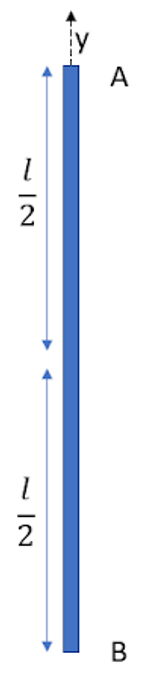
A uniform rod of mass m and length l is placed over a smooth horizontal surface along the y-axis and is at rest as shown in the figure an impulsive force F is applied for a small-time $\Delta t$ along x-direction at a point A. The x-coordinate of the end of the rod when the rod becomes parallel to the x-axis for the first time is: [Initially, the coordinate of the center of mass of the rod is (0,0)]
A. $\dfrac{\pi l}{12}$
B. $\dfrac{l}{2}\left( 1+\dfrac{\pi }{12} \right)$
C. $\dfrac{l}{2}\left( 1-\dfrac{\pi }{6} \right)$
D. $\dfrac{l}{2}\left( 1+\dfrac{\pi }{6} \right)$
Answer
 Verified
587.7k+ views
Hint: As the only force that acts on the body is the impulse, the body will have both linear and angular motion. We will take the axis of rotation as the center of mass and then write expressions for the angular displacement and use that to find the linear displacement of the center of mass.
Formula used:
$\begin{align}
& F.\Delta t=\Delta p \\
& \tau .\Delta t=\Delta L \\
\end{align}$
Complete step-by-step solution:
We know that the torque applied on the rod multiplied by the time for which it is applied gives us the change in angular momentum of the body. Similarly, the product of the force applied to the body and the time for which it is applied gives us the change in linear momentum of the body. So, the linear velocity of the rod will be given as
$F.\Delta t=mv\Rightarrow v=\dfrac{F.\Delta t}{m}$
And we will get the angular velocity as
\[\tau .\Delta t=I\omega =\dfrac{m{{L}^{2}}}{12}\omega \Rightarrow \omega =\dfrac{12\times \tau .\Delta t}{m{{L}^{2}}}\]
The angular displacement of the rod will be $\dfrac{\pi }{2}$ as the rod goes from being parallel to the y-axis to being parallel to the x-axis as shown in the figure.
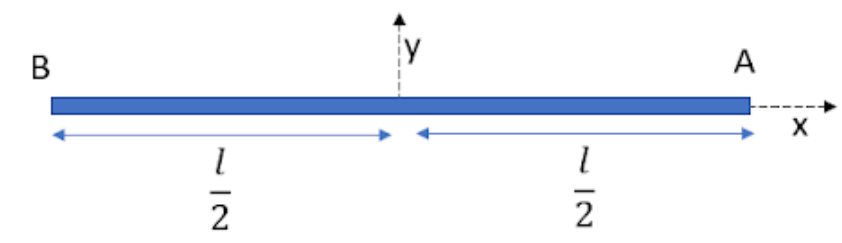
We will find the linear displacement of the centre of mass of the rod in the meantime. Let t be the time the rod takes to become parallel to x-axis for the first time. Then
\[\begin{align}
& \omega t=\dfrac{12\times t\times \tau .\Delta t}{m{{L}^{2}}}=\dfrac{\pi }{2} \\
& \Rightarrow t=\dfrac{\pi \times m{{L}^{2}}}{2\times 12\times \tau .\Delta t} \\
\end{align}\]
We will use this value of t to find the linear displacement of the centre of mass of the rod.
$vt=\dfrac{F.\Delta t}{m}\times t=\dfrac{F.\Delta t}{m}\times \dfrac{\pi \times m{{L}^{2}}}{2\times 12\times \tau .\Delta t}=\dfrac{F\times \pi \times {{L}^{2}}}{24\tau }$
The torque on the stick can be written as the product of Force and the distance of force from the centre of mass
\[vt=\dfrac{F\times \pi \times {{L}^{2}}}{24\tau }=\dfrac{F\times \pi \times {{L}^{2}}}{24\times F\times \dfrac{L}{2}}=\dfrac{\pi \times L}{12}\]
The x coordinate of the point A thus will be \[\dfrac{\pi \times L}{12}+\dfrac{L}{2}\]. Hence the correct option is D, i.e. $\dfrac{l}{2}\left( 1+\dfrac{\pi }{6} \right)$
Note: Students must take care that as there is no friction on the table, the axis of rotation will pass through the center of mass of the stick and the moment of inertia must be taken accordingly. The rod will become parallel to the x-axis multiple times as there are no dissipative forces and as the question asks for the first time the angular displacement must be taken as $\dfrac{\pi }{2}$.
Formula used:
$\begin{align}
& F.\Delta t=\Delta p \\
& \tau .\Delta t=\Delta L \\
\end{align}$
Complete step-by-step solution:
We know that the torque applied on the rod multiplied by the time for which it is applied gives us the change in angular momentum of the body. Similarly, the product of the force applied to the body and the time for which it is applied gives us the change in linear momentum of the body. So, the linear velocity of the rod will be given as
$F.\Delta t=mv\Rightarrow v=\dfrac{F.\Delta t}{m}$
And we will get the angular velocity as
\[\tau .\Delta t=I\omega =\dfrac{m{{L}^{2}}}{12}\omega \Rightarrow \omega =\dfrac{12\times \tau .\Delta t}{m{{L}^{2}}}\]
The angular displacement of the rod will be $\dfrac{\pi }{2}$ as the rod goes from being parallel to the y-axis to being parallel to the x-axis as shown in the figure.
We will find the linear displacement of the centre of mass of the rod in the meantime. Let t be the time the rod takes to become parallel to x-axis for the first time. Then
\[\begin{align}
& \omega t=\dfrac{12\times t\times \tau .\Delta t}{m{{L}^{2}}}=\dfrac{\pi }{2} \\
& \Rightarrow t=\dfrac{\pi \times m{{L}^{2}}}{2\times 12\times \tau .\Delta t} \\
\end{align}\]
We will use this value of t to find the linear displacement of the centre of mass of the rod.
$vt=\dfrac{F.\Delta t}{m}\times t=\dfrac{F.\Delta t}{m}\times \dfrac{\pi \times m{{L}^{2}}}{2\times 12\times \tau .\Delta t}=\dfrac{F\times \pi \times {{L}^{2}}}{24\tau }$
The torque on the stick can be written as the product of Force and the distance of force from the centre of mass
\[vt=\dfrac{F\times \pi \times {{L}^{2}}}{24\tau }=\dfrac{F\times \pi \times {{L}^{2}}}{24\times F\times \dfrac{L}{2}}=\dfrac{\pi \times L}{12}\]
The x coordinate of the point A thus will be \[\dfrac{\pi \times L}{12}+\dfrac{L}{2}\]. Hence the correct option is D, i.e. $\dfrac{l}{2}\left( 1+\dfrac{\pi }{6} \right)$
Note: Students must take care that as there is no friction on the table, the axis of rotation will pass through the center of mass of the stick and the moment of inertia must be taken accordingly. The rod will become parallel to the x-axis multiple times as there are no dissipative forces and as the question asks for the first time the angular displacement must be taken as $\dfrac{\pi }{2}$.
Recently Updated Pages
Master Class 11 Computer Science: Engaging Questions & Answers for Success

Master Class 11 Business Studies: Engaging Questions & Answers for Success
Master Class 11 Economics: Engaging Questions & Answers for Success
Master Class 11 English: Engaging Questions & Answers for Success
Master Class 11 Maths: Engaging Questions & Answers for Success
Master Class 11 Biology: Engaging Questions & Answers for Success
Trending doubts
There are 720 permutations of the digits 1 2 3 4 5 class 11 maths CBSE
Discuss the various forms of bacteria class 11 biology CBSE
Draw a diagram of a plant cell and label at least eight class 11 biology CBSE
Explain zero factorial class 11 maths CBSE
What organs are located on the left side of your body class 11 biology CBSE
Draw a diagram of nephron and explain its structur class 11 biology CBSE